
Understanding Quick Assets: Definition & Examples
Quick assets are those assets that can be converted into cash within a short period of time. The term is also used to refer to assets that are already in cash form. They are considered to be the most liquid assets that a company owns.
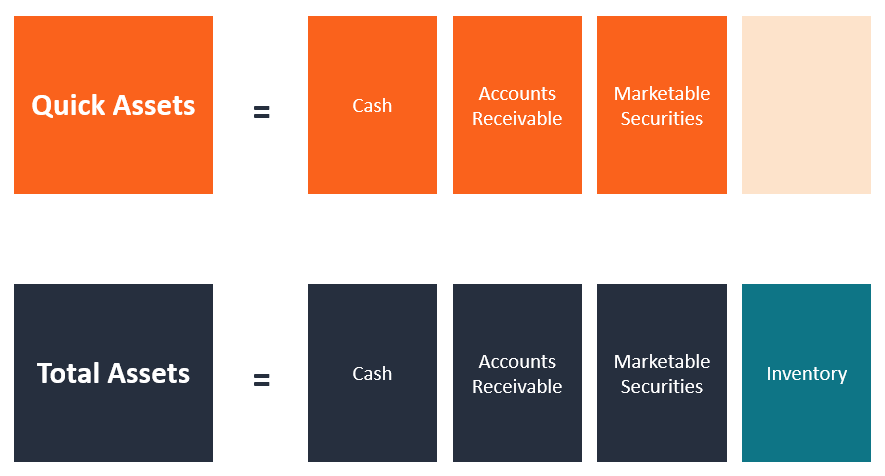
The main assets that fall under the quick assets category include cash, cash equivalentsCash EquivalentsCash and cash equivalents are the most liquid of all assets on the balance sheet. Cash equivalents include money market securities, banker's acceptances, accounts receivable, and marketable securitiesMarketable SecuritiesMarketable securities are unrestricted short-term financial instruments that are issued either for equity securities or for debt securities of a publicly listed company. The issuing company creates these instruments for the express purpose of raising funds to further finance business activities and expansion.. Companies use quick assets to compute certain financial ratios that indicate their liquidity and financial health. In particular, they’re used to calculate the quick ratio.
Classifying Quick Assets
Contrary to other kinds of assets, quick assets comprise economic resources that can be quickly converted to cash.
Another requirement for an item to be classified as a quick asset is that while converting it to cash, there should be minimal or no loss in value. In other words, a company shouldn’t incur a high cost when liquidating the asset.
It is important to note that inventories don’t fall under the category of quick assets. This is because realizing cash from them takes time. The only way a business can convert inventoryInventoryInventory is a current asset account found on the balance sheet, consisting of all raw materials, work-in-progress, and finished goods that a into cash quickly is if it offers steep discounts, which would result in a loss of value.
The majority of companies keep their quick assets in two primary forms: cash and short-term investments (marketable securities). By doing so, they hold enough capital to cover their operating, investing, and financing needs.
A company with a low cash balance in its quick assets can boost its liquidity by making use of its credit lines.
A major component of quick assets for most companies is their accounts receivableAccounts ReceivableAccounts Receivable (AR) represents the credit sales of a business, which have not yet been collected from its customers. Companies allow. If a business sells products and services to other large businesses, it’s likely to have a large number of accounts receivable. In contrast, a retail company that sells to individual clients will have a small number of accounts receivable on its balance sheet.
How to Calculate Quick Assets and the Quick Ratio
Quick assets make up part of current assets, which includes inventories. Thus:
Quick Assets = Current Assets – Inventories
As mentioned earlier, quick assets are used to calculate the quick ratio. This metric is used to determine a company’s capability to address its financial expenses in the short term by utilizing its most liquid assets. Given that it represents how well a company can utilize its near-cash assets to settle its current liabilities, it is also called the acid test. The formula for computing the quick ratio is:
Quick Ratio = (Cash & Cash Equivalents + Investments (Short-term) + Accounts Receivable) / Existing Liabilities
Or,
Quick Ratio = (Current Assets – Inventory) / Current Liabilities
When calculating the ratio, the first thing you need to do is look for each component in the current liabilities and current assets section of the balance sheet. Plug the corresponding values into the formula and compute.
Be sure to double-check the assets you’re using. The numerator should only constitute those assets that are easy to convert into cash (typically within 90 days or less) without jeopardizing their value.
On the same note, the accounts receivable should only consist of debts that can be collected within a 90-day period.
Example
Consider the balance sheet of Greenshaw Furnitures showing the following data:
- Cash: $200,000
- Marketable securities: $300,000
- Receivables: $2,500,000
- Inventories: $1,800,000
The value of the company’s quick assets is $3 million ($200,000 + $300,000 + $2,500,000).
Quick Ratio Example
Let’s say Ashley’s Clothing Store plans to apply for a loan to renovate its storefront. The lending institution asks the owner for a balance sheet. Ashley’s Clothing Store’s financial statement shows the following:
- Cash: $10,000
- Accounts receivable: $5,000
- Inventory: $5,000
- Short-term investments: $2,000
- Current liabilities: $14,000
The clothing store’s quick ratio is 1.21 ($10,000 + $5,000 + $2,000) / $14,000.
Interpreting the Quick Ratio
A high quick ratio is an indication that a company is utilizing its short-term assets effectively to meet its financial needs.
If a company reports an acid test ratioAcid-Test RatioThe Acid-Test Ratio, also known as quick ratio, is a liquidity ratio that measures how sufficient a company's short-term assets can cover current liabilities of 1, this indicates that its quick assets equal its existing liabilities. A ratio higher than 1 indicates that the company’s quick assets are more than sufficient to cover liabilities. The company is fully capable of paying current liabilities without tapping into its long-term assets and will still have cash or cash equivalents left over.
Long-term assets are those used to generate revenue. As such, selling those resources would hurt the company’s ability to generate revenue and also indicate that its current activities aren’t creating adequate profits to cover its current liabilities.
As seen in the example above, Ashley’s Clothing Store’s quick ratio is greater than 1. It means that it has enough quick assets to cover all its current liabilities and still has more left.
Companies should aim for a high quick ratio because it can help attract investors. It also increases the company’s chance of getting loans, as it shows creditors that it is able to handle its debt obligations.
More Resources
CFI is the official provider of the global Financial Modeling & Valuation Analyst (FMVA)®Become a Certified Financial Modeling & Valuation Analyst (FMVA)®CFI's Financial Modeling and Valuation Analyst (FMVA)® certification will help you gain the confidence you need in your finance career. Enroll today! certification program, designed to help anyone become a world-class financial analyst. To keep advancing your career, the additional CFI resources below will be useful:
- Liquidation ValueLiquidation ValueLiquidation value is an estimation of the final value which will be received by the holder of financial instruments when an asset is sold or liquidated.
- Projecting Balance Sheet Line ItemsProjecting Balance Sheet Line ItemsProjecting balance sheet line items involves analyzing working capital, PP&E, debt share capital and net income. This guide breaks down how to calculate
- Statement of Cash FlowsStatement of Cash FlowsThe Statement of Cash Flows (also referred to as the cash flow statement) is one of the three key financial statements that report the cash
- Types of FinancingFinancingFinancing refers to the methods and types of funding a business uses to sustain and grow its operations. It consists of debt and equity capital, which are used to carry out capital investments, make acquisitions, and generally support the business.
-

Non-Current Assets: Definition, Examples & Accounting
Non-current assets are assets whose benefits will be realized over more than one year and cannot easily be converted into cash. The assets are recorded on the balance sheet at acquisition cost, and th
-

Understanding Stranded Assets: Risks and Impacts
Stranded assets are assets that are unable to earn their original economic return due to changes in the landscape in which the assets operate. In simpler terms, stranded assets are assets that are wor
finance
- Investable Assets: A Comprehensive Guide for Investors
- Understanding Household Assets: A Comprehensive Guide
- Fixed Assets: Definition, Examples & Importance for Businesses
- Monetary Assets: Definition, Examples & Key Characteristics
- Understanding Non-Monetary Assets: Definition & Examples
- Understanding Hard Assets: Definition, Examples & Investment
- Trading Assets: Definition, Types & How They Work
- Biological Assets: Definition, Examples & Accounting
- Understanding Liquid Assets: A Comprehensive Guide
-
 Capital Expenditures (CAPEX): Definition & Examples
Capital expenditures refer to funds that are used by a company for the purchase, improvement, or maintenance of long-term assetsLong Term AssetsLong term assets are assets that a company uses in its p...
-
 Understanding Current Assets: Definition & Importance
Current assets are all assets that a company expects to convert to cash within one year. They are commonly used to measure the liquidity of a company. A company’s assets on its balance sheetBala...