
Interim Dividends: Definition, Payment & Benefits
An interim dividend is the distribution of earnings to shareholders before the end of the fiscal yearFiscal Year (FY)A fiscal year (FY) is a 12-month or 52-week period of time used by governments and businesses for accounting purposes to formulate annual. Such dividends are typically paid out monthly or quarterly and in smaller amounts than an annual dividend.

Summary
- An interim dividend is the distribution of earnings to shareholders before the end of the fiscal year.
- Companies pay dividends to incentivize equity investors that are looking for income together with share price appreciation.
- Dividends are usually calculated as a percentage of earnings and distributed on a per-share basis.
Understanding Dividends
To better understand an interim dividend, it is important to first understand how dividends work. Generally speaking, companies have the option to raise capital through two major asset classes – debt and equity. Through debt, the company assumes the corporate liability to pay interest and/or principal according to the debt covenantDebt CovenantsDebt covenants are restrictions that lenders (creditors, debt holders, investors) put on lending agreements to limit the actions of the borrower (debtor)..
Alternatively, companies can issue equity. To investors, equity is riskier than debt on two fronts.
First, in the event of the company’s bankruptcy, debt holders enjoy seniority in claiming liquidation proceeds. Equity holders are the last in line, meaning they may receive little to nothing. Secondly, debt holders are legally entitled to repayment of the interest and/or principal, while equity investors receive no guarantee as to recovery of their investment.
Therefore, companies may choose to reward equity investors by distributing their earnings through dividends. Dividends are most commonly paid out as cash or shares but can also be in the form of assets or scrips.
Mature, large-cap companies are more likely to pay dividends compared to small-growth companies. It is because of the large companies’ mature business modelsBusiness Strategy vs Business ModelSetting up and running a business involves differentiating between business strategy vs business model. To reach their goals and achieve success, owners and stable cash flows and earnings.
On the other hand, small growth companies generally tend not to pay dividends because they prefer to use their earnings to reinvest back into the company. Equity investors will still invest in such companies despite the lack of dividends because they see higher growth prospects and, therefore, higher share price appreciation expectations.
Dividends are usually calculated as a percentage of earnings and distributed on a per-share basis. For example, Company X decides to distribute 50% of its earnings to its shareholders. If they report earnings of $1 million and 2 million shares outstanding, each share will get (1M*50%)/2M = $0.25/share dividend payout.
Types of Dividends
The three types of dividends are:
1. Final Dividend
The final dividend is paid out after the audited final version of financial statements – the SEC Form 10-K10-KForm 10-K is a detailed annual report that is required to be submitted to the U.S. Securities and Exchange Commission (SEC). The filing provides a comprehensive summary of a company’s performance for the year. It is more detailed than the annual report that is sent to shareholders in the United States. The dividend is approved at the annual general meeting (AGM) and calculated based on the amount of current earnings once they are known.
2. Interim Dividend
The interim dividend is paid out before the annual audited financial statements – typically along with the SEC Form 10-Q, a quarterly unaudited report. Since current earnings are not known, interim dividends are paid from retained earningsRetained EarningsThe Retained Earnings formula represents all accumulated net income netted by all dividends paid to shareholders. Retained Earnings are part (earnings accumulated from previous fiscal years). They are declared by the company’s board of directors, but the final approval comes from the shareholders.
3. Special Dividend
A special dividend is a non-recurring dividend that is not scheduled like the final and interim dividends. Such dividends are rare in that they are usually due to exceptional earnings or in anticipation of financial structural changes.
Real-Life Example of Interim Dividend
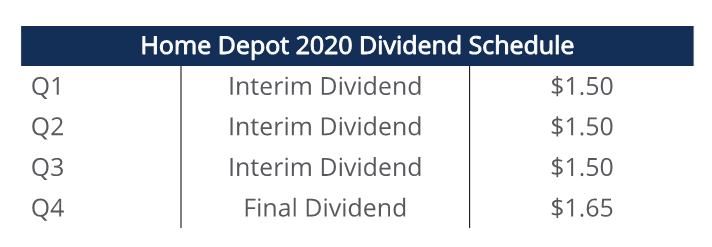
Home Depot (NYSE: HD) is a large-cap company in the Dow Jones Index that distributes interim dividends on a quarterly basis. For the fiscal year 2020, Home Depot distributed $1.50/share of interim dividends from their retained earnings every quarter from Q1-Q3. After their annual general meeting and audited Form 10-K, the company distributed $1.65/share from their current earnings as the final dividend in Q4.
Related Readings
CFI is the official provider of the global Capital Markets & Securities Analyst (CMSA)®Program Page - CMSAEnroll in CFI's CMSA® program and become a certified Capital Markets &Securities Analyst. Advance your career with our certification programs and courses. certification program, designed to help anyone become a world-class financial analyst. To keep advancing your career, the additional CFI resources below will be useful:
- Chapter 11 BankruptcyChapter 11 BankruptcyChapter 11 is a legal process that involves reorganization of a debtor’s debts and assets. It is available to individuals, partnerships, corporations
- Important Dividend DatesImportant Dividend DatesIn order to understand dividend-paying stocks, knowledge of important dividend dates is crucial. A dividend typically comes in the form of a cash distribution that is paid from the company's earnings to investors.
- Liquidation PreferenceLiquidation PreferenceLiquidation preference determines the order in which a bankrupt firm’s liquidated assets are paid out to claimants of the firm.
- Qualified DividendQualified DividendA qualified dividend is a dividend that is taxed at the long-term capital gains rate rather than the ordinary income rate. Criteria for a
-

Understanding Earnings Announcements: A Comprehensive Guide
An earnings announcement is the public statement a company offers to reveal its profitability for a certain period of time. Most often, an earnings announcement details profit for a quarter or a year.
-

Understanding Earnings Calls: A Comprehensive Guide
An earnings call is a conference call (typically held in the form of a teleconference or a webcast) during which the management of a public companyPrivate vs Public CompanyThe main difference between
finance
- Understanding YTD Dividends: A Guide for Investors
- Understanding Dividends: A Comprehensive Guide
- Dividend Irrelevance Theory: Understanding Its Implications
- Earnings Management: Definition, Techniques & Impact
- Understanding Earnings Volatility: Risk & Stock Price Prediction
- Understanding Dividends: A Guide for Investors
- Understanding Homemade Dividends: A Strategy for Portfolio Income
- Qualified Dividends: Tax Rates & Benefits Explained
- Understanding Dividends: A Beginner's Guide to Investment Income
-
 Understanding Dividend Yield: A Key Metric for Investors
The Dividend Yield is a financial ratio that measures the annual value of dividends received relative to the market valueMarket CapitalizationMarket Capitalization (Market Cap) is the most recent ...
-
 Understanding Earnings: A Guide to Financial Profitability
Earnings refer to the income that an individual or organization gains during a certain period. They can be found on a company’s income statement and are used to measure the profitability of that...