
Interim Financial Statements: A Comprehensive Guide
An interim statement refers to a financial statement that covers a period of less than a year. Interim financial statements portray the financial performanceFinancial PerformanceFinancial performance is a complete evaluation of a companies overall standing in categories such as assets, liabilities, equity, expenses, of a company over a short period of time.

Publicly traded companies are required to release interim statements on a quarterly basis, providing investors with updates on how the company is performing and also to keep its financial activities transparent. It’s also important to note that the term “interim” can be applied to any period of time that’s less than a year and does not necessarily refer to quarterly results.
Example of an Interim Statement
Here’s an income statement from an interim financial report released by Sundial Growers Inc., a Canadian cannabis company.
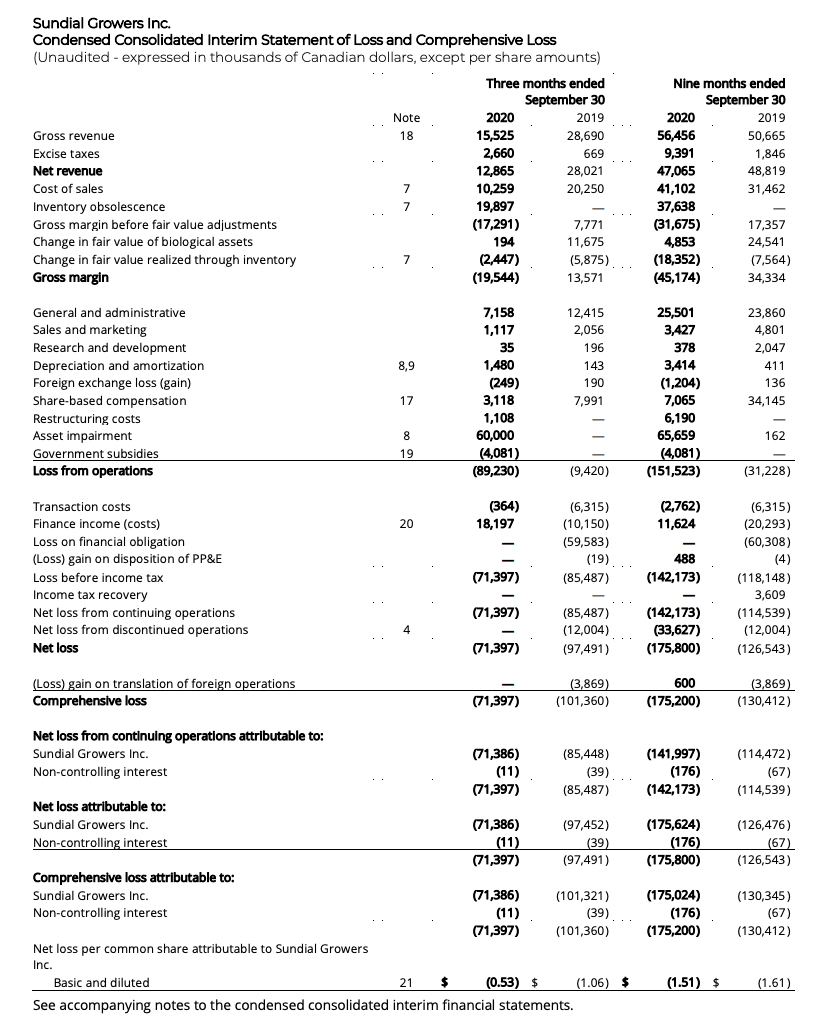
In the example above, Sundial Growers reports losses over the three-month and nine-month period ended September 30, 2020. The statement is unaudited since interim statements are not required to be audited, unlike annual financial statements. However, they still contain the same elements – a balance sheet, an income statement, and a statement of cash flowsStatement of Cash FlowsThe Statement of Cash Flows (also referred to as the cash flow statement) is one of the three key financial statements that report the cash.
The Role of Interim Statements in Capital Markets
Interim statements allow investors to receive timely updates on a company’s operations and financial performance, which, in turn, influences investor’s capital decisions. For example, if a company exceeds expectations by reporting much higher sales in a particular quarter, investors are likely to be impressed and therefore invest more money in the company’s shares, and vice versa.
By providing a more frequent look at a company’s performance than annual statements, interim statements ensure that investors have the information required to make decisions on their allocation of capital. As a result, they ensure that the capital market remains liquid throughout the year.
Interim Statements vs. Annual Statements
Disclosures
Annual financial statements require certain disclosuresDisclosureDisclosure, in financial terms, basically refers to the action of making all relevant information about a business available to the public in that can be omitted or referenced for interim statements. In other words, the regulations for reporting in annual statements are much more stringent than those for interim statements.
Accrued expenses
If an expense is accrued within a particular interim reporting period, it will be reflected on the financial statements. For example, if Company X reports financial results from May-September, expenses accrued during that period will appear on the interim report. Therefore, if a company accrues an overwhelming majority of expenses within a short period of time, it can skew its interim statements towards the negative.
Seasonality
If a business goes through a period of higher-than-average sales due to seasonality (i.e., surfboards during the summer or toys during the Christmas season), it will be reflected in its interim statement that covers that particular period. However, it may not be reflected in its annual statement that covers the entire year.
External audit
Annual statements must be audited externally, which can be a costly process. The process is not necessary for interim statements. However, for many public companies, a review engagement is conducted instead, and audit procedures are performed at each interim period for annual audit purposes.
Learn More
CFI offers the Capital Markets & Securities Analyst (CMSA)®Program Page - CMSAEnroll in CFI's CMSA® program and become a certified Capital Markets &Securities Analyst. Advance your career with our certification programs and courses. certification program for those looking to take their careers to the next level. To keep learning and advance your career, the following resources will be helpful:
- Annual ReportAnnual ReportAn annual report is a comprehensive report detailing a company’s activities throughout the preceding year. Its purpose is to provide users, such as
- SeasonalitySeasonalitySeasonality is a characteristic of data where there exist predictive fluctuations in a data set depending on the time of year. Many different
- Accrued ExpensesAccrued ExpensesAccrued expenses are expenses that are recognized even though cash has not been paid. They are usually paired up against revenue via the matching principle
- SEC Form S-1SEC Form S-1SEC Form S-1 is a filing needed to register the securities of companies that wish to go public with the U.S. Securities and Exchange
-

Financial Statement Manipulation: Definition & Examples
Financial statement manipulation refers to the practice of using creative accounting tricks to make a company’s financial statements reflect what the company wants its performance to look like r
-
Understanding Financial Statements: A Comprehensive Guide
Financial statements are the records of a company’s financial condition and activities during a period of time. Financial statements show the financial performance and strength of a companyCorpo
finance
- Original Bank Statement: Definition & How to Obtain
- Understanding Joint Financial Statements: A Comprehensive Guide
- Understanding HOA Statements: A Comprehensive Guide
- Understanding Account Statements: A Comprehensive Guide
- Understanding Bank Statements: A Comprehensive Guide
- Interim Financial Statements: A Comprehensive Guide
- Understanding Equity Statements: A Comprehensive Guide
- Understanding Financial Statement Notes: A Comprehensive Guide
- Understanding Bank Statements: A Comprehensive Guide
-
 Understanding Use of Proceeds: A Guide for Investors
The use of proceeds statement is a short document that summarizes how a company that aims to secure additional capital is going to spend the funds. In other words, the document provides the reader wit...
-
 Understanding Audited Financial Statements: A Comprehensive Guide
Public companies are obligated by law to ensure that their financial statementsThree Financial StatementsThe three financial statements are the income statement, the balance sheet, and the statement o...