
Understanding Dividend Yield: A Key Metric for Investors
The Dividend Yield is a financial ratio that measures the annual value of dividends received relative to the market valueMarket CapitalizationMarket Capitalization (Market Cap) is the most recent market value of a company’s outstanding shares. Market Cap is equal to the current share price multiplied by the number of shares outstanding. The investing community often uses the market capitalization value to rank companies per share of a security. In other words, the dividend yield formula calculates the percentage of a company’s market price of a share that is paid to shareholdersStockholders EquityStockholders Equity (also known as Shareholders Equity) is an account on a company's balance sheet that consists of share capital plus in the form of dividends.
Dividend Yield Formula
The dividend yield formula is as follows:
Dividend Yield = Dividend per share / Market value per share
Where:
- Dividend per shareDividend Per Share (DPS)Dividend Per Share (DPS) is the total amount of dividends attributed to each individual share outstanding of a company. Calculating the dividend per share is the company’s total annual dividend payment, divided by the total number of shares outstanding
- Market value per share is the current share price of the company
Example
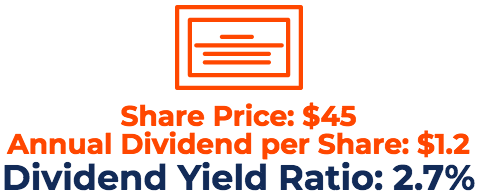
Company A trades at a price of $45. Over the course of one year, the company paid consistent quarterly dividends of $0.30 per share. The dividend yield ratio for Company A is calculated as follows:
Dividend Yield Ratio = $0.30 + $0.30 + $0.30 + $0.30 / $45 = 0.02666 = 2.7%
The dividend yield ratio for Company A is 2.7%. Therefore, an investor would earn 2.7% on shares of Company A in the form of dividends.
Dividend Yield Ratio Across Industries
The comparison of dividend yield ratios should only be done for companies operating in the same industry – average yields vary significantly between industries. The average dividend yield for several industries is as follows:
- Basic materials industry: 4.92%
- Financial services industry: 4.17%
- Healthcare industry: 2.28%
- Industrial industry: 1.76%
- Services industry: 2.37%
- Technology industry: 3.2%
- Utility industry: 3.96%
Dividend Yield Formula Among Companies
The following is information related to Company A and Company B for FY 2018:
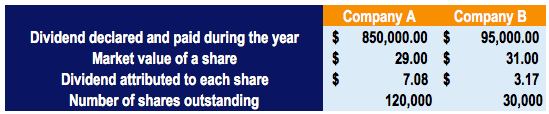
Both companies operate in the same industry. However, Company A entered the marketplace a long time ago, while Company B is a relatively new company. One of your friends, John, is looking to invest in a company with a good dividend payout. Which will you recommend to John – Company A or Company B?

The dividend yield ratio for each company is calculated as follows:
Company A:
= $7.08 / $29.00 = 0.24413 = 24.413%
Company B:
= $3.17 / $31.00 = 0.10226 = 10.226%
Note: The dividend attributed to each share is simply the total dividend declared divided by the number of weighted average shares outstandingWeighted Average Shares OutstandingWeighted average shares outstanding refers to the number of shares of a company calculated after adjusting for changes in the share capital over a reporting period. The number of weighted average shares outstanding is used in calculating metrics such as Earnings per Share (EPS) on a company's financial statements.
In this case, we can see that Company A is a more attractive option for John. Company A is an older and more established company that is able to sustain a stable dividend distribution to its investors. Company A is a more reliable and less risky company, as compared to Company B.
Interpretation of Dividend Yield Formula
The dividend yield formula is used to determine the cash flows attributed to an investor from owning stocks or shares in a company. Therefore, the ratio shows the percentage of dividends for every dollar of stock.
A high or low yield depends on factors such as the industry and the business life cycle of the company. For example, it may be in the best interest of a fast-growing company to not pay any dividends. The money might be better used by reinvesting into the company to grow the business.
On the other hand, a mature company may report a high yield due to a relative lack of future high growth potential. Therefore, the yield ratio does not necessarily indicate a good or bad company. Rather, the ratio is used by investors to determine which stocks align with their investment strategy.
Other Resources
Thank you for reading this guide to help you better understand dividends. CFI is the global provider of the Financial Modeling & Valuation Analyst (FMVA)™Become a Certified Financial Modeling & Valuation Analyst (FMVA)®CFI's Financial Modeling and Valuation Analyst (FMVA)® certification will help you gain the confidence you need in your finance career. Enroll today! certification, a training program of financial modeling courses for investment banking professionals. To help you advance your career in the financial services industry, check out the following additional CFI resources:
- Dividend Coverage RatioDividend Coverage RatioThe Dividend Coverage Ratio, or dividend cover, is a coverage ratio that measures the number of times that a company can pay dividends to its shareholders.
- Dividend Payout RatioDividend Payout RatioDividend Payout Ratio is the amount of dividends paid to shareholders in relation to the total amount of net income generated by a company. Formula, example
- Dividend vs Share Buyback/RepurchaseDividend vs Share Buyback/RepurchaseShareholders invest in publicly traded companies for capital appreciation and income. There are two main ways in which a company returns profits to its shareholders – Cash Dividends and Share Buybacks. The reasons behind the strategic decision on dividend vs share buyback differ from company to company
- Comparable Company AnalysisComparable Company AnalysisThis guide shows you step-by-step how to build comparable company analysis ("Comps") and includes a free template and many examples.
-

Dividend Irrelevance Theory: Understanding Its Implications
Dividend Irrelevance Theory is a financial theory that claims that the issuing of dividends does not increase a company’s potential profitability or its stock price. It suggests that invest
-

Stock Dividends: Definition, Types & How They Work
A stock dividend, a method used by companies to distribute wealth to shareholders, is a dividend payment made in the form of shares rather than cash. Stock dividends are primarily issued in lieu of ca
finance
- Capital Gains Yield (CGY): Definition & Formula | [Your Brand]
- Understanding Dividend Per Share (DPS): A Comprehensive Guide
- Understanding Forward Dividend Yield: A Key Metric for Investors
- Understanding Liquidating Dividends: A Comprehensive Guide
- Shareholder Yield: A Comprehensive Guide to Returns for Investors
- Special Dividends: Understanding One-Time Distributions
- Understanding Dividend Policy: A Comprehensive Guide
- Dividend Recapitalization: Definition & How It Works
- Dividend Yield Explained: Calculate & Understand Returns
-
 Parent Company Explained: Definition, Control & Examples
A parent company is a company that owns more than 50% of the outstanding voting shares of another company. Therefore, it controls the other company or companies and can directly influence the business...
-
 Understanding Stocks: A Beginner's Guide to Share Ownership
When a person owns stock in a company, the individual is called a shareholder and is eligible to claim part of the company’s residual assets and earnings (should the company ever have to dissolv...