
Irrevocable Proxy: Understanding Proxy Voting & Shareholder Rights
An irrevocable proxyProxy VoteA Proxy Vote is a delegation of voting authority to a representative on behalf of the original vote-holder. The party who receives the authority to vote is known as the Proxy and the original vote-holder is known as the Principal. The concept is important in financial markets and particularly with public companies is an enforceable power granted by the owner to another party to exercise his voting rightsPreferred SharesPreferred shares (preferred stock, preference shares) are the class of stock ownership in a corporation that has a priority claim on the company’s assets over common stock shares. The shares are more senior than common stock but are more junior relative to debt, such as bonds. independently, without requiring his consent each time. Typically, most proxies are revocable, but some agreements may include specific clauses that require the proxy to be irrevocable for a specified period. The owner of the sharesPreferred SharesPreferred shares (preferred stock, preference shares) are the class of stock ownership in a corporation that has a priority claim on the company’s assets over common stock shares. The shares are more senior than common stock but are more junior relative to debt, such as bonds. cannot revoke the irrevocable proxy until the expiry of an agreed-upon duration of time.
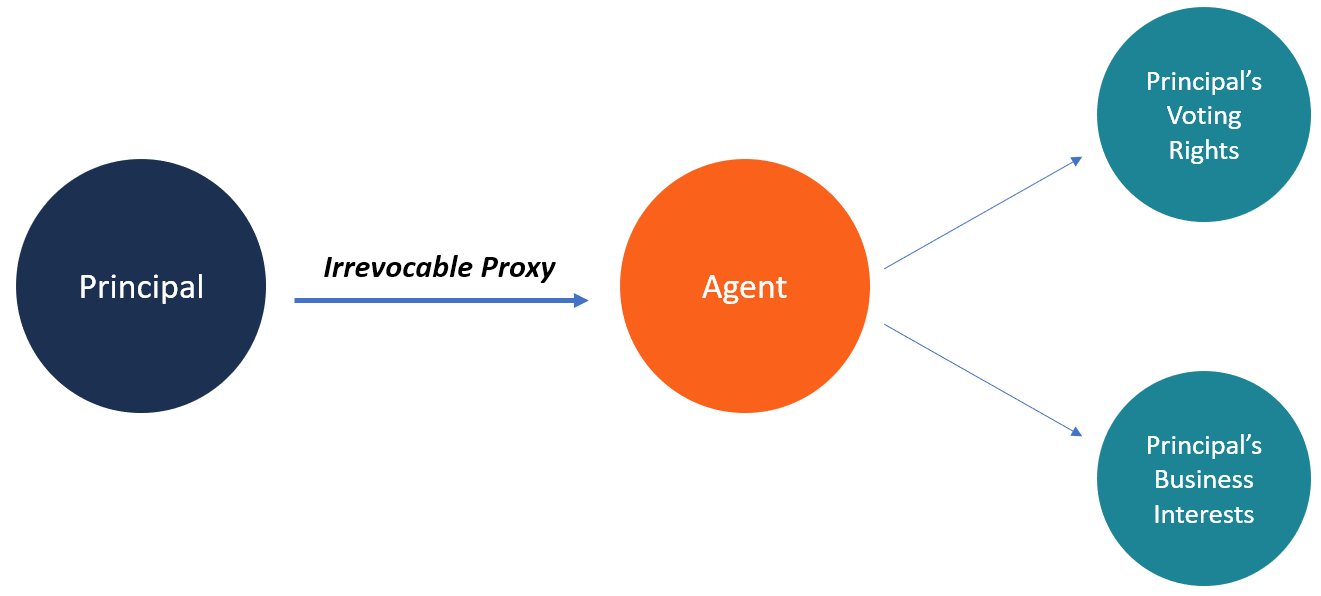
The reason for making a proxy irrevocable is to absolve the agent in the agent-principal relationship of his/her actions when acting in the capacity of the principalStakeholder vs. ShareholderThe terms “stakeholder” and “shareholder” are often used interchangeably in the business environment. Looking closely at the meanings of stakeholder vs shareholder, there are key differences in usage. Generally, a shareholder is a stakeholder of the company while a stakeholder is not necessarily a shareholder.. Any decisions that the agent makes are assumed to be in the best interests of the principal. Therefore, he/she is not held liable for their actions before the expiry of the proxy. However, if the agent has a personal interest in the business, they are unlikely to be absolved by the law for consequences resulting from their actions.
Criteria for an Irrevocable Proxy
Several situations make a proxy irrevocable for a specified period, including:
- The proxy holder is an existing shareholderShareholder ValueShareholder value is the financial worth owners of a business receive for owning shares in the company. An increase in shareholder value is created of the company or has agreed to purchase shares of the company in the future.
- The proxy holder is one of the pledgees of the company’s shares.
- The proxy holder has an existing employment contractEmployee Stock Ownership Plan (ESOP)An Employee Stock Ownership Plan (ESOP) refers to an employee benefit plan that gives the employees an ownership stake in the company. The employer allocates a percentage of the company’s shares to each eligible employee at no upfront cost. The distribution of shares may be based on the employee’s pay scale, terms of with the company (under specific circumstances).
- The proxy holder is one of the parties in a voting agreement.
- The proxy holder has advanced some form of credit to the company.
How Irrevocable Proxies Work
Irrevocable proxies are based on the same ideology as revocable proxies. Both types of proxies are based on an agent-principal agreement where the principal gives the agent the power to act on their behalf during voting and decision-making processes. By appointing an agent, the principal faces the risk of the agent’s unpredictable (and possibly unwanted) dealings with third parties as long as the agent retains the proxy authority.
The agent represents the principal, and his/her actions are taken as the principal’s actions. However, in most proxy agreements, the principal retains some form of control, depending on how the agent performs, and has the right to revoke the agent’s powers.
When the agent representing the principal has a stake in the organization, this means that his/her actions may have a significant impact on the company’s decisions. In most cases, proxies that have a proprietary interest in the organization where they also act as agents of the principal are irrevocable. This means that the principal may not terminate the relationship before the expiry of the agreed period. Also, the proxy will be irrevocable if the principal explicitly provided for the irrevocability at the onset of the agreement.
Legal Treatment of Irrevocable Proxy
There are different views on the legality of irrevocable proxies. Initially, irrevocable proxies faced a lot of hostilities from the courts, since they perceived proxies as a way of suspending the ordinary rights of the actual owners and their voting rights. In the court’s opinion, such authorizations need to be voided since they are against public policy.
One of the instances where the court deems irrevocable proxies unenforceable is when the proxy has a proprietary interest in the organization. For example, the proxy holder may have lent money to the company or be an existing employee. However, according to a Delaware statute, a proxy may be made irrevocable regardless of whether the proxy has a personal interest in the company or its stock.
In some jurisdictions, irrevocable proxies are recognized under various circumstances. For example, In New York, courts have upheld such proxies if they were accompanied by a pledge. They are also recognized when the irrevocable proxy is granted in return for credit, or if the purpose is to retain control of the company or maintain a corporate policy.
Example
Irrevocable proxy is illustrated in the case of Haft vs Haft. The CEO of the company and a controlling shareholder of the company induced his son to become the company’s President and COO. The father transferred a controlling block of stock to the son, in exchange for the grant of a lifetime irrevocable proxy to vote the stock.
Later, there was a dispute on the composition of the board of directors and the validity of an option to buy back the shares held by the son. In reaction, the son revoked the father’s proxy. When the case was presented before a Delaware court, the court ruled that the proxy was enforceable, and the father’s interest in the stability of his position as the CEO appeared as an interest to support irrevocability under the Delaware statute.
Related Readings
CFI is the official provider of the global Financial Modeling & Valuation Analyst (FMVA)™Become a Certified Financial Modeling & Valuation Analyst (FMVA)®CFI's Financial Modeling and Valuation Analyst (FMVA)® certification will help you gain the confidence you need in your finance career. Enroll today! certification program, designed to help anyone become a world-class financial analyst. To keep advancing your career, the additional CFI resources below will be useful:
- Capital StructureCapital StructureCapital structure refers to the amount of debt and/or equity employed by a firm to fund its operations and finance its assets. A firm's capital structure
- Stockholders EquityStockholders EquityStockholders Equity (also known as Shareholders Equity) is an account on a company's balance sheet that consists of share capital plus
- Voting TrustVoting TrustA voting trust is an arrangement where the voting rights of shareholders are transferred to a trustee for a specified period. The shareholders are then
- Sweat EquitySweat EquitySweat equity refers to the non-monetary contribution that the individuals or founders of a company make towards a business venture. Cash-strapped startups
-

Understanding Account Statements: A Comprehensive Guide
An account statement is a periodic report that is sent to a customer. It contains a summary of account activity within a defined period – usually a month, quarter, year, or other custom periods.
-
Acquirer Definition: Understanding Corporate Acquisitions
An acquirer is a registered company that purchases a portion of, or all the rights to, another company. The acquiring company takes over the management of another company by obtaining a majority stake
finance
- PC Banking: A Comprehensive Guide to Online Banking Security & Features
- Understanding Proxy Season: Shareholder Meetings & Key Dates
- Understanding Stock Market Proxies: A Comprehensive Guide
- IRA CDs: Secure Retirement Savings with FDIC Insurance
- Jumbo CDs: Higher Rates & Deposits Explained
- Proxy Fight: Understanding Shareholder Power & Corporate Control
- Proxy Voting Explained: Understand Your Voting Rights
- Understanding Regulation Z: Your Rights as a Borrower
- Annuities Explained: A Simple Guide to Retirement Income
-
 Understanding Account Balances: A Comprehensive Guide
An account balance is the amount of money present in a financial repository during the current accounting period. It is the net difference between the credits and debits posted in any given accounting...
-
 Understanding Account Numbers: Your Key to Financial Records
An account number is a unique code composed of numbers, letters, or other characters, and is assigned to the account owner for ease of reference in a financial institution’s accounting records.&...