
Proxy Fight: Understanding Shareholder Power & Corporate Control
A proxy fight, also known as a proxy contest or proxy battle, refers to a situation in which a group of shareholders in a company joins forces in an attempt to oppose and vote out the current management or board of directors. In other words, a proxy fight is a battle between shareholders and senior management for control of the company. It is also a strategy commonly employed in hostile takeoversHostile TakeoverA hostile takeover, in mergers and acquisitions (M&A), is the acquisition of a target company by another company (referred to as the acquirer) by going directly to the target company’s shareholders, either by making a tender offer or through a proxy vote. The difference between a hostile and a friendly.
How Does a Proxy Fight Work?
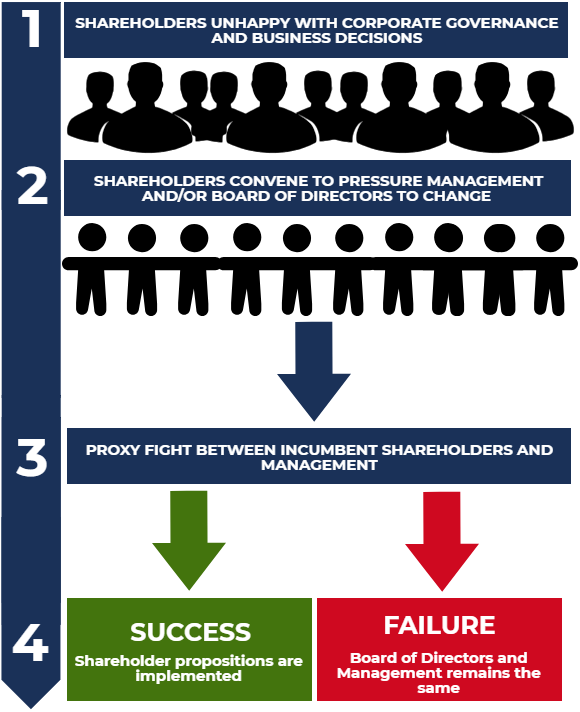
Proxy fights are commonly initiated by dissatisfied shareholders of a company. In a proxy battle, shareholders convene with other shareholders to use their votes to pressure management and the board of directorsBoard of DirectorsA board of directors is a panel of people elected to represent shareholders. Every public company is required to install a board of directors. to make changes within the company. The shareholders typically pressure the board of directors by voting against them at the annual general meeting (AGM).
For example, in Guyana Goldfields’ proxy fight with its shareholders, the company lost the proxy battle, which resulted in the appointment of two new independent directors to the board and two other long-serving independent directors stepping down.
Proxy fights are typically difficult to win as companies typically put various corporate governance tactics in place such as staggered boardsStaggered BoardA staggered board of directors, also known as a classified board, refers to a board that consists of different classes of directors. In a staggered board of and include restrictive requirements in its bylaws. Therefore, most proxy battles by shareholders are unsuccessful.
Reasons and Examples of Proxy Fights
There are many reasons for a proxy fight, but the main rationale is due to shareholders being unhappy with the current corporate governance and business decisions. Below are real-life examples of why shareholders wage proxy battles.
Hyundai Motor Group vs. Elliott Management
U.S. hedge fund Elliott Management Corporation was unhappy with Hyundai Motor Group’s dividend plan and its call-off of a corporate restructuring that Elliott believed lacked business rationale and adversely impacted shareholders.
Luby’s vs. Bandera Partners
Activist investor Bandera Partners pushed for restaurant operator Luby’s to change its heavy debt structure and turn around its declining same-store revenues and traffic. Bandera Partners was dissatisfied with the way management was navigating the company.
Guyana Goldfields’ vs. Shareholders
Shareholders of Guyana Goldfields were unhappy with the way management ran the business. The gold mining company faced immense pressure from shareholders due to poor performance – the amount of gold in proven and probable reserves at its Aurora mine in Guyana declined 1.7 million ounces compared to management estimates from the prior year.
Campbell Soup vs. Third Point
Activist investor Third Point sent a letter to the chairman of Campbell Soup’s board blaming the leadership for the problems at the company and accused management of mismanagement, ill-devised strategies, and poor business decisions.
As apparent in each of the examples above, a common catalyst for a proxy fight is management dissatisfaction by shareholders.
Graphical Representation of a Proxy Fight
The following visually depicts a common proxy battle:
Additional Resources
CFI is the official provider of the Financial Modeling and Valuation Analyst (FMVA)™Become a Certified Financial Modeling & Valuation Analyst (FMVA)®CFI's Financial Modeling and Valuation Analyst (FMVA)® certification will help you gain the confidence you need in your finance career. Enroll today! certification program, designed to transform anyone into a world-class financial analyst.
To keep learning and developing your knowledge of financial analysis, we highly recommend the additional CFI resources below:
- Activist ShareholderActivist ShareholderAn activist shareholder is a shareholder of a corporation who attempts to use his or her equity stake in a company to achieve certain goals
- Irrevocable ProxyIrrevocable ProxyAn irrevocable proxy is an enforceable power granted by the owner to another party to exercise his voting rights independently, without requiring his consent each time. Typically, most proxies are revocable, but some agreements may include specific clauses that require the proxy to be irrevocable for a specified period.
- Pre-Offer Defense MechanismPre-Offer Defense MechanismPre-offer defense mechanism is a general term for a broad group of defensive strategies in M&A transactions. Essentially, the pre-offer defense mechanism is a preemptive strategy undertaken by a target company to protect itself from a possible bidding offer from a hostile acquirer.
- Voting TrustVoting TrustA voting trust is an arrangement where the voting rights of shareholders are transferred to a trustee for a specified period. The shareholders are then
-

Understanding Regulation Z: Your Rights as a Borrower
Regulation Z is a consumer-protection regulation that compels lenders to disclose the cost of credit in a clear way for consumers. Whether you’re applying for a mortgage or dealing
-

Annuities Explained: A Simple Guide to Retirement Income
So you're wondering what is an annuity? There are dozens of different flavours of annuities that perform different functions and pay their holders out in different ways, but for our purposes let’
finance
- Understanding Proxy Season: Shareholder Meetings & Key Dates
- Activist Shareholders: Definition, Tactics & Impact
- Understanding Corporations: Definition, Formation & Key Features
- Understanding Dividends: A Comprehensive Guide
- Irrevocable Proxy: Understanding Proxy Voting & Shareholder Rights
- Majority Shareholder: Definition, Rights & Implications
- Proxy Voting Explained: Understand Your Voting Rights
- Shareholder Agreement: Definition, Purpose & Key Provisions | [Your Company Name]
- Shareholders' Agreement: Definition, Purpose & Key Provisions
-
 Come-Along Clause in Shareholders Agreements: Definition & Impact
Close-up of business contract A come-along clause, also known as a drag-along clause, is a common provision included in shareholder agreements, particularly in the agreements of growing compa...
-
 Jumbo CDs: Higher Rates & Deposits Explained
A jumbo CD is similar to a conventional CD although the former generally requires a higher deposit and accrues interest at a higher rate. A CD is a certificate of deposit that is offered by banks for ...