
Understanding the Justified P/E Ratio: A Deep Dive
The justified price to earnings ratio is the price to earnings ratio that is “justified” by using the Gordon Growth Model. This version of the popular P/E ratio uses a variety of underlying fundamental factors such as cost of equityCost of EquityCost of Equity is the rate of return a shareholder requires for investing in a business. The rate of return required is based on the level of risk associated with the investment and growth rate. Commonly shortened to “justified P/E ratio”, or simply “justified P/E”, this variation of the standard P/E metric is frequently used by market analysts and investors.

Analyzing the Justified Price to Earnings Ratio
The justified price to earnings ratio is determined by connecting the traditional P/E ratio to the Gordon Growth Model (GGM)Gordon Growth ModelThe Gordon Growth Model – also known as the Gordon Dividend Model or dividend discount model – is a stock valuation method that calculates a stock’s intrinsic value, regardless of current market conditions. Investors can then compare companies against other industries using this simplified model.
The P/E ratio compares the current valuation of a company’s common stock shares to the company’s earnings.

The GGM is a discount model that factors in stock dividendsDividendA dividend is a share of profits and retained earnings that a company pays out to its shareholders. When a company generates a profit and accumulates retained earnings, those earnings can be either reinvested in the business or paid out to shareholders as a dividend. to estimate a stock’s intrinsic value, based on an assumption of future, consistent dividend growth. The GGM is used to calculate the fair market value of a stock. In the justified price to earnings ratio calculation, we use the price derived from the GGM to find the justified P/E.
The GGM is calculated as follows:

Where:
- P – the current fair market price for the company’s stock
- D_0 – the dividend per share
- r_E – the cost of equity
- g – the company’s projected growth rate for the immediate future
To determine the justified P/E – also referred to as the fundamental P/E – both sides of the equation need to be divided by the earnings per shareEarnings Per Share (EPS)Earnings per share (EPS) is a key metric used to determine the common shareholder's portion of the company’s profit. EPS measures each common share's profit that are expected for the following year.
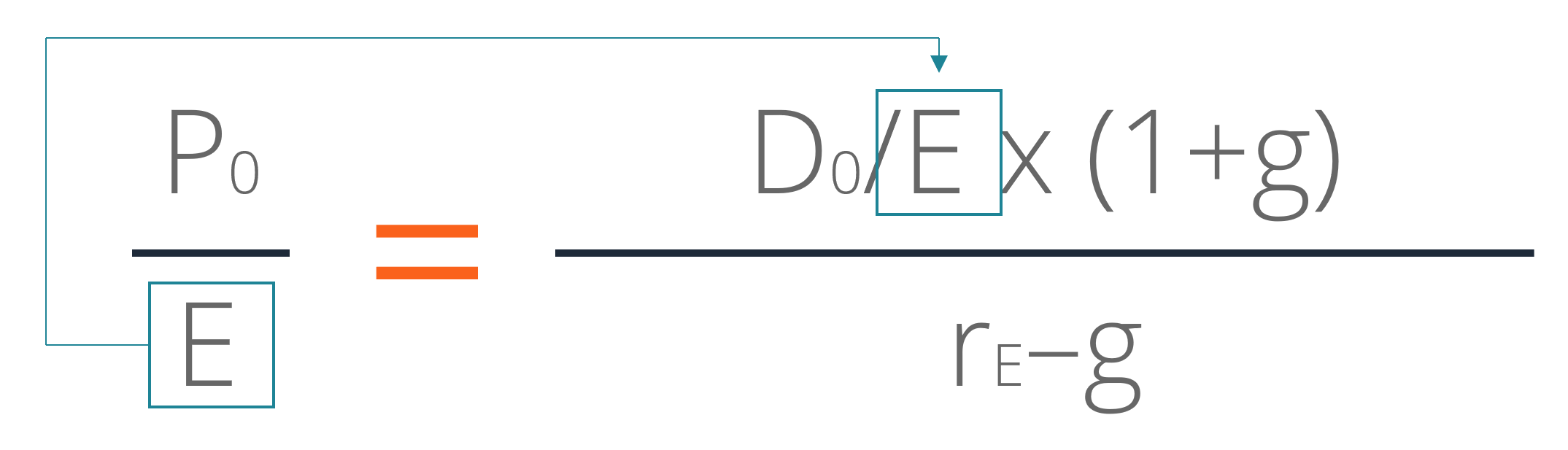
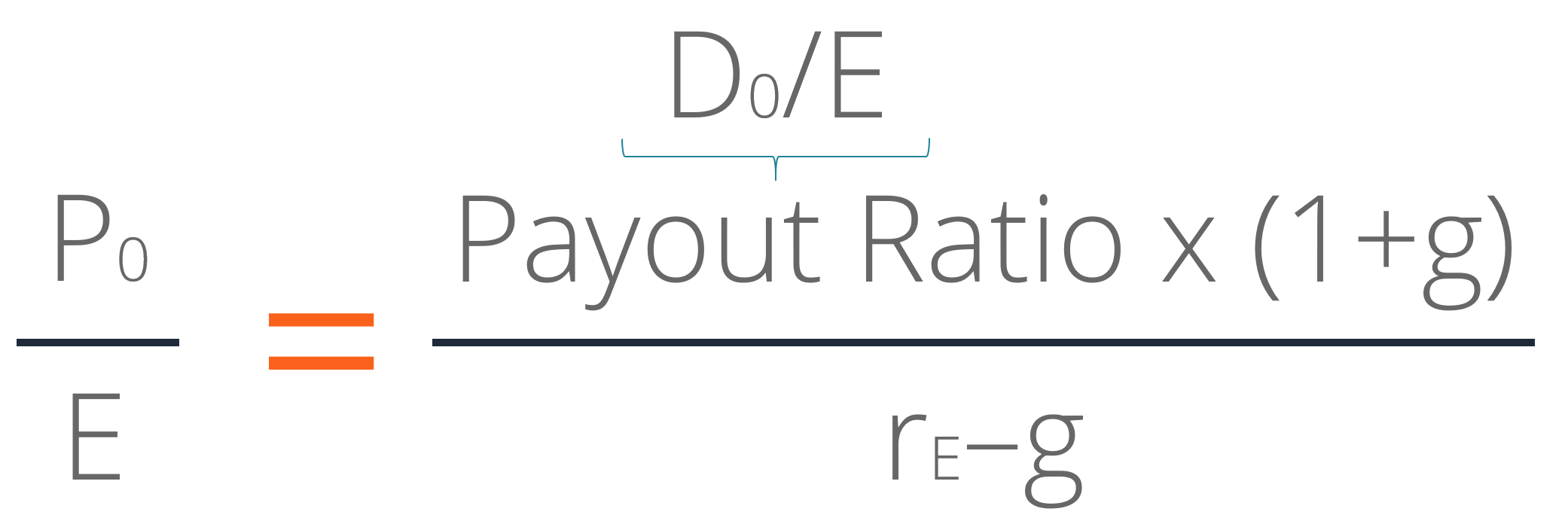
Alternatively, the justified price to earnings ratio calculation can be presented in a different way, using the payout ratio.
Using the Justified P/E Ratio
The justified price to earnings ratio can be compared with other stock evaluation metrics such as the standard P/E, trailing P/E, and forward P/E. The trailing P/E is useful for evaluating a stock’s historical track record, while the forward P/E is most often used to predict the future performance of a stock.
When the justified P/E figure is close to identical to the stock’s forward P/E figure, many market analysts interpret that as an indication that the company’s stock is priced fairly, based on historical price movements, cost of equity, and the company’s current and future projected growth rate.
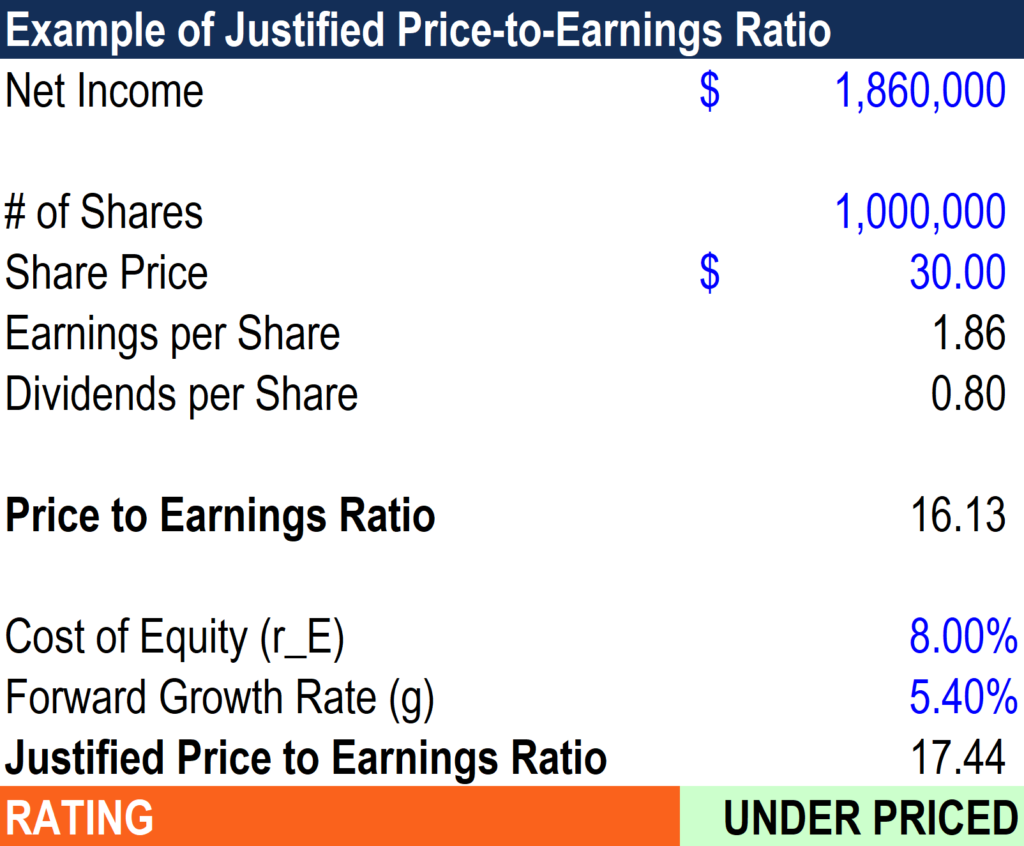
If the justified P/E is greater than the forward P/E, then the stock is likely undervalued/underpriced. Alternatively, if the justified P/E is lower than the stock’s forward P/E, all other things being equal, the stock is considered overvalued at its current price.
Determining a company’s justified P/E is important for analysts and traders because it helps them to determine if a company is valued fairly – or under- or overvalued. This kind of information can be crucial in helping traders make smart buying or selling moves in the stock market.
Example in Excel
Below are an example and template of how to calculate and compare the justified price to earnings ratio and the standard price to earnings ratio in Excel.
Download the Free Template
Enter your name and email in the form below and download the free template now!
Additional Resources
Thank you for reading CFI’s guide to the Justified Price to Earnings Ratio. CFI is the official provider of the global Financial Modeling & Valuation Analyst (FMVA)™Become a Certified Financial Modeling & Valuation Analyst (FMVA)®CFI's Financial Modeling and Valuation Analyst (FMVA)® certification will help you gain the confidence you need in your finance career. Enroll today! certification program, designed to help anyone become a world-class financial analyst. To keep advancing your career, the additional CFI resources below will be useful:
- Balance SheetBalance SheetThe balance sheet is one of the three fundamental financial statements. The financial statements are key to both financial modeling and accounting.
- Cash Flow StatementCash Flow StatementA cash flow Statement contains information on how much cash a company generated and used during a given period.
- Dividend Per Share (DPS)Dividend Per Share (DPS)Dividend Per Share (DPS) is the total amount of dividends attributed to each individual share outstanding of a company. Calculating the dividend per share
- PEG RatioPenetration PricingPenetration pricing is a pricing strategy that is used to quickly gain market share by setting an initially low price to entice customers to purchase from
-

Understanding Debt-to-Income Ratio (DTI): A Comprehensive Guide
The debt-to-income (DTI) ratio is a metric used by creditors to determine the ability of a borrower to pay their debts and make interest payments. The DTI ratio compares an individual’s monthly
-

Understanding the Earnings Multiplier (P/E Ratio): A Comprehensive Guide
The earnings multiplier, or the price-to-earnings ratio, is a method used to compare a company’s current share price to its earnings per share (EPS)Earnings Per Share (EPS)Earnings per share (EP
finance
- Current Ratio: Definition, Calculation & Financial Health
- Molodovsky Effect: Understanding Market Inverted Cycles
- Operating Ratio: Definition, Calculation & Importance
- Quick Ratio: Understanding Your Business's Short-Term Liquidity
- Understanding the Price-to-Earnings (P/E) Ratio: A Beginner's Guide
- Earnings Yield vs. P/E Ratio: A Comprehensive Comparison
- Understanding the P/E Ratio: A Guide for Investors
- Understanding the Price-to-Earnings (P/E) Ratio: A Beginner's Guide
- Understanding the Price-to-Earnings (P/E) Ratio: A Comprehensive Guide
-
 Debt-to-Assets Ratio: Definition, Calculation & Risk Assessment
The Debt to Assets Ratio is a leverage ratioLeverage RatiosA leverage ratio indicates the level of debt incurred by a business entity against several other accounts in its balance sheet, income statem...
-
 Debt-to-Equity Ratio: Definition, Calculation & Importance
The Debt to Equity ratio (also called the “debt-equity ratio”, “risk ratio”, or “gearing”), is a leverage ratioLeverage RatiosA leverage ratio indicates the le...