
Market Value vs. Investment Value: Understanding the Key Differences
In finance, you frequently encounter the concepts of market value vs investment value. The two terms may seem synonymous, however, there are some critical differences between them. In this article, we look at each concept and discuss the key differences between them.
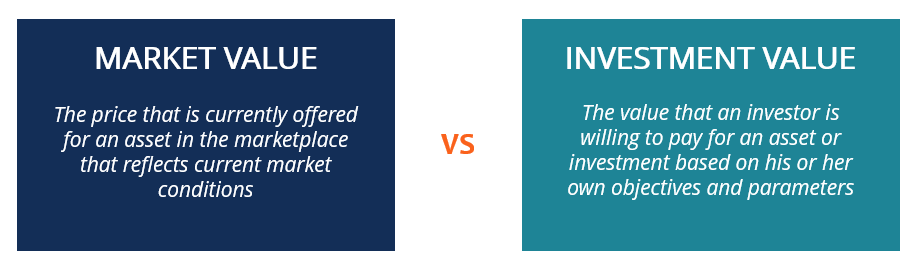
Market value is the price that is currently offered for an assetTypes of AssetsCommon types of assets include current, non-current, physical, intangible, operating, and non-operating. Correctly identifying and in the marketplace. In other words, the market value is a reasonable estimate of the investment’s value that reflects current market conditions.
Conversely, investment value is a concept that describes the value that an investor is willing to pay for the asset or investment based on his or her own objectives and parameters. Essentially, the investment value is a subjective judgment of an asset’s value.
What is Market Value?
Market value is the price that is currently offered for an asset in the marketplace, which reflects current market conditions. Essentially, market value is an objective estimate of the asset’s value in the given market conditions.
The calculation of market value may vary among different assets. For example, the market value for liquid assets such as equities or futuresFutures ContractA futures contract is an agreement to buy or sell an underlying asset at a later date for a predetermined price. It’s also known as a derivative because future contracts derive their value from an underlying asset. Investors may purchase the right to buy or sell the underlying asset at a later date for a predetermined price. can be easily found using the quotes on the exchanges where the securities are traded.
Conversely, illiquid assets such as real estate do not have the same kind of obvious price point. Thus, the true market value of such assets is usually determined by appraisal professionals. They conduct research on an asset, as well as consider current market conditions, to identify a reasonable market value.
What is Investment Value?
Investment value is the value that an investor is willing to pay to obtain an asset or investment. It is based on the individual’s subjective goals, criteria, and opinion about the asset, and it does not always reflect the asset’s true value.
Investment value is a metric that investors use to make investment decisions. In identifying investment value, investors generally consider several criteria, including, but not limited to, return on investment, their investment strategy, and risk levels. In addition, investors also may make forecasts of market conditions that can have a significant impact on the asset’s value.
The calculation of investment value is a challenging process that usually combines both art and science. Each investor must carefully assess his or her own objectives, market conditions, and factors attributable to the investment to come up with a quantified investment value. There are a number of different methodologies for calculating the investment value. The most notable of these methods include comparable analysisComparable Company AnalysisThis guide shows you step-by-step how to build comparable company analysis ("Comps") and includes a free template and many examples. and the discounted cash flows (DCF) modelDiscounted Cash Flow DCF FormulaThis article breaks down the DCF formula into simple terms with examples and a video of the calculation. Learn to determine the value of a business..
More Resources
CFI is the official provider of the Financial Modeling and Valuation Analyst (FMVA)™Become a Certified Financial Modeling & Valuation Analyst (FMVA)®CFI's Financial Modeling and Valuation Analyst (FMVA)® certification will help you gain the confidence you need in your finance career. Enroll today! certification program, designed to transform anyone into a world-class financial analyst. To keep learning and advancing your career, the following CFI resources will be helpful:
- Book Value vs Fair ValueBook Value vs Fair ValueIn accounting and finance, it is important to understand the differences between book value vs fair value. Both concepts are used in the
- Net Present ValueNet Present Value (NPV)Net Present Value (NPV) is the value of all future cash flows (positive and negative) over the entire life of an investment discounted to the present.
- Valuation MethodsValuation MethodsWhen valuing a company as a going concern there are three main valuation methods used: DCF analysis, comparable companies, and precedent transactions
- Investing: A Beginner’s GuideInvesting: A Beginner's GuideCFI's Investing for Beginners guide will teach you the basics of investing and how to get started. Learn about different strategies and techniques for trading
-

What is Value Date?
Value date refers to the date when a transaction takes place or when the value of assets or money becomes effective. it is also used to determine the present value of a product with a fluctuating pric
-

Understanding Investment Alpha: A Guide for Investors
Investing is an opportunity and being a successful investor are two different things. Although anyone can come up with a trading idea, those who want to make money need sound
finance
- Understanding Market Capitalization: A Comprehensive Guide
- Compound Annual Growth Rate (CAGR): Definition & Calculation
- Understanding Financial Denomination: A Comprehensive Guide
- Understanding Market Capitalization: A Comprehensive Guide
- Understanding Market Value of Debt: Beyond Book Value
- Value Traps: Identifying & Avoiding Investment Pitfalls
- Understanding Fair Market Value: A Comprehensive Guide
- Market Value vs. Book Value: Understanding the Difference
- Understanding Financial Investment Companies: Roles & How They Work
-
 Nominal Value Explained: Definition & Financial Significance
Nominal value is a common financial term that is used in various contexts within finance. For stocks and bonds, it is also referred to as the “face value” of an investment that is stated o...
-
 Understanding Value Added: Definition & Business Applications
Value added is the extra value created over and above the original value of something. It can apply to products, services, companies, management, and other areas of business. In other word...