
Understanding Value Added: Definition & Business Applications
Value added is the extra value created over and above the original value of something. It can apply to products, services, companies, management, and other areas of business. In other words, it is an enhancement made by a company/individual to a product or service before offering it for sale to the end customer.
Value can be added to a product, service, process, or an entire business. Value can be added by providing better or extra services in the form of after-sales services and better customer support. Value can also be added by improving a product in some way, or by including extras with the product. For example, a retail seller of computers can add value by including software or computer accessories with the basic product – the computer.
Companies with strong branding can add value to their products or services simply by using the company’s logo to sell a product.
Gross Value Added (GVA)
Gross Value Added (GVA) helps to measure the contribution to an economy of an individual sector, region, industry, or producer. In other words, GVA helps to measure the gross value added by a particular product, service, or industry. GVA is important because it helps to calculate Gross Domestic ProductGDP FormulaGross Domestic Product (GDP) is the monetary value, in local currency, of all final economic goods and services produced in a country during a, which is a key indicator of the state of the nation’s total economy.
GVA can be calculated using the Value Added Statement (VAS).
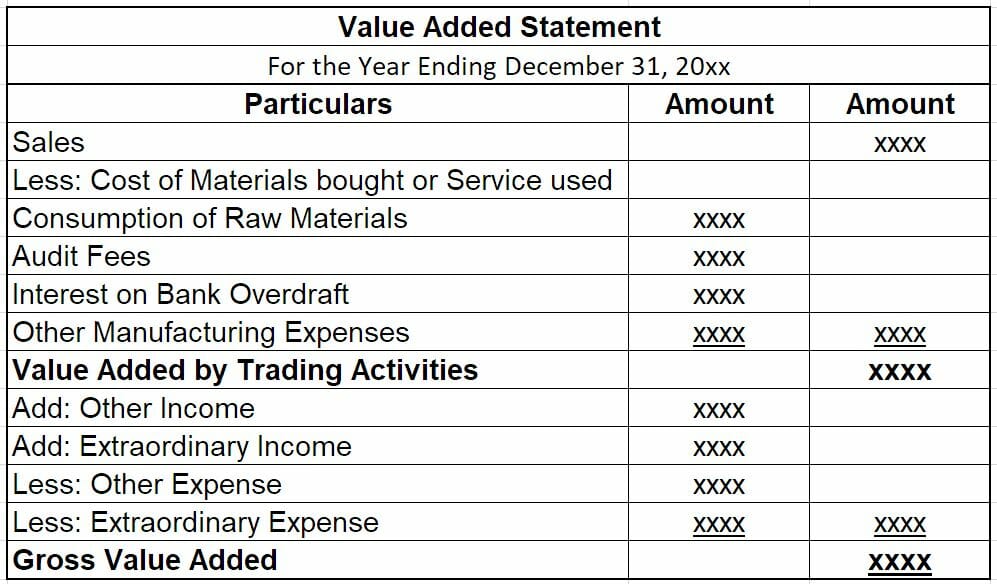
Net Value Added can be calculated by subtracting Depreciation from Gross Value Added.
Economic Value Added
Economic Value AddedEconomic Value Added (EVA)Economic Value Added (EVA) shows that real value creation occurs when projects earn rates of return above their cost of capital and this increases value for shareholders. The Residual Income technique that serves as an indicator of the profitability on the premise that real profitability occurs when wealth is (EVA) can be defined as the incremental difference between a company’s rate of returnInternal Rate of Return (IRR)The Internal Rate of Return (IRR) is the discount rate that makes the net present value (NPV) of a project zero. In other words, it is the expected compound annual rate of return that will be earned on a project or investment. and its cost of capital. Economic Value-Add is used to measure the value that a company generates from the funds invested in it.

Where:
- NOPATNOPATNOPAT stands for Net Operating Profit After Tax and represents a company's theoretical income from operations. – Net Operating Profit After Tax is the profit generated by a company through its operations, after adjusting for taxes but before adjusting for financing costs and noncash costs.
- CE – Capital Employed is the amount of cash that is invested in the business.
- WACC – Weighted Average Cost of Capital WACCWACC is a firm’s Weighted Average Cost of Capital and represents its blended cost of capital including equity and debt.is the minimum rate of return expected by the provider of capital – the investors in the business.
EVA helps to quantify the cost of investing capital in a project. It also helps to assess whether the project is generating enough cash to be considered a good investment. EVA indicates the performance of a company on the basis of where and how the company creates wealth.
In order to assess EVA, a lot of financial modelingWhat is Financial ModelingFinancial modeling is performed in Excel to forecast a company's financial performance. Overview of what is financial modeling, how & why to build a model. is required to project future cash flows and discount them back to the present using the WACC. Modeling is an advanced form of financial analysis – to learn more, check out CFI’s online financial modeling courses.
Download the Free Template
Enter your name and email in the form below and download the free template now!
Market Value Added
Market Value Added (MVA) can be defined as the difference between the market value of a business and the capital invested by both the shareholders and debt holders.

MVA indicates a company’s capacity to increase shareholder value over time. A high MVA indicates effective management and strong operational capabilities, whereas a low MVA can indicate that the value of management’s actions and investments is less than the value of capital contributed by the company’s investors.
Cash Value Added
Cash Value Added (CVA) helps to measure the amount of cash a company generates through its operations. CVA gives investors an idea of the company’s ability to generate cash from one financial periodFiscal Year (FY)A fiscal year (FY) is a 12-month or 52-week period of time used by governments and businesses for accounting purposes to formulate annual to another.

Ways to Add Value for Customers
- Customer’s perspective – To understand what customers from the target market want from the product or service of the company. Doing business according to customers’ expectations is something that many businesses miss out or fall short on.
- Improving customer satisfaction – To get the customer’s feedback through things, such as surveys, about the product or service, and then continue working to enhance customer satisfaction delivered with the product or service.
- Customer experience – To provide customers with not only a satisfactory product or service but also with satisfactory after-sales services to create a memorable experience for the customer.
- Marketing – To implement a marketing strategy after well-informed market research about what customers expect and what is the best way to make the product or service available to customers.
Other Resources
CFI is the leading global provider of financial modeling courses and financial analyst certificationBecome a Certified Financial Modeling & Valuation Analyst (FMVA)®CFI's Financial Modeling and Valuation Analyst (FMVA)® certification will help you gain the confidence you need in your finance career. Enroll today!. To continue developing your career as a financial professional, take a look the following additional CFI resources, which discuss various aspects of business costing:
- Activity-based CostingActivity-Based CostingActivity-based costing is a more specific way of allocating overhead costs based on “activities” that actually contribute to overhead costs. An activity is
- Cost of Goods ManufacturedCost of Goods Manufactured (COGM)Cost of Goods Manufactured (COGM) is a term used in managerial accounting that refers to a schedule or statement that shows the total
- Job Order-based CostingJob Order Costing GuideJob Order Costing is used to allocate costs based on a specific job order. This guide will provide the job order costing formula and how to calculate it. As an example, law firms or accounting firms use job order costing because every client is different and unique. Process-costing, on the other hand can be used
- Marginal Cost FormulaMarginal Cost FormulaThe marginal cost formula represents the incremental costs incurred when producing additional units of a good or service. The marginal cost
-

Initial Outlay: Definition, Examples & Business Implications
An initial outlay refers to the initial investments needed in order to begin a given project. For instance, if opening a new factory, a company would need to purchase new land and machinery in order t
-

Understanding Market Capitalization: A Comprehensive Guide
Market Capitalization (Market Cap) is the most recent market value of a company’s outstanding sharesWeighted Average Shares OutstandingWeighted average shares outstanding refers to the numb
finance
- Understanding Financial Denomination: A Comprehensive Guide
- Understanding Equity: A Comprehensive Guide for Investors
- Face Value Explained: Definition, Examples & Importance
- Understanding Fair Value: Definition & Importance
- Understanding Money: Definition, History & Value
- Nominal Value Explained: Definition & Financial Significance
- What is Value Date?
- Ex-Post Analysis: Understanding Outcomes After Events
- Understanding Value Added Tax (VAT): A Comprehensive Guide
-
 Understanding Forced Sale Value: A Business Valuation Guide
A forced sale value is the estimate of the amount that a business would receive if it sold off its assets one piece at a time during an unforeseen or uncontrollable event. The appraiser assumes that t...
-
 Gross Merchandise Value (GMV): Definition & Importance
Gross Merchandise Value (GMV), also referred to as gross merchandise volume, is the total amount of sales a company makes over a specified period of time, typically measured quarterly or yearly. GMV i...