
Understanding Non-Objecting Beneficial Owners (NOBOs)
The term non-objecting beneficial owner (NOBO) refers to beneficial owners of companies who have permitted their financial institutions to release their personal information to the companies they have invested in. The information given out includes the name and address of the beneficial owner, along with information regarding their investment in the security.

A company will generally have the contact information of their NOBOs. This allows them to contact their investors directly with communications related to the company.
In contrast, objecting beneficial owners (OBOs) are beneficial owners who prohibit their financial institutions from disclosing their personal information. In such cases, the company will not know the identity and personal information of the investor, and the investor will receive any communication from the company through a broker or intermediary.
Investors are almost always given a choice as to whether or not they want to be a NOBO when opening a trading account with a financial institution or broker.
Summary
- A non-objecting beneficial owner (NOBO) is a beneficial owner who has allowed his or her name and other personal information to be disclosed to the companies they have invested in.
- A company can contact a NOBO directly regarding company-related information, whereas OBOs can only be contacted via a broker or intermediary.
- SEC has created the distinction between NOBOs and OBOs to protect investors from potential solicitation and unnecessary corporate spam.
NOBOs vs. OBOs – Example of Investor Communication Chain
Let’s say for simplicity that a corporation has two retail investors – Investor A and Investor B. Both of them have a brokerage account with the same financial institution. Investor A is a NOBO, while Investor B is an OBO. Let’s assume that the company they both have invested in is releasing a new investor presentation, and it wants to send the presentation to its investors.
Since Investor A is a NOBO, he will most likely get this news in his email directly from the company. On the other hand, Investor B will get this news in his email from the broker or financial institution that holds the shares. Generally, a NOBO will receive the communication before an OBO, as there is no intermediary involved.
Securities and Exchange Commission (SEC) Laws
The Securities and Exchange Commission (SEC)Securities and Exchange Commission (SEC)The US Securities and Exchange Commission, or SEC, is an independent agency of the US federal government that is responsible for implementing federal securities laws and proposing securities rules. It is also in charge of maintaining the securities industry and stock and options exchanges has created the distinction between NOBOs and OBOs to protect investors from potential solicitation and unnecessary corporate spam. For example, companies may try to communicate with investors to persuade them to vote in a particular direction on a proxy vote or other shareholder approval items. It can interfere with independent decision-making.
Furthermore, some companies tend to over-communicate, which can lead to a certain level of corporate spam. By adding an intermediary, the cost of communication to companies increases. As a result, they are less likely to send unnecessary communications.
Under SEC laws, intermediaries are strictly prohibited from disclosing the name and personal information of OBOs. As a result, the company cannot contact OBOs directly. Even though companies can directly contact NOBOs, the SEC still requires that proxy materials be forwarded to investors only via an intermediary. It is to avoid solicitation.
Advantages of Being a Non-Objecting Beneficial Owner (NOBO)
There are some advantages to being a NOBO, especially when it comes to receiving important communication promptly. Companies and issuers request the personal contact information of their investors so they can directly contact their shareholders regarding important investor communications such as financial reports, investor presentations, press releases, and other shares-related information.
There has been much debate amongst the different players in the financial industry regarding the distinction between NOBOs and OBOs. Corporations and investors that prefer to be NOBOs often cite these two common advantages:
1. Time and cost efficiencies
Directly communicating with investors saves time and administrative costsAdministrative ExpensesAdministrative expenses refer to the costs incurred by a company or organization that include, but are not limited to, the salaries and benefits of the for both the company and the investors. Financial intermediaries such as brokerage firms generally charge the company and its investors a small fee for receiving and forwarding investor communications. Both the company and the investors would save on the administrative cost if communications were sent to investors directly.
2. Stronger relationships with retail investors
Another reason most corporations are against having this distinction is due to SEC rules. Under SEC rules, communication between corporations and investors is done through a bank or broker that holds shares for investors.
If an investor has opted to be an OBO, intermediaries are prohibited from disclosing the identity or other personal information of investors to the company. It means corporations cannot know the profile of their retail investors. Corporations argue that not having this distinction would allow for greater transparency and stronger relationships with retail investors.
Related Readings
CFI offers the Capital Markets & Securities Analyst (CMSA)®Program Page - CMSAEnroll in CFI's CMSA® program and become a certified Capital Markets &Securities Analyst. Advance your career with our certification programs and courses. certification program for those looking to take their careers to the next level. To keep learning and developing your knowledge base, please explore the additional relevant resources below:
- BrokerageBrokerageA brokerage provides intermediary services in various areas, e.g., investing, obtaining a loan, or purchasing real estate. A broker is an intermediary who
- Financial IntermediaryFinancial IntermediaryA financial intermediary refers to an institution that acts as a middleman between two parties in order to facilitate a financial transaction. The institutions that are commonly referred to as financial intermediaries include commercial banks, investment banks, mutual funds, and pension funds.
- Proxy VoteProxy VoteA Proxy Vote is a delegation of voting authority to a representative on behalf of the original vote-holder. The party who receives the authority to vote is known as the Proxy and the original vote-holder is known as the Principal. The concept is important in financial markets and particularly with public companies
- SEC FilingsSEC FilingsSEC filings are financial statements, periodic reports, and other formal documents that public companies, broker-dealers, and insiders are required to submit to the U.S. Securities and Exchange Commission (SEC). The SEC was created in the 1930s with an aim to curb stock manipulation and fraud
-

Information Ratio: A Comprehensive Guide to Risk-Adjusted Returns
The information ratio measures the risk-adjusted returns of a financial asset or portfolio relative to a certain benchmarkDow Jones Industrial Average (DJIA)The Dow Jones Industrial Average (DJIA), al
-
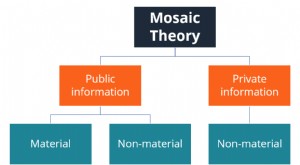
Mosaic Theory: A Comprehensive Approach to Security Valuation
The mosaic theory is an approach to financial security analysis that involves the analysis of a variety of resources, including public and non-public material and non-material information, to determin
finance
- Bank Account Access: Who Can See Your Information?
- Identifying Property Insurance Providers: A Guide
- Selling Your Colorado Home For Sale By Owner: A Step-by-Step Guide
- Angel Investors: Definition, Funding & vs. Venture Capital
- Asymmetric Information: Definition, Examples & Implications
- Understanding Financial Disclosure: A Comprehensive Guide
- Jack Welch: Biography & Legacy of GE's Transformative Leader
- Understanding Investors: A Comprehensive Guide
- Understanding Beneficial Ownership: Benefits & How It Works
-
 Chinese Walls in Finance: Understanding Information Barriers
In finance, a Chinese Wall (or a Wall of China) is a virtual information barrier erected between those who have material, non-public information, and those who don’t, to prevent conflicts of int...
-
 Dutch Auction Explained: How It Works & When to Use It
A Dutch auction is a price discovery process in which the auctioneer starts with the highest asking price and lowers it until it reaches a price level where the bids received will cover the entir...