
Mosaic Theory: A Comprehensive Approach to Security Valuation
The mosaic theory is an approach to financial security analysis that involves the analysis of a variety of resources, including public and non-public material and non-material information, to determine the underlying value of a security.
The theory provides a more comprehensive and meticulous approach to the valuation of financial securitiesMarketable SecuritiesMarketable securities are unrestricted short-term financial instruments that are issued either for equity securities or for debt securities of a publicly listed company. The issuing company creates these instruments for the express purpose of raising funds to further finance business activities and expansion. because it allows the inclusion of a broader range of information sources. At the same time, the method is extremely complicated, as it requires the integration of information that may not seem relevant to a security’s price.
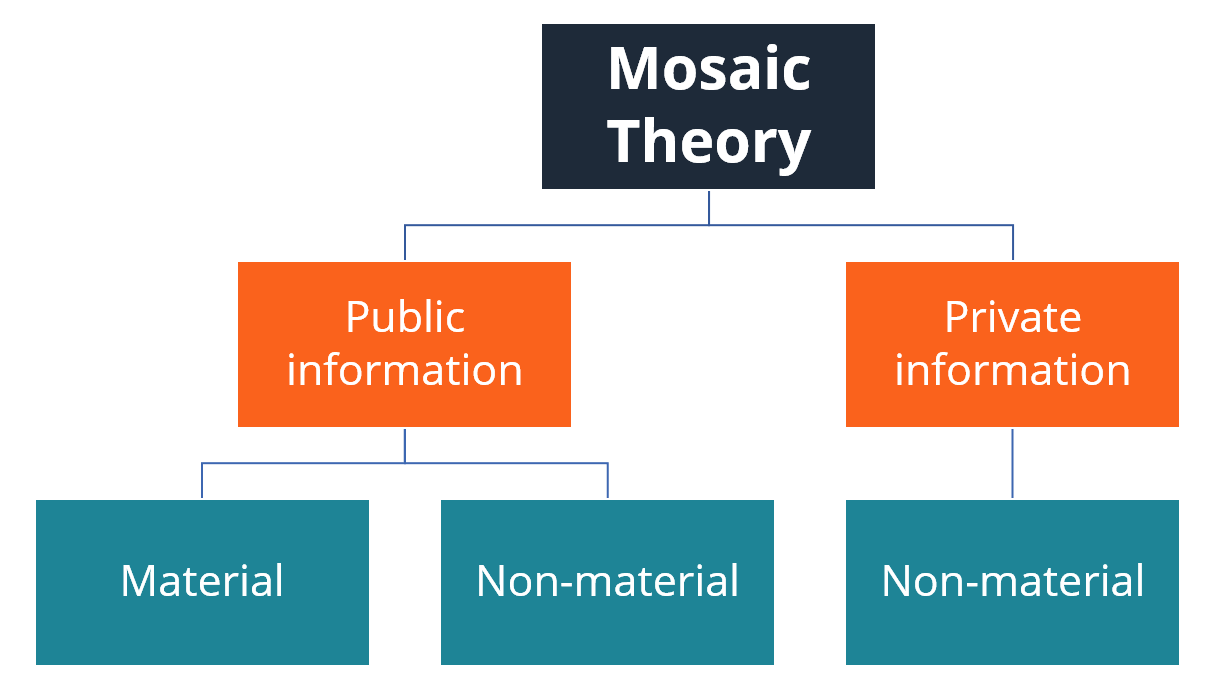
An analyst who relies on the mosaic theory must carefully assess the information used in valuation analysis. Due to the fact that the method allows the use of non-public information, there is a chance that an analyst may cross the line and use material, non-public information in the analysis, which is strictly prohibited under existing securities laws.
In case of illegal use of material, non-public information, an analyst may face charges related to insider tradingInsider TradingInsider trading refers to the practice of purchasing or selling a publicly-traded company’s securities while in possession of material information that is practices. Therefore, everyone who uses such information in valuation should carefully evaluate the sources of information.
The CFA Institute recognizes mosaic theory as a valid method of security analysis.
Material information vs. Non-material information
The distinction between material and non-material information is quintessential in mosaic theory because it draws the line between legal and illegal activities.
1. Material information
This is the information that exerts a certain (even small) effect on the price of a security. Whenever a piece of material information becomes available to the public, it turns into a catalyst that causes price changes in a security. Only public material information can be used in the security’s analysis.
The use of private material information in security valuation is a criminal offense. The most common examples of material information are the announcement of dividendsDividendA dividend is a share of profits and retained earnings that a company pays out to its shareholders. When a company generates a profit and accumulates retained earnings, those earnings can be either reinvested in the business or paid out to shareholders as a dividend., quarterly earnings, management changes, and M&A activities.
2. Non-material information
Non-material information is information that does not affect the price of a security. It does not directly change a security’s price but may provide some insights to an analyst regarding the possible future performance of the security. Some examples of non-material information include levels of employee satisfactionEmployee MoraleEmployee morale is defined as the overall satisfaction, outlook, and feelings of well-being that an employee holds in the workplace. In other, the company’s popularity in Internet searches, etc.
Examples of information sources in Mosaic Theory
In the modern world, large amounts of data are easily accessible. Therefore, analysts may use various sources that may help them to identify the underlying value of a security. Examples of information sources that can be used by analysts who rely on the mosaic theory may include:
- Company’s financial reports (10-K10-KForm 10-K is a detailed annual report that is required to be submitted to the U.S. Securities and Exchange Commission (SEC). The filing provides a comprehensive summary of a company’s performance for the year. It is more detailed than the annual report that is sent to shareholders, 10-Q)
- Social networks (e.g., Facebook, LinkedIn, Glassdoor)
- Insights from the company’s management and employees
- Insights from other analysts or industry professionals
Additional resources
Thank you for reading CFI’s explanation of the Mosaic Theory. CFI is the official provider of the Financial Modeling and Valuation Analyst (FMVA)™Become a Certified Financial Modeling & Valuation Analyst (FMVA)®CFI's Financial Modeling and Valuation Analyst (FMVA)® certification will help you gain the confidence you need in your finance career. Enroll today! certification program, designed to transform anyone into a world-class financial analyst. To keep learning and developing your knowledge of financial analysis, we highly recommend the additional CFI resources below:
- Competitive AdvantageCompetitive AdvantageA competitive advantage is an attribute that enables a company to outperform its competitors. It allows a company to achieve superior margins
- ScalabilityScalabilityScalability can fall in both financial and business strategy contexts. In both cases, it stands for the ability of the entity to withstand pressure of
- Strategic AnalysisStrategic AnalysisStrategic analysis refers to the process of conducting research on a company and its operating environment to formulate a strategy. The definition
- Valuation MethodsValuation MethodsWhen valuing a company as a going concern there are three main valuation methods used: DCF analysis, comparable companies, and precedent transactions
-

Understanding Underlying Securities: A Key to Derivatives Investing
Underlying security is a term in investing that denotes the negotiable financial instrument upon which a financial derivative, such as an option on a stock – is based. Therefore, the value of th
-
Understanding Wash Sales: IRS Rules and Implications
A wash sale is categorized when an investor sells a stockStockWhat is a stock? An individual who owns stock in a company is called a shareholder and is eligible to claim part of the company’s re
finance
- Understanding Security Deposits: What You Need to Know
- Asymmetric Information: Definition, Examples & Implications
- Direct Security Explained: Types & How It Works
- Understanding Financial Disclosure: A Comprehensive Guide
- Entity Theory: Separating Business & Personal Finances - Definition & Benefits
- Understanding Material Non-Public Information (MNPI)
- Securities Explained: Types, Categories & Trading in the US
- Insider Information: Definition, Examples & Legal Implications
- Social Security Retirement Requirements: What You Need to Know
-
 Understanding Stock Market Signaling: Insider Information Explained
Signaling refers to the act of using insider information to initiate a trading position. It occurs when an insider releases crucial information about a company that triggers the buying or selling of i...
-
 Understanding Technical Decline in Securities: Causes & Factors
Technical decline is the downward price movement of a security that is caused by factors other than a fundamental change in the security’s value. The forces that power the downward movement rela...