
Information Ratio: A Comprehensive Guide to Risk-Adjusted Returns
The information ratio measures the risk-adjusted returns of a financial asset or portfolio relative to a certain benchmarkDow Jones Industrial Average (DJIA)The Dow Jones Industrial Average (DJIA), also referred to as "Dow Jones” or "the Dow", is one of the most widely-recognized stock market indices.. This ratio aims to show excess returns relative to the benchmark, as well as the consistency in generating the excess returns. The consistency of generating excess returns is measured by the tracking error.

The selection of the benchmark is subjective. The most commonly used benchmarks are the yields of government-issued bonds (e.g., US Treasury BillsTreasury Bills (T-Bills)Treasury Bills (or T-Bills for short) are a short-term financial instrument issued by the US Treasury with maturity periods from a few days up to 52 weeks.) or a major equity index (e.g., S&P 500).
Uses of the Information Ratio
The information ratio is primarily used as a performance measure by fund managers. In addition, it is frequently used to compare the skills and abilities of fund managers with similar investment strategies. The ratio provides investors with insights about the ability of a fund manager to sustain the generation of excess, or even abnormal (as in “abnormally high”), returns over time. Finally, some hedge funds and mutual fundsMutual FundsA mutual fund is a pool of money collected from many investors for the purpose of investing in stocks, bonds, or other securities. Mutual funds are owned by a group of investors and managed by professionals. Learn about the various types of fund, how they work, and benefits and tradeoffs of investing in them use the information ratio to calculate the fees that they charge their clients (e.g., performance fee).
The information ratio and the Sharpe ratioSharpe RatioThe Sharpe Ratio is a measure of risk-adjusted return, which compares an investment's excess return to its standard deviation of returns. The Sharpe Ratio is commonly used to gauge the performance of an investment by adjusting for its risk. are similar. Both ratios determine the risk-adjusted returns of a security or portfolio. However, the information ratio measures the risk-adjusted returns relative to a certain benchmark while the Sharpe ratio compares the risk-adjusted returns to the risk-free rate.
Formula for Calculating the Information Ratio
The information ratio is calculated using the formula below:
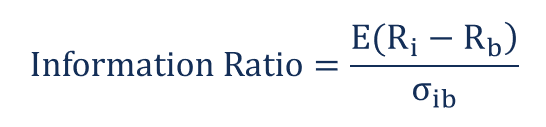
Where:
- Ri – the return of a security or portfolio
- Rb – the return of a benchmark
- E( Ri – Rb) – the expected excess return of a security or portfolio over benchmark
- δib – the standard deviation of a security or portfolio returns from the returns of a benchmark (tracking error)
Example
John is willing to invest his money in a hedge fund. He considers the ABC Fund and XYZ Fund. In order to choose the right fund, John wants to compare the information ratios for the two funds. The benchmark for the ratio’s calculation is the S&P 500 index. The information about the funds is summarized in the table below:
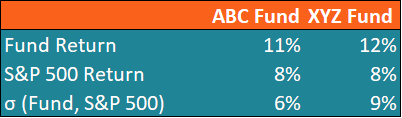
Using the information above, we can calculate the ratios for the funds:
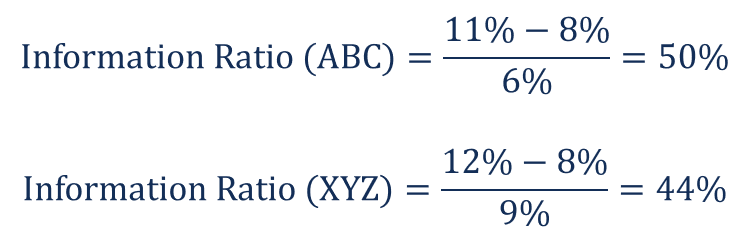
The ABC Fund shows a higher ratio than the XYZ Fund. This indicates that the ABC Fund can more consistently generate excess returns, as compared to the XYZ Fund.
More Resources
CFI is the official provider of the global Financial Modeling & Valuation Analyst (FMVA)™Become a Certified Financial Modeling & Valuation Analyst (FMVA)®CFI's Financial Modeling and Valuation Analyst (FMVA)® certification will help you gain the confidence you need in your finance career. Enroll today! certification program, designed to help anyone become a world-class financial analyst. To keep advancing your career, the additional CFI resources below will be useful:
- Investing: A Beginner’s GuideInvesting: A Beginner's GuideCFI's Investing for Beginners guide will teach you the basics of investing and how to get started. Learn about different strategies and techniques for trading
- Equity Risk PremiumEquity Risk PremiumEquity risk premium is the difference between returns on equity/individual stock and the risk-free rate of return. It is the compensation to the investor for taking a higher level of risk and investing in equity rather than risk-free securities.
- Rate of ReturnRate of ReturnThe Rate of Return (ROR) is the gain or loss of an investment over a period of time copmared to the initial cost of the investment expressed as a percentage. This guide teaches the most common formulas
- Risk ManagementRisk ManagementRisk management encompasses the identification, analysis, and response to risk factors that form part of the life of a business. It is usually done with
-

Asset Turnover Ratio: Definition & Calculation - Financial Analysis
The asset turnover ratio, also known as the total asset turnover ratio, measures the efficiency with which a company uses its assets to produce salesSales RevenueSales revenue is the income recei
-
Treynor Ratio: Understanding Risk-Adjusted Portfolio Performance
The Treynor Ratio is a portfolio performance measure that adjusts for systematic riskSystematic RiskSystematic risk is that part of the total risk that is caused by factors beyond the control of a spe
finance
- Acid-Test Ratio: Understanding Your Company's Short-Term Liquidity
- Advertising to Sales Ratio: Measuring Ad Effectiveness & ROI
- Current Ratio: Definition, Calculation & Financial Health
- Operating Ratio: Definition, Calculation & Importance
- Quick Ratio: Understanding Your Business's Short-Term Liquidity
- Reserve Ratio Explained: Understanding Bank Reserves
- Understanding the Retention Ratio: Reinvesting for Growth
- Sharpe Ratio: Calculate & Interpret Investment Performance
- Understanding the Information Ratio: A Guide for Investors
-
 Loan-to-Value (LTV) Ratio: Understanding Risk & Home Equity
The loan-to-value (LTV) ratio is a financial ratio that compares the size of a loan to the value of an asset that is purchased using the proceeds of the loan. The LTV ratio is an important metric that...
-
![Shareholder Equity Ratio: Definition & Calculation | [Your Company Name]](https://www.etffin.com/article/uploadfiles/202110/2021100815180064_S.png) Shareholder Equity Ratio: Definition & Calculation | [Your Company Name]
Shareholder Equity Ratio: Definition & Calculation | [Your Company Name]The shareholder equity ratio is a ratio that shows the amount of a company’s assets that have been financed using the owner’s equity instead of debt. It shows the portion of shareholders&r...