
P/AFFO Explained: Understanding REIT Financial Health
The P/AFFO is calculated by adding the P/FFO to any rent increases and subtracting capital expenditures and the routine maintenance costs. The P/AFFO is a measure of the financial performance of a REIT (Real Estate Investment Trust)Real Estate Investment Trust (REIT)A real estate investment trust (REIT) is an investment fund or security that invests in income-generating real estate properties. The fund is operated and owned by a company of shareholders who contribute money to invest in commercial properties, such as office and apartment buildings, warehouses, hospitals, shopping centers, student housing, hotels. It is equal to the P/FFO adjusted to consider capital expenditures and regular maintenance costs, making it a more accurate REIT valuation tool than P/FFO.
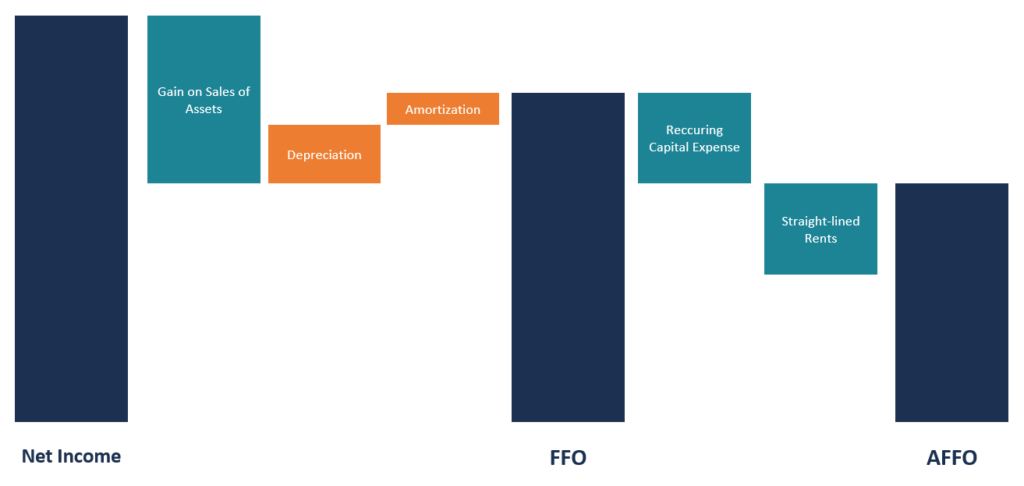
It is also a more precise predictor of dividends that a company will pay in the future, and it can help potential investors make a decision on whether or not to buy shares of the company. The P/AFFO is also known as the Funds Available for Distribution.
Quick Summary
- P/AFFO is an adjusted version of Funds from Operations (FFO), which takes into account capital expenditures of a company.
- The P/AFFO metric is not standardized, making it impossible to compare one REIT from the other since there are no standard procedures for the P/AFFO between companies.
- The P/AFFO takes into account the capital expenditures of the portfolio, such as an increase in rent, repaint of the premises, and roof replacement.
How to Calculate P/AFFO
The calculation of the P/AFFO requires that we first determine the P/FFOP/FFOP/FFO, or Price to Funds From Operations, can be described as a reliable and modern way of determining the value of a REIT. The P/FFO metric is calculated, and then deduct other forms of expenditures from the P/FFO to get the P/AFFO. The P/FFO is used to evaluate cash flow from real estate investments. It is calculated by first getting the net income of the company and then adding back any depreciation and amortization costs during the period. The depreciation is added back to the equation because real estate properties appreciate in value, and deducting depreciation would distort the value of a property.
The P/AFFO is obtained from taking the P/FFO value and then deducting capital expendituresCapital ExpendituresCapital expenditures refer to funds that are used by a company for the purchase, improvement, or maintenance of long-term assets to improve like maintenance costs and any capital gains on the sale of the property. The capital gains on the property sale are deducted since it’s a one-time event and does not result in any long-term effect on the property.
P/AFFO Payout Ratio
The P/AFFO ratio measures a REIT’s ability to pay dividends to shareholders in the long term. The payout ratio is calculated by taking a REIT’s yearly dividend rate and dividing it by the estimated P/AFFO per share. It helps evaluate the REIT’s operations cash flow after taking into account the capital expenditures and other routine maintenance costs.
If a calculated ratio is over 100%, it means that the dividends of that REIT are higher than income projected for future operations. As a result, the REIT can be obliged to pay dividends from its cash reserve. However, such a scenario is not a cause for alarm if it prevails in the short term. It can, however, be a cause for alarm if it extends to the long term, which will be unsustainable for the business and will require swift action for the adjustment of dividends payoutDividend PolicyA company’s dividend policy dictates the amount of dividends paid out by the company to its shareholders and the frequency with which the dividends are paid.
P/AFFO vs. P/FFO
The P/AFFO is more preferred than P/FFO when measuring the REITs performance since the former deducts expenses incurred by the business in detail, including capital expenditures and routine maintenance costs. The P/FFO only considers the depreciation and amortization costs, while excluding other important costs that affect a company’s value.
Another point of contention between the two metrics is that the P/FFO is more standardized than the P/AFFO for most companies. There are guidelines that companies can use when calculating the P/FFO, but there is no standard method for calculating the P/AFFO.
It means that every company can use its preferred way to determine its P/AFFO; the values obtained by companies may not be comparable with other values across the industry. Comparison is an important aspect in the real estate industry since it enables experts to determine how different companies are performing.
Debt (Leverage Ratio)
For a steady growth of per-share P/AFFO and an increase in the dividends payable to shareholders, companies are required to maintain lower costs of capital than cash yields. Debt is a key aspect for most companies since they can take on debt to boost their growth or cover a deficit in the financing of their operations. However, the cost of debt varies, and companies should obtain the cheapest debts that are flexible and with manageable terms of repayment.
Companies use leverage ratios to evaluate the risk associated with a given debt offer. The ratio is also used by credit rating bureaus in assessing the viability of REITs in terms of credit. Creditors use the data obtained by the rating agencies to prove the creditworthinessCreditworthinessCreditworthiness, simply put, is how "worthy" or deserving one is of credit. If a lender is confident that the borrower will honor her debt obligation in a timely fashion, the borrower is deemed creditworthy. of a borrowing firm.
The data elaborates on the cash flow and ability of a REIT to comfortably repay the debt and whether they have other outstanding debts with other creditors. A company’s credit rating is essential to their creditworthiness since creditors consult such records to gauge the repayment ability and the default risk. Low credit rates, therefore, limits a company’s growth opportunity.
Additional Resources
CFI is the official provider of the Financial Modeling and Valuation Analyst (FMVA)™Become a Certified Financial Modeling & Valuation Analyst (FMVA)®CFI's Financial Modeling and Valuation Analyst (FMVA)® certification will help you gain the confidence you need in your finance career. Enroll today! certification program, designed to transform anyone into a world-class financial analyst.
In order to help you become a world-class financial analyst and advance your career to your fullest potential, these additional resources will be very helpful:
- Cap Rate (REIT)Cap Rate (REIT)Cap rate is a financial metric that is used by real estate investors to analyze real estate investments, and determine their potential rate of return based
- Foundations of Real Estate Financial ModelingFoundations of Real Estate Financial ModelingLearn the foundations of real estate financial modeling in this introductory guide to building a financial model for a real estate development project.
- Leverage RatiosLeverage RatiosA leverage ratio indicates the level of debt incurred by a business entity against several other accounts in its balance sheet, income statement, or cash flow statement. Excel template
- Price AppreciationPrice AppreciationPrice appreciation in real estate refers to the increase in the value of a real estate property over a period of time. One of the goals of investing in real
-

Understanding Regulation Z: Your Rights as a Borrower
Regulation Z is a consumer-protection regulation that compels lenders to disclose the cost of credit in a clear way for consumers. Whether you’re applying for a mortgage or dealing
-

Annuities Explained: A Simple Guide to Retirement Income
So you're wondering what is an annuity? There are dozens of different flavours of annuities that perform different functions and pay their holders out in different ways, but for our purposes let’
finance
- Understanding P/E Ratios: A Guide for New Investors
- Understanding Adjusted Funds From Operations (AFFO) for REITs
- Understanding the Justified P/E Ratio: A Deep Dive
- Molodovsky Effect: Understanding Market Inverted Cycles
- Understanding P/FFO: A Key REIT Valuation Metric
- P/FFO vs. P/AFFO: Understanding REIT Valuation Metrics
- Understanding the S&P/TSX Composite Index: A Comprehensive Guide
- P/B Ratio vs. P/E Ratio for Banks: Which is More Reliable?
- Understanding the Price-to-Earnings (P/E) Ratio: A Comprehensive Guide
-
 Jumbo CDs: Higher Rates & Deposits Explained
A jumbo CD is similar to a conventional CD although the former generally requires a higher deposit and accrues interest at a higher rate. A CD is a certificate of deposit that is offered by banks for ...
-
Understanding the Price-to-Earnings (P/E) Ratio: A Beginner's Guide
One of the most common measures that investors use to evaluate a stock is its price-to-earnings (or P/E) ratio. The P/E ratio is calculated by dividing a stocks price by its per-share earnings f...