
Understanding Private Companies: Ownership, Structure, and Types
A private company is owned by either a small number of shareholders, company members, or a non-governmental organization, and it does not offer its stocks for sale to the general public. Instead, its stock is offered, owned, or exchanged privately among a small number of shareholders – or even held by a single individual. Private companies are also referred to as privately-held companies, limited companies, limited liability companiesLimited Liability Company (LLC)A limited liability company (LLC) is a business structure for private companies in the United States, one that combines aspects of partnerships and corp, or private corporations, depending on the country they’re incorporated and how they are structured.
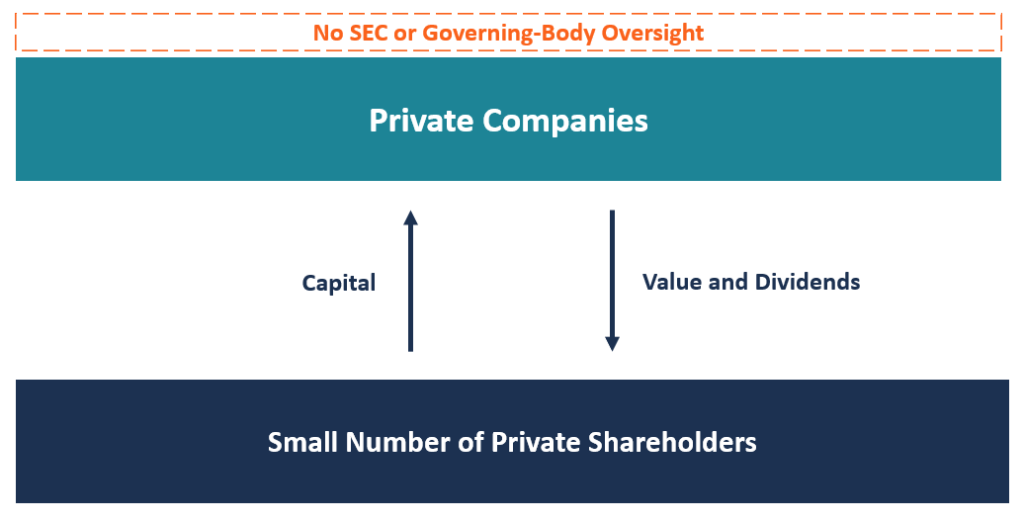
Private companies may include family-owned businesses, sole proprietorshipsSole ProprietorshipA sole proprietorship (also known as individual entrepreneurship, sole trader, or proprietorship) is a type of an unincorporated entity that is owned only, partnerships, and small to medium-sized enterprises (SME). Since such companies lack access to the public exchange market, they can only raise funds through private investments, company profits, or loans from lenders.
Summary
- A private company is formed by a small number of shareholders who come together for a social cause or profit motive.
- The shares of a private company are not traded on a public stock exchange.
- The common types of private companies include sole proprietorships, partnerships, and limited liability companies.
Types of Private Companies
1. Sole proprietorship
A sole proprietorship is a business owned and managed by one person, and the owner bears unlimited personal liability on the debts incurred by the business. All of its assets, liabilities, and obligations are the responsibility of the business owner.
If the business goes into debt, the owner may be required to sell personal assets to settle the debt. The owner can decide to either run the business on their own or employ other people to help run the business.
2. Partnership
A partnership has a lot of similarities to a sole proprietorship, except the partnership is owned and managed by two or more people who come together with the goal of making a profit. The partners bear unlimited personal liabilities on any debts incurred by the business. The main types of partnerships include general partnerships, limited partnerships, and limited liability partnershipsLimited Liability Partnerships (LLPs)Limited Liability Partnerships (LLPs) are a corporate business structure that enables entrepreneurs, professionals, and enterprises to provide services via.
3. Corporation
A corporation is a for-profit or not-for-profit business entity that exists as a separate legal entity from its owners. A corporation possesses the rights and privileges of an individual, as it can enter into contracts, sue or be sued, own assets, and pay taxes. Corporations are owned by shareholders or individual investors who provide capital to the business through the purchase of the corporation’s stock.
The shareholders are required to elect a board of directors, which is required to oversee the overall operation of the business. The board appoints the managerial officers, such as the chief executive officer (CEO), who supervise, direct, and manage the core business activities of the corporation.
Why Do Private Companies Stay Private?
1. To avoid regulatory and government scrutiny
Public companies are under high scrutiny from their shareholders, regulators, and the government, and they are required to publicly release their financial statements by filing the quarterly reports, annual reports, and other major events with the Securities and Exchange Commission in the United States, or with a similar government entity in other countries.
In contrast, private companies can choose to keep their financial status and operations to themselves, avoiding government scrutiny and all the regulations that apply to publicly traded companies. There are no legal obligations for private companies to make their financial statements public. However, privately held companies must keep their accounting records in order and make financial statements available to their shareholders.
2. To keep ownership within the family
Companies sometimes opt to stay private to retain their family ownership. Some of the biggest US companies are family-owned, and they’ve been passed on from one generation to another. Going public would mean that the company would be answerable to a large number of shareholders and might be required to choose different members for the board of directors other than the members of the founding family.
Remaining private means that the company alone can decide who sits on the board of directors, and it is only answerable to a small number of shareholders or private investors. Private companies self-finance their projects and acquisitions without selling large equity stakes to investors through an Initial Public Offering (IPO)Initial Public Offering (IPO)An Initial Public Offering (IPO) is the first sale of stocks issued by a company to the public. Prior to an IPO, a company is considered a private company, usually with a small number of investors (founders, friends, family, and business investors such as venture capitalists or angel investors). Learn what an IPO is.
Changing from a Private Company to a Public Company
A majority of public companies start as private entities, either as a family-owned business, partnership, or limited liability company with a few shareholders and advisors. As the business expands, it typically requires additional funds to finance its operations, expansion, or acquisition of other smaller companies beyond what it can raise from internal revenue sources and a small circle of investors.
Transitioning from a private to a public company gives the company access to a large pool of funds in the public exchange market. The process of becoming a public company involves offering stock to the investing public through an IPO.
The private company planning to go public is required to select an underwriter, usually an investment bank, to provide guidance on the IPO process. The underwriter acts as a broker between the issuing company and the public and is responsible for conducting due diligence and helping the issuer navigate all government regulatory requirements for public companies.
When the company goes public, all the privately-held shares are converted to public ownership, and existing shares are assigned a new value equivalent to the public trading price. The original shareholders can choose to hold on to their shares when the company goes public or sell them to new investors for a profit.
More Resources
CFI is the official provider of the Financial Modeling and Valuation Analyst (FMVA)®Become a Certified Financial Modeling & Valuation Analyst (FMVA)®CFI's Financial Modeling and Valuation Analyst (FMVA)® certification will help you gain the confidence you need in your finance career. Enroll today! certification program, designed to transform anyone into a world-class financial analyst.
In order to help you become a world-class financial analyst and advance your career to your fullest potential, these additional CFI resources will be very helpful:
- Corporate StructureCorporate StructureCorporate structure refers to the organization of different departments or business units within a company. Depending on a company’s goals and the industry
- EntrepreneurEntrepreneurAn entrepreneur is a person who starts, designs, launches, and runs a new business. Instead of being an employee and reporting to a supervisor
- General PartnershipGeneral PartnershipA General Partnership (GP) is an agreement between partners to establish and run a business together. It is one of the most common legal entities to form a business. All partners in a general partnership are responsible for the business and are subject to unlimited liability for business debts.
- Joint VentureJoint Venture (JV)A joint venture (JV) is a commercial enterprise in which two or more organizations combine their resources to gain a tactical and strategic edge in the market. Companies often enter into a joint venture to pursue specific projects. The JV may be a new project or new core business
-
Understanding Expenditures: Definition and Types
An expenditure represents a payment with either cash or credit to purchase goods or services. An expenditure is recorded at a single point in time (the time of purchase), compared to an expenseAccrued
-
Goodwill in Accounting: Definition & Value
In accounting, goodwill is an intangible assetIntangible AssetsAccording to the IFRS, intangible assets are identifiable, non-monetary assets without physical substance. Like all assets, intangible as
finance
- Acquirer Definition: Understanding Corporate Acquisitions
- Understanding Clawbacks: Protecting Stakeholders from Failed Performance
- Understanding Financial Gearing: Debt & Leverage Explained
- Understanding Non-Banking Financial Companies (NBFCs): A Comprehensive Guide
- Private vs. Public Company: Key Differences Explained
- Understanding Privately Held Companies: Definition & Key Features
- Understanding Public Companies: A Comprehensive Guide
- Understanding Affiliated Companies: Definition & Key Differences
- Understanding Associate Companies: Definition & Ownership
-
 Understanding Net-Net: A Financial Health Indicator
Net-net is a term used for a company with a market capitalization that is less than the difference between the company’s current assets and total liabilities. The equation does not consider long...
-
 EBITA Explained: Understanding Earnings Before Interest, Taxes, and Amortization
EBITA is an acronym that refers to the earnings of a company before interest, tax, and amortization expenses are deducted. Investors use EBITA as an indicator to measure the profitability and efficien...