
Authorized Shares: Understanding a Company's Issuance Limit
Authorized shares, or authorized stock, are simply a legally allowed maximum number of shares that a company can issue to investors. The number of authorized shares is specified in the company’s articles of incorporationArticles of IncorporationArticles of Incorporation are a set of formal documents that establish the existence of a company in the United States and Canada. For a business to be. You can also see the number in the capital accounts section on the balance sheet.

Understanding Authorized Shares
When companies are first formed, they file documents to become registered in the government system, i.e., through the articles of incorporation. The company must describe its stock structure, specifically, what kinds of shares it plans to issue to the owners and the total number of shares that can be made available to investors. The number of shares represents the authorized shares.
The number of authorized shares can be increased by the shareholders of the company at annual shareholder meetings, provided a majority of the current shareholders vote for the change.
Importantly, the number of authorized shares can be significantly higher than the number of shares previously issued and trading on the secondary marketSecondary MarketThe secondary market is where investors buy and sell securities from other investors. Examples: New York Stock Exchange (NYSE), London Stock Exchange (LSE).. This gives the company the flexibility to potentially sell more shares at some point in the future.
The issued or outstanding number of shares can be either equal to or less than the number of authorized shares.
How Many Shares to Authorize?
There is no requirement regarding how many shares can be authorized. Enterprises use authorized shares when they go public by offering a company’s equity, for instance, through an initial public offering (IPO)Initial Public Offering (IPO)An Initial Public Offering (IPO) is the first sale of stocks issued by a company to the public. Prior to an IPO, a company is considered a private company, usually with a small number of investors (founders, friends, family, and business investors such as venture capitalists or angel investors). Learn what an IPO is.
Thus, it is crucial to make enough shares available to fulfill the objectives of stock offerings and employee compensation by providing them with financial instruments that can be exercised at a particular date and a predetermined price, such as stock warrantsStock WarrantsStock warrants are options issued by a company that trade on an exchange and give investors the right (but not obligation) to purchase company stock at a specific price within a specified time period. When an investor exercises a warrant, they purchase the stock, and the proceeds are a source of capital for the company. or options.
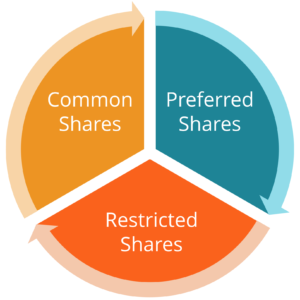
Authorized capital shares include all types of shares that can be issued, such as:
- Common shares
- Preferred shares
- Restricted shares
What are Common Shares?
Common shares are one of the types of securities that represent equity ownership in a corporation. Other terms, such as common stock, ordinary share, or voting share, all refer to common shares.
Holders of common shares have the right to claim a certain portion of a company’s earnings. The portion depends on the percentage of equity stake a shareholder holds in the company.
Common shares also give voting rights to a shareholder. In other words, an investor with a stake in a company, holding common shares, can participate in the elections of the board of directors during annual shareholder meetings and may have the right to vote on other company decisions.
What are Preferred Shares?
Preferred shares (also known as preferred stock or preference shares) are a type of security that is similar to common shares. The main difference is that preferred shares have a priority claim over the common shares on a company’s assets and earnings.
Preferred shares are senior to common shares because the holders of preferred shares are prioritized over the common shareholders in dividend payments.
It is important to remember that preferred shareholders do not have voting rights.
The main features of preferred shares are as follows:
- Preference in assets during liquidation (priority over common shareholders to claim assets if the company defaults)
- Preference in dividends (preferred shareholders are paid first, ahead of common shareholders but after any debt holders)
- No voting rights
- Convertible to common shares (can be converted to a predetermined number of common shares)
- Callable (can be repurchased by the issuer at certain dates in the future)
What are Restricted Shares?
Restricted shares are shares granted to mainly corporate officers, directors, and other senior executives. The shares are non-transferrable until certain conditions are met.
Examples of such conditions include the continued employment of a company’s director for a defined period, the company achieving a certain earnings per share (EPS)Earnings Per Share (EPS)Earnings per share (EPS) is a key metric used to determine the common shareholder's portion of the company’s profit. EPS measures each common share's profit figure, or any other financial goal for the company. Upon meeting the restriction requirements, the issuing company transfers the shares to the grantees.
Restricted shares serve as a great motivational tool for employees because, after receiving the shares, they automatically become owners of the company and, thus, receive voting rights. They will then feel more responsible for the company and its overall performance. It produces more motivation for them to work hard and achieve further corporate goals because it will proportionally make an impact on their worth as shareholders.
Additional Resources
CFI is the official provider of the global Financial Modeling & Valuation Analyst (FMVA)™Become a Certified Financial Modeling & Valuation Analyst (FMVA)®CFI's Financial Modeling and Valuation Analyst (FMVA)® certification will help you gain the confidence you need in your finance career. Enroll today! certification program, designed to help anyone become a world-class financial analyst. To keep advancing your career, the additional CFI resources below will be useful:
- Capital AccountsCapital AccountThe capital account is used to account for and measure any financial transaction within a country that isn’t exerting an active effect on that country’s savings, production, or income. The capital account – along with the current and financial accounts – make up the country’s balance of payments
- Non-Callable Preferred StockNon-Callable Preferred StockNon-callable preferred stock (also known as non-redeemable preferred stock) is a type of preferred stock shares that do not include a callable feature. In other words, the issuer of non-callable preferred shares does not have the option to buy back the issued shares
- Options: Calls and PutsOptions: Calls and PutsAn option is a derivative contract that gives the holder the right, but not the obligation, to buy or sell an asset by a certain date at a specified price.
- Stockholders EquityStockholders EquityStockholders Equity (also known as Shareholders Equity) is an account on a company's balance sheet that consists of share capital plus
-

Understanding Public Companies: A Comprehensive Guide
Public companies are entities that trade their stocks on the public exchange market. Investors can become shareholders in a public company by purchasing shares of the company’s stock. The compan
-

Understanding Redundant Assets: Definition & Impact on Business
Redundant assets are assets that generate incomeOperating IncomeOperating income is the amount of revenue left after deducting the operational direct and indirect costs from sales revenue. for the bus
finance
- Authorized Stock: Understanding Share Issuance Limits
- CCPPO Shares Explained: Understanding Cumulative, Convertible, & Participating Preferred Stock
- Understanding Company Bylaws: A Comprehensive Guide
- Understanding Earnings: A Guide to Financial Profitability
- Outstanding Shares: Definition & Importance for Investors
- Preferred Shares: A Comprehensive Guide for Investors
- Understanding Voting Shares: Your Right to Participate in Company Decisions
- Retired Shares: Definition, Impact & Accounting Methods
- Treasury Stock: Definition, Purpose, and Implications
-
 Understanding Forfeited Shares: Causes, Consequences, and Rights
Forfeited shares often result from when investors in equity shares fail to comply with pre-specified purchase agreements or restrictions. The end result of share forfeiture is that the shareholder no ...
-
 Understanding Provisions: A Guide to Financial Liabilities
Provisions represent funds put aside by a company to cover anticipated losses in the future. In other words, provision is a liability of uncertain timing and amount. Provisions are listed on a company...