
Quantitative Finance: Models, Data & Market Analysis
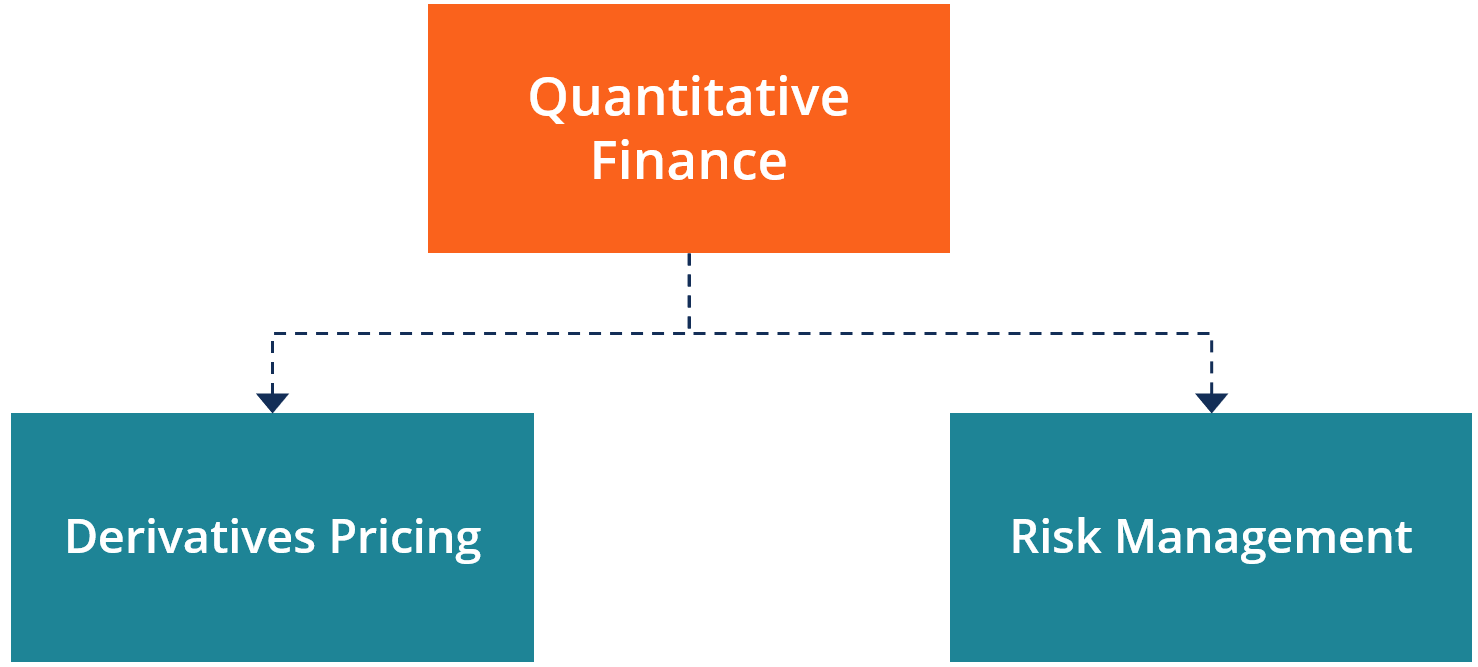
Quantitative finance is the use of mathematical models and extremely large datasets to analyze financial markets and securitiesTrading SecuritiesTrading securities are securities purchased by a company for the purpose of realizing a short-term profit. The securities are issued within the company's industry,. Common examples include (1) the pricing of derivative securities such as options, and (2) risk management, especially as it relates to portfolio management applications. Professionals who work in this field are often referred to as “QuantsQuantsQuantitative analysts (also called “quants”) are professionals specializing in the design, development, and implementation of algorithms and mathematical or statistical models intended to solve complex financial problems. In their work, quantitative analysts apply a blend of techniques and knowledge.”
Learn more in CFI’s Financial Analyst Training Courses.
Quantitative Finance vs Financial Engineering
Quantitative finance focuses on the mathematical models used to price securities and measure riskMarket Risk PremiumThe market risk premium is the additional return an investor expects from holding a risky market portfolio instead of risk-free assets.. Financial engineering goes one step further to focus on applications and build tools that will implement the results of the models.
Financial engineering combines the mathematical theory of quantitative finance with computational simulations to make price, trade, hedge, and other investment decisions.
Quantitative Analysts
A quantitative analyst uses mathematical models and applies them to financial marketsJapan Exchange GroupJapan Exchange Group is a Tokyo-based financial services corporation that operates different financial instruments exchange markets. It facilitates the trading of Japan’s financial securities under the country's Financial Instruments and Exchange Act. It was established in 2013 in order to support the trading and risk management departments that operate in banks and financial institutions.
A career as a quant requires a strong background in math, with analysts often getting advanced degrees such as a Master’s or Ph.D. in the field. These types of jobs are much less common than traditional financial analysts who work across the finance industry.
Specifically, quantitative finance analysts need to understand:
- Algorithms
- C++
- Differential equations
- Linear algebra
- Multi-variable calculus
- Probability theories
- Statistical analysis
Most large banks and financial institutions have quantitative finance analysts working in either operations or information technology (IT) departments, which means there are numerous career opportunities available. Smaller, boutique firms typically don’t have such analysts, so you’ll want to focus on the bulge bracket banks and other large institutions in your career search.
Additional Resources
CFI’s mission is to help you advance your career, and with that goal in mind, these additional CFI resources will be a big help:
- Equity Risk PremiumEquity Risk PremiumEquity risk premium is the difference between returns on equity/individual stock and the risk-free rate of return. It is the compensation to the investor for taking a higher level of risk and investing in equity rather than risk-free securities.
- High-Frequency Trading (HFT)High-Frequency Trading (HFT)High-frequency trading (HFT) is algorithmic trading characterized by high speed trade execution, an extremely large number of transactions,
- SpoofingSpoofingSpoofing is a disruptive algorithmic trading practice that involves placing bids to buy or offers to sell futures contracts and canceling the bids or offers prior to the deal’s execution. The practice intends to create a false picture of demand or false pessimism in the market.
- Systematic RiskSystematic RiskSystematic risk is that part of the total risk that is caused by factors beyond the control of a specific company or individual. Systematic risk is caused by factors that are external to the organization. All investments or securities are subject to systematic risk and therefore, it is a non-diversifiable risk.
-

Comprehensive Financial Planning: Your Path to Financial Security
A financial plan is a document that covers an individual’s current financial situation, short-term and long-term economic goals, and an in-depth strategy to achieve the goals. A finan
-

Understanding Financial Systems: Institutions & Key Players
A financial system is a network of financial institutions – such as insurance companies, stock exchanges, and investment banksList of Top Investment BanksList of the top 100 investment banks in
finance
- Understanding Risk Acceptance: A Comprehensive Guide
- Understanding AIRB: Advanced Internal Rating-Based Risk Modeling in Banking
- Understanding Auditors: Roles, Responsibilities & Audit Processes
- Understanding Credit Risk: Definition & Implications
- EBITDARM Explained: A Comprehensive Guide to Financial Analysis
- Understanding Finance: A Comprehensive Overview of Key Concepts
- Quantitative Finance: Models, Data & Market Analysis
- Understanding Systemic Risk: Causes, Impacts & Prevention
- Understanding Financial Risk: Types, Impacts, and Management
-
 Financial Mathematics: Applications & Quantitative Finance Explained
Financial mathematics describes the application of mathematics and mathematical modeling to solve financial problems. it is sometimes referred to as quantitative financeQuantitative FinanceQuantitativ...
-
 Understanding Financial Performance: A Comprehensive Overview
Financial performance is a complete evaluation of a company’s overall standing in categories such as assets, liabilities, equity, expenses, revenue, and overall profitability. It is measured thr...