
Reserve Funds: A Comprehensive Guide for Businesses & Individuals
A reserve fund refers to a savings account or highly liquid assets set aside to meet unexpected costs or financial obligations. Businesses, individuals, and condominium homeowners’ associations are common users of reserve funds.

Understanding Reserve Funds
Reserve funds are established to meet unexpected future costs or financial obligations that may occur. Additionally, they may be used to cover scheduled and routine expenses. Periodic deposits are usually made into the fund, and cash or highly liquid assets are drawn out as needed. Reserve funds are typically kept in a highly liquid account such as a savings accountSavings AccountA savings account is a typical account at a bank or a credit union that allows an individual to deposit, secure, or withdraw money when the need arises. A savings account usually pays some interest on deposits, although the rate is quite low..
For example, consider a business that makes bi-monthly $500 deposits into a reserve fund and faces an unexpected cost of $1,500 in August:
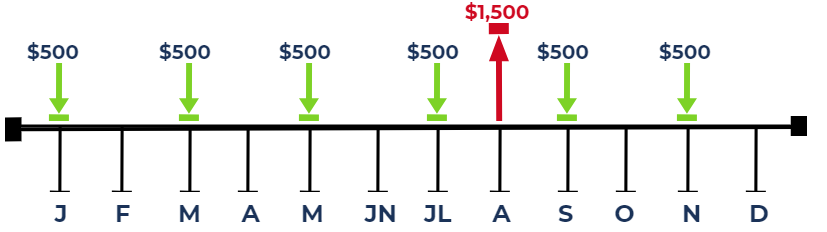
Through a reserve fund, the business is able to accumulate cash and pay off the unexpected financial obligation in August without having to draw cash from the business’s general operating fund.
Example
ABC Company is looking to establish a reserve fund due to the inconvenience of having to draw cash from the company’s general operating fund. The company anticipates paying expenses of $10,000 bi-annually related to third-party contracts. Currently, it is the beginning of 2027. Assuming no interest incomeInterest IncomeInterest income is the amount paid to an entity for lending its money or letting another entity use its funds. On a larger scale, interest income is the amount earned by an investor’s money that he places in an investment or project. or unexpected future costs, how much would the company need to deposit into the fund on a monthly basis?
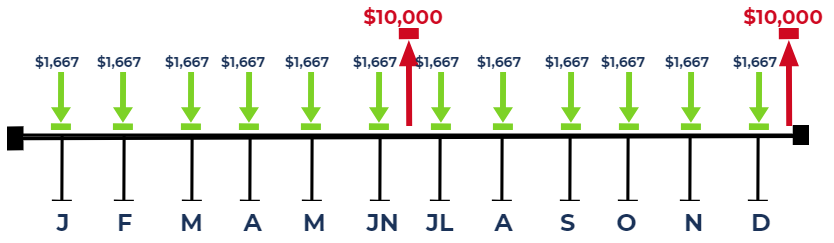
To meet expenses of $10,000 paid bi-annually, the company must deposit at least $1,667 every month into the reserve fund. By doing so, the company would have $10,002 ($1,667 x 6) to meet the $10,000 expense due at the end of July and $10,002 ($1,667 x 6) to meet the $10,000 expense due at the end of December.
At the end of the year, the company would have $4 ($1,667 x 12 – $10,000 x 2) remaining in the fund.
Reserves for Homeowners Associations
Condominium homeowners associations commonly use such funds to handle renovation projects, unexpected maintenance costs, emergencies, etc. In Ontario, Canada, the Condominium Act, 1998 requires all condominium complexes to maintain a reserve fund.
For condominiums, cash inflows are through:
- Common expenses fee contributions: Fees that unit owners pay that cover amenities, building insurance, property taxes, etc.
- Interest income from investing surplus funds
For a condominium complex, cash outflows are through:
- Major repairs
- Replacements of existing assets
The “Critical Year”
The reserve fund balance fluctuates year-over-year depending on financial obligations. Therefore, the fund’s balance may be high one year and low the next year.
In this context, a “critical year” refers to a year in which the fund’s balance is unusually low. Low is referenced relative to the average fund balance.
For example, assume that the average planned reserve fund balance is $100,000 for the period 2021-2026. Unexpectedly, in 2027, a major repair cost is incurred, dropping the fund’s balance to a low of $20,000. In this case, 2027 would be termed a “critical year.”
Additional Resources
CFI is the official provider of the Financial Modeling and Valuation Analyst (FMVA)™Become a Certified Financial Modeling & Valuation Analyst (FMVA)®CFI's Financial Modeling and Valuation Analyst (FMVA)® certification will help you gain the confidence you need in your finance career. Enroll today! certification program, designed to transform anyone into a world-class financial analyst.
To keep learning and developing your knowledge of financial analysis, we highly recommend the additional CFI resources below:
- Fixed and Variable CostsFixed and Variable CostsCost is something that can be classified in several ways depending on its nature. One of the most popular methods is classification according
- Idle CashIdle CashIdle cash is, as the phrase implies, cash that is idle or is not being used in a way that can increase the value of a business. It means that the cash is not earning interest from sitting in savings or a checking account, and is not generating a profit in the form of asset purchases or investments. The cash is simply sitting in a form where it does not appreciate.
- Projecting Balance Sheet Line ItemsProjecting Balance Sheet Line ItemsProjecting balance sheet line items involves analyzing working capital, PP&E, debt share capital and net income. This guide breaks down how to calculate
- Restricted CashRestricted CashRestricted cash refers to cash that is held onto by a company for specific reasons and is, therefore, not available for immediate ordinary business use. It can be contrasted with unrestricted cash, which refers to cash that can be used for any purpose.
-

Floating Rate Funds: Understanding & Investing in Variable Interest Rates
A floating rate fund is a type of mutual fund that invests in securities paying fluctuating interest rates. Floating rate funds primarily invest in debt instrumentsDebt InstrumentA debt instrument is
-

Understanding Foreign Funds: Investing in Global Markets
A foreign fund refers to a fund that invests in businesses outside the country of origin of the investor. They can be exchange-traded funds, closed-end funds, or mutual fundsMutual FundsA mutual fund
finance
- Emergency Fund: What It Is & Why You Need One
- Sinking Funds: Definition, Purpose & How They Work
- Endowment Funds: A Comprehensive Guide for Investors & Donors
- Hedge Funds Explained: Strategies, Risks & Investment
- NFO Explained: Understanding New Fund Offers & Investment
- No-Load Funds: Understanding Commission-Free Mutual Funds
- Sinking Funds: Definition, How They Work & Benefits
- Understanding Vice Funds: A Guide to Controversial Investments
- Commingled Funds: Understanding Pooled Investment Strategies
-
 Understanding Annual Turnover: A Key Fund Performance Metric
Annual turnover is a measurement to describe a fund’s annual trading activity. It is a percentage used to demonstrate how many holdings a mutual fundMutual FundsA mutual fund is a pool of money ...
-
 Equity Funds: A Comprehensive Guide to Investing in Stocks
An equity fund refers to an investment fund that is primarily invested in equities or stocks. It is usually categorized by different investment styles, market capitalizationMarket CapitalizationMarket...