
Equity Funds: A Comprehensive Guide to Investing in Stocks
An equity fund refers to an investment fund that is primarily invested in equities or stocks. It is usually categorized by different investment styles, market capitalizationMarket CapitalizationMarket Capitalization (Market Cap) is the most recent market value of a company’s outstanding shares. Market Cap is equal to the current share price multiplied by the number of shares outstanding. The investing community often uses the market capitalization value to rank companies ranges, or different geographies. Equity funds are also referred to as stock funds.

Understanding Equity Funds
Equity funds are pools of capital that many investors can invest together in gaining specific exposures to equity investments. Such funds are ideal for investors who lack investing acumen and hold smaller amounts of capital that they want to invest, yet still would like to achieve a higher return.
Different retail or everyday investors possess different risk tolerances and time horizons. It leads to differing goals and desired exposures from such investors. Equity funds are aimed at providing investors with different exposures in order to meet their goals.
Structure of Equity Funds
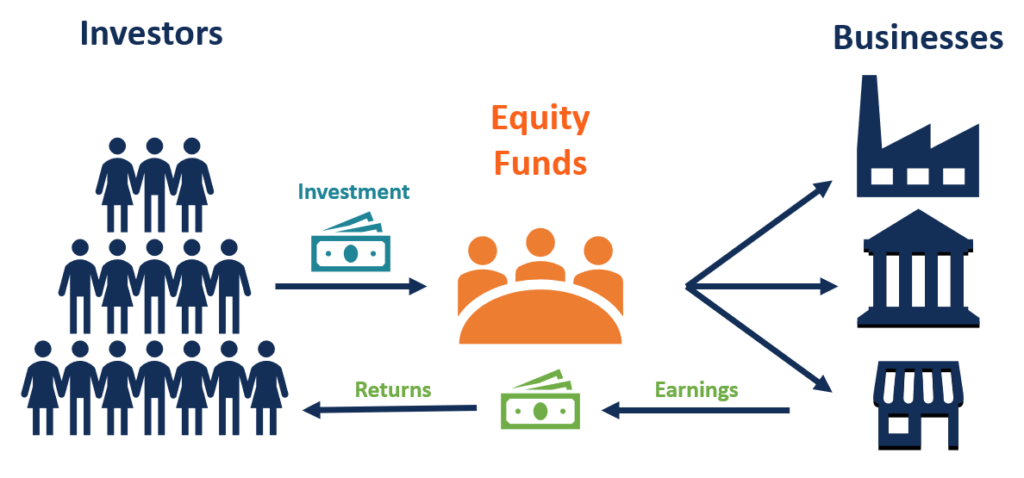
Equity funds facilitate investment by gathering capital from investors into a single fund and investing the capital into various businesses. The returns from businesses in the form of earnings and dividendsDividendA dividend is a share of profits and retained earnings that a company pays out to its shareholders. When a company generates a profit and accumulates retained earnings, those earnings can be either reinvested in the business or paid out to shareholders as a dividend. are collected by the equity funds and passed through back to the investors.
Equity funds usually take a management fee, which varies depending on the level of involvement of the equity fund in the investment process.
Prices of equity funds are determined based on the fund’s net asset value (NAV), which is calculated by assessing the fund’s total assets, minus its total liabilities. Generally, equity funds are managed by portfolio managers with extensive experience investing in the financial markets and with their track record published publicly.
Types of Equity Funds
Equity funds can be distinguished by certain fund characteristics. Some common ways of classifying funds are by:
- Geography – Can be focused on a single domestic country – e.g., the United States – or can be focused on many different countries – e.g., Internationally.
- Market Capitalization (Size) – Can be focused on different market capitalization companies – e.g., small-cap, large-cap, etc.
- Investment Style – Can be focused on different investment strategies – e.g., value-style, income-funds, growth-style, low-volatility, etc.
- Sectors or Industries – Can be focused on different industries – e.g., technology, real estate, and commoditiesCommoditiesCommodities are another class of assets just like stocks and bonds. Most commodities are products that come from the earth that possess.
After considering the different characteristics above, investors can invest in equity funds that are tailored to their preferences. It gives investors many different options for how they want to invest their capital.
Investors can receive very preferential investment options, including modifying the return and risk objectives. However, they can also receive exposure based on certain interests – political, religious, or brand-oriented.
For example, some vegan investors may not be comfortable investing in any businesses with affiliation to the factory-farming industry; therefore, they can invest in equity funds that specifically avoid companies that are associated with factory-farming.
Active Funds vs. Passive Funds
Equity funds can be either actively managed or passively managed.
Active Management
Active management refers to when there is a portfolio manager who picks individual equities for the equity fund to invest in, with the goal of beating some form of benchmark.
Active management is characterized by attempting to achieve an “above-average” return by identifying mispriced equities and investing based on those mispricings.
Buying undervalued stocks and short-selling overvalued stocks should, in theory, allow active managers to achieve above-average returns.
Advantages
- It allows investors the possibility to outperform the market and achieve excess risk-adjusted returns.
- It allows investors to manage volatility and risk differently than the overall market.
- It allows investors to follow a strategy that may align more closely with their personal investment goals.
- It allows investors to gain more diverse exposures that may not be captured by indexes.
Disadvantages
- It usually underperforms passive management, so it is unlikely that investors can achieve excess returns through active management.
- Actively-managed funds that become very large begin to show index-like characteristics, which negates the purpose of investing in an actively-managed fund.
- It requires more fees to be paid by investors to compensate for the infrastructure of portfolio managers, analysts, tools, and operations.
Passive Management
Passive management refers to when the equity fund simply tracks equities that are contained within an index. An index is essentially a basket of equities whose performances are tracked to provide insight into the returns of certain sectors, markets, or geographies.
Passive management is characterized by not reacting to capital market expectations. For example, if a portfolio is tied to the S&P 500 index (representing the U.S. equity markets), it may add or drop holdings in response to the index’s composition, but it will not respond to changes in capital market expectations of individual stocks within the S&P 500.
Additional Resources
CFI is the official provider of the global Commercial Banking & Credit Analyst (CBCA)™Program Page - CBCAGet CFI's CBCA™ certification and become a Commercial Banking & Credit Analyst. Enroll and advance your career with our certification programs and courses. certification program, designed to help anyone become a world-class financial analyst. To keep advancing your career, the additional CFI resources below will be useful:
- Equity FinancingEquity FinancingEquity financing refers to the sale of company shares in order to raise capital. Investors who purchase the shares are also purchasing
- NAV (Net Asset Value)NAV (Net Asset Value)NAV (Net Asset Value) refers to the total equity of a business. While NAV can be applied to any entity, it is mostly used to reference investment funds,
- Economic CapitalEconomic CapitalEconomic capital is a risk measure that is defined in terms of capital. It is essentially the amount of capital that a financial company requires to
- Portfolio ManagerPortfolio ManagerPortfolio managers manage investment portfolios using a six-step portfolio management process. Learn exactly what does a portfolio manager do in this guide. Portfolio managers are professionals who manage investment portfolios, with the goal of achieving their clients’ investment objectives.
-

Hedge Funds Explained: Strategies, Risks & Investment
A hedge fund, an alternative investment vehicle, is a partnership where investors (accredited investors or institutional investors) pool money together, and a fund manager deploys the money in a varie
-

NFO Explained: Understanding New Fund Offers & Investment
An NFO (new fund offer) is a call for investors made by an asset management company (AMC) to invest money into a new fund. An AMC is an enterprise that collects money from different clients and places
invest
- Hedge Funds Explained: A Comprehensive Guide for Investors
- Interval Funds: Understanding Illiquidity & High Yields
- Understanding Foreign Funds: Investing in Global Markets
- Fund of Funds (FOF): A Comprehensive Guide for Investors
- Income Funds: A Comprehensive Guide to Current Income Investments
- Understanding Private Equity Funds: An Investor's Guide
- Quantitative Funds: A Deep Dive into Algorithmic Investing
- Equity Funds: Investing in Stocks for Growth | [Your Company Name]
- Quantitative Funds (Quant Funds): An In-Depth Explanation
-
 Endowment Funds: A Comprehensive Guide for Investors & Donors
An endowment fund is an investment portfolio with the initial capital deriving from donations. Endowment funds are established to fund charitable and nonprofit institutions such as churches, hospitals...
-
![Growth Equity: Investing in Expanding Businesses | [Your Company Name]](https://www.etffin.com/article/uploadfiles/202110/2021100815235075_S.jpeg) Growth Equity: Investing in Expanding Businesses | [Your Company Name]
Growth Equity: Investing in Expanding Businesses | [Your Company Name]Growth equity (also known as growth capital or expansion capital) is a type of investment opportunity in relatively mature companies that are going through some transformational event in their lifecyc...