
Bottom-Up Budgeting: A Comprehensive Guide
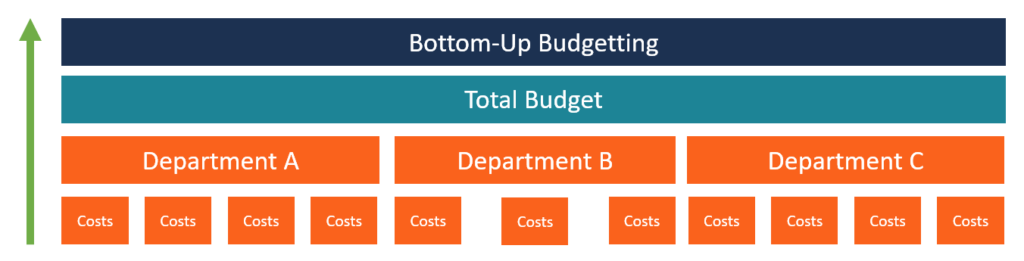
Bottom-up budgeting is a budgeting method that starts at the department level, moving up to the top level. Each department within the organization is required to compile a list of the things it needs, the projects it plans to carry out in the next financial periodFiscal Year (FY)A fiscal year (FY) is a 12-month or 52-week period of time used by governments and businesses for accounting purposes to formulate annual, and cost estimates. The estimates of all the departments are then summed up to get the overall company budget. The managers of each department are required to give their input since they know the cost estimates for the projects to be implemented.
How to Create a Bottom-up Budget
The following is the basic process that organizations follow when formulating a bottom-up budget:
1. Identify the individual components of the business
The first step when creating a bottom-up budget is to identify the individual components of the business and projects that the organization plans to carry out in the coming financial year. List the components and projects and establish the estimated cost to be incurred.
For example, a department may include costs like wages for employees, furniture and fittings, equipment purchases and hires, administrative costsSG&ASG&A includes all non-production expenses incurred by a company in any given period. It includes expenses such as rent, advertising, marketing, conference fees, etc. If the organization uses individual projects to get budget estimates, it must first obtain a list of all projects to be carried out in the coming year and then come up with cost estimates for each project.
2. Get a sum of cost projections of each department
After departments finish preparing a list of planned projects and expenditures, the costs should be added up to get the total budget for the department. For example, the cost estimates of the human resource departmentHuman Resource ManagementHuman Resource Management (HRM) is a collective term for all the formal systems created to help in managing employees and other stakeholders within a may include $10,000 for recruiting personnel, $20,000 for employee salaries, and $6,000 for administrative costs, bringing the department’s total budget to $36,000. The departmental managers of other departments should come up with the totals for their respective departments.
3. Sum up the budgets of all departments
After getting the budgets of all the departments or identified projects, the budgets should be summed up to get the overall budget for the organization. The totals should be obtained from the departmental heads or head of projects appointed by the organization’s management.
4. Submit for approval
The final stage of the bottom-up budgeting process is submitting the budget estimates to the management for approval. When reviewing the budget, management is interested in knowing if the budgets are aligned with the goals and objectives that the company wants to achieve in the next financial period.
If satisfied with the budget, the management will approve the budget estimates and send it to the finance department to make allocations to individual departments. However, if the company’s leadership is not satisfied with the budget estimates, they can ask the departmental managers to make necessary changes before the budget is again submitted for approval.
Advantages of Bottom-up Budgeting
The following are some of the benefits that organizations receive when they use bottom-up budgeting:
1. Better accuracy
Bottom-up budgeting calculates budget estimates from the lowest level, which helps boost the accuracy and accountability of the budget. The process involves all the individuals in each department. The estimates given will be as close as possible to reality since the employees are better placed to understand the costs, resources, expenses, and requirements of their respective departments. When the estimates for all departments are added up to get the overall budget, the senior management should know what to expect in the coming year.
2. Employee motivation
When employees are involved in the budget-making process, they are motivated to work hard to achieve the organization’s goals. The employees in each department of the organization are involved in formulating the budget estimates, giving them a sense of ownership in the budget-making process.
Bottom-Up vs. Top-down Budgeting
Top-down budgetingTop-Down BudgetingTop-down budgeting refers to a budgeting method where senior management prepares a high-level budget for the company. The company’s senior management prepares the budget based on its objectives and then passes it on to department managers for implementation. and bottom-up budgeting are the two most popular types of budgets in corporate budgeting. Top-down budgeting starts with the senior management creating a budget for the entire organization and allocating budgets to the departments.
The departments are then required to create their own budget estimates that are confined to the amounts allocated by the top management. Although the top-down budgeting process takes less time, some departments may struggle to fit into the amounts allocated by management, since management may not be aware of all the associated costs a department may incur.
Bottom-up budgeting gives the departmental heads more power in contributing to the organizational budget. The department-level budget estimates are summed up to get the overall organizational budget that is sent to the senior management for approval.
The bottom-up budgeting process allows employees to own the process since they are familiar with the expenditures at the departmental levels. They will also be motivated to work hard since they feel that their input in the organization is valued by the management. On the downside, the departments may produce budgets that are off-target and not in-line with the company’s objectives. The budget may need to be modified to reflect the company objectives and remove unnecessary expenditures.
More Resources
CFI is the official provider of the Financial Modeling and Valuation Analyst (FMVA)™Become a Certified Financial Modeling & Valuation Analyst (FMVA)®CFI's Financial Modeling and Valuation Analyst (FMVA)® certification will help you gain the confidence you need in your finance career. Enroll today! certification program, designed to transform anyone into a world-class financial analyst.
To keep learning and developing your knowledge of financial analysis, we highly recommend the additional CFI resources below:
- Employee MoraleEmployee MoraleEmployee morale is defined as the overall satisfaction, outlook, and feelings of well-being that an employee holds in the workplace. In other
- Imposed BudgetingImposed BudgetingImposed budgeting, also known as top-down budgeting, is the process wherein the top management of a company prepares a budget and then imposes it on lower-level managers for implementation. It starts at the top, where the budget is prepared by senior management
- Negotiated BudgetingNegotiated BudgetingNegotiated budgeting is a budgeting process that combines both top-down budgeting and bottom-up budgeting. The negotiated budgeting process does not impose the budget preparation process on a single level, but rather allows shared responsibility between superiors and subordinates.
- Types of BudgetsTypes of BudgetsThere are four common types of budgeting methods that companies use: (1) incremental, (2) activity-based, (3) value proposition, and (4)
-
Business Budgeting: A Comprehensive Guide to Planning & KPIs
Budgeting is the tactical implementation of a business plan. To achieve the goals in a business’s strategic planCorporate StrategyCorporate Strategy focuses on how to manage resources, risk and
-
![Budgeting Software: Types, Features & Comparison - [Year]](https://www.etffin.com/article/uploadfiles/202110/2021100815344465_S.jpeg)
Budgeting Software: Types, Features & Comparison - [Year]
Budgeting software is any computer program that helps an individual or business design, manage, monitor and alter their budgetTypes of BudgetsThere are four common types of budgeting methods that comp
finance
- Understanding Balanced Budgets: Definition & Importance
- Imposed Budgeting: Definition, Pros & Cons | [Your Company Name]
- Negotiated Budgeting: A Collaborative Approach to Financial Planning
- Output/Input Budgeting: A Comprehensive Guide
- Participative Budgeting: Definition, Benefits & Implementation
- Top-Down Budgeting: Definition, Advantages & Disadvantages
- Zero-Based Budgeting (ZBB): A Comprehensive Guide
- Zero-Based Budgeting: A Comprehensive Guide for Businesses
- Incremental Budgeting: Pros, Cons & Why It's Often Problematic
-
 Advertising Budget: Definition, Planning & Best Practices
An advertising budget is a company’s allocation of promotional expenditures over a specified time period. It is a measure of a company’s planned expenditure on accomplishing marketing obje...
-
 Understanding Budget Deficits: Causes, Effects & Solutions
A budget deficit occurs when government expenditures exceed revenues from taxes and other sources. Although the concept of a budget deficit applies to any organization with operating revenues and expe...