
Balancer (BAL): A Deep Dive into Automated Market Making
Other DeFi platforms like Uniswap and Curve also support AMM. Bringing Balancer as an AMM into Ethereum’s DeFi ecosystem, the assets in a market, along with the algorithm controlling that market, and the ability to create such a market all become decentralized.
Balancer stands out because its growing assets per market, and growing, along with custom trading fees set by the pool creator.
As between Uniswap and Balancer, please see the table below:
Features Uniswap Balancer Labs Supported assets ETH & ERC20 ETH & ERC20 # supported assets per LP 2 8 Weighing of LP assets 1:1 Arbitrary LP token Yes (for bookeeping) Yes (functional ERC-20 token) Price oracle No outside oracle, asset prices change based on trades No outside oracle, asset prices change based on trades Trading fees 0.3% Set by the liquidity pool creator Protocol fees No No Native token No NoUniswap vs. Balancer Labs. Source: Token Terminal
The “Flywheel Effect” and Balancer Pools
Under the pooling system, users create the “flywheel” network effect, resulting in increased liquidity, traders, fees, and profits for liquidation pools (LPs). Consequently, users can use pools in two different ways:
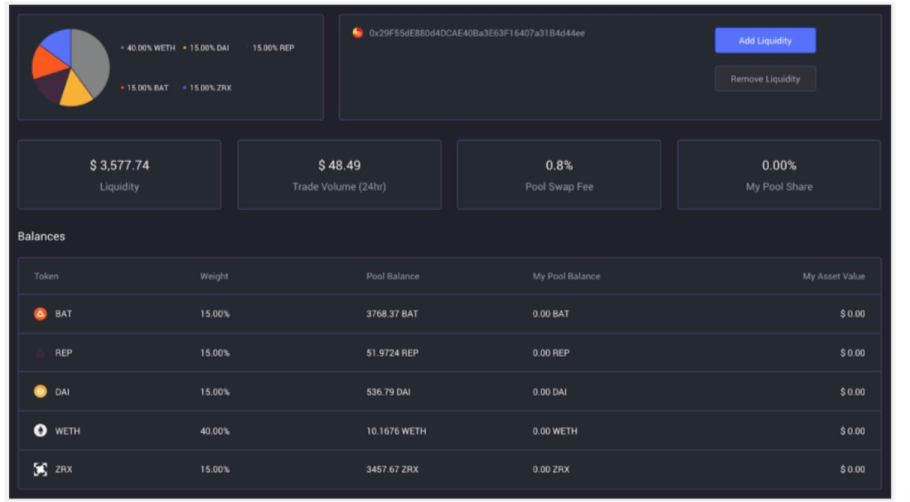
Example Balancer pool with five assets: Basic Attention Token, Augur’s REP, DAI, Wrapped Ethereum, and 0x’s ZRX
#1 - Providing Liquidity
Users are able to deposit supported assets* into pools, providing liquidity to users of the pool. For those users who choose to deposit their assets into the pool, they earn a fee. However, when users provide liquidity, there’s never a guarantee they keep their assets, as there are cases where some liquidity providers may lose them.
#2 - Trading
Pools also allow for users to trade tokens, with Balancer’s smart order routing system, which helps ensure the exchange of crypto at low fees and at quick speeds.
Comparing Balancer to centralized exchanges like Coinbase and Binance, which use order books to derive prices (think of Kelly Blue Book for motor vehicles). The price of tokens in a pool is based on their deviation from their set weighting. Based on Balancer’s flexible parameters, pools serve as more than just a locale for crypto holders to exchange their assets. Balancer Labs has released pool schematics to remove the risk of LPs losing their assets.
-
Understanding Hard Assets: Definition, Examples & Investment
Hard assets are physical or tangible assets that hold value and are normally held for the long term. In addition to tangibility, they are also visible and are considered an investable asset because of
-
Trading Assets: Definition, Types & How They Work
Trading assets are securities that firms hold to resell for profit, rather than holding them for investment. They include different account components from the investment portfolio. Trading
Fund information
- Investable Assets: A Comprehensive Guide for Investors
- Understanding Deficit Equity: Causes, Impacts & Solutions
- Asset Dissipation: Financing Your Home with Liquid Assets
- Understanding Household Assets: A Comprehensive Guide
- Understanding Momentum in Finance: A Comprehensive Guide
- Understanding Asset Impairment: Causes and Impact
- Understanding Trusts: A Comprehensive Guide to Asset Management & Estate Planning
- Balancer: Understanding Decentralized Crypto Indexing & Automated Portfolio Management
- Balancer (BAL): DeFi Portfolio Management & Automated DEX Solutions
-
 Understanding Quick Assets: Definition & Examples
Quick assets are those assets that can be converted into cash within a short period of time. The term is also used to refer to assets that are already in cash form. They are considered to be the most ...
-
 Arbitrageurs: Understanding Market Inefficiencies & Profit Opportunities
An arbitrageur is an individual who earns profits by taking advantage of inefficiencies in financial marketsNew York Stock Exchange (NYSE)The New York Stock Exchange (NYSE) is the largest securities e...