
Arbitrageurs: Understanding Market Inefficiencies & Profit Opportunities
An arbitrageur is an individual who earns profits by taking advantage of inefficiencies in financial marketsNew York Stock Exchange (NYSE)The New York Stock Exchange (NYSE) is the largest securities exchange in the world, hosting 82% of the S&P 500, as well as 70 of the biggest. Arbitrage opportunities arise when an asset is priced differently between multiple markets at the same time. Such price differences are inefficiencies resulting from deficiencies in the marketplace.

A successful arbitrageur profits by simultaneously purchasing financial assets at a lower price and selling them at a higher price, pocketing the difference. By taking advantage of the inefficiencies, arbitrageurs can earn risk-free profits because the financial assets being traded are equivalent. In turn, the actions of the arbitrageur result in greater market efficiency by causing asset prices to equalize.
Summary
- An arbitrageur is an individual who profits through inefficiencies in the financial markets.
- Arbitrage trades are generally risk-free because the transactions occur simultaneously to ensure prices do not change.
- When enough arbitrage trades are conducted, the mispriced assets between two markets will equalize to maximize market efficiency.
How Does Arbitrage Work?
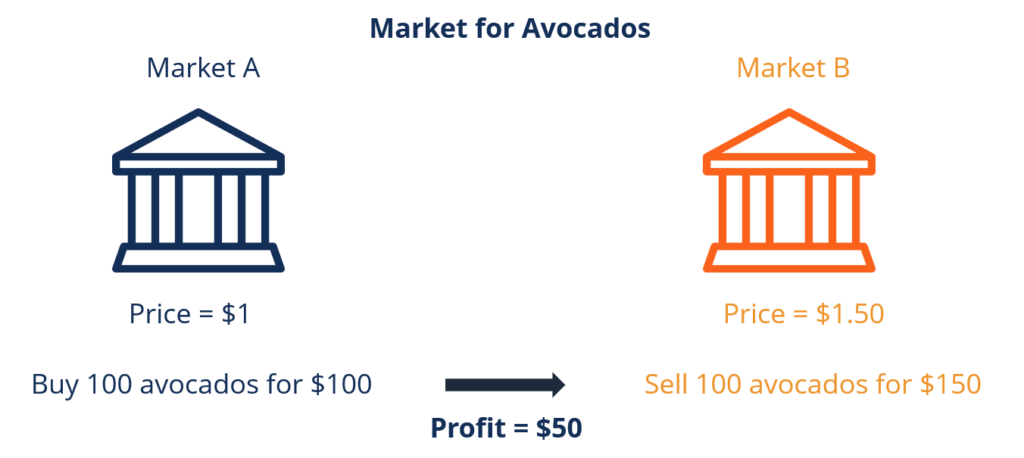
The concept of arbitrage is quite simple. By taking advantage of price differences in equivalent assets, an arbitrageur can make risk-free profits by buying low and selling high.
Suppose you can buy avocados from a farm at $1.00 each. Soon after, you sell the avocados to a local restaurant at $1.50 each. In this case, you earn a profit of 50 cents for each avocado you sell.
Financial arbitrage is similar, but the prices of financial assets can change on a moment’s notice. To take advantage of price differences in assets like stocksStockWhat is a stock? An individual who owns stock in a company is called a shareholder and is eligible to claim part of the company’s residual assets and earnings (should the company ever be dissolved). The terms "stock", "shares", and "equity" are used interchangeably., the transactions must occur simultaneously to ensure that the prices do not change during the transaction.
What Does an Arbitrageur Do?
An arbitrageur uses trading strategies designed to profit from small differences in the price of equivalent assets. The assets can be stocks, bonds, currencies, commodities, or any other financial instruments that can be bought and sold. Deficiencies in financial markets, such as delays in updating stock prices, can result in prime opportunities for an arbitrageur.
To conduct arbitrage, an investor purchases stocks on one exchange while simultaneously selling the same stock on another exchange. If the transaction happens simultaneously, there is no chance that the stock price will change during the transaction. By selling the same stock at a higher price, the arbitrageur can earn a risk-free profit equal to the difference between the mispriced assets.
Due to the incremental price differences and time-sensitive nature, most arbitrage trades involve institutional investors, such as hedge fundsHedge FundA hedge fund, an alternative investment vehicle, is a partnership where investors (accredited investors or institutional investors) pool or banks. For most retail investors who trade stocks on their smartphones, arbitrage trades are difficult because of the significant technical resources required to trade simultaneously between various stock exchanges.
Also, the price difference between the two financial assets can be minuscule. Large sums of money are required to take advantage of small price differences to ensure that arbitrage trades are profitable and worthwhile.
Effects of Arbitrage
By taking advantage of market inefficiencies, arbitrageurs help the financial system by causing prices to equalize through a system of supply and demandSupply and DemandThe laws of supply and demand are microeconomic concepts that state that in efficient markets, the quantity supplied of a good and quantity. When an arbitrageur buys an asset from cheaper markets and sells the same asset in more expensive markets, the demand for the asset in the cheaper market will increase, causing prices to go up. In contrast, the more expensive market will see an increase in supply, causing prices to decrease.
If enough arbitrage trades are conducted, the prices of assets between the two markets will equalize and maximize overall efficiency. When market prices are equalized with no potential for arbitrage, it is known as an arbitrage equilibrium.
Arbitrageur Example
Differences in stock prices typically result from companies that are dual-listed on multiple stock exchanges. Let’s say that shares of Company XY are priced at $165.40 per share on the New York Stock Exchange (NYSE). On the Toronto Stock Exchange (TSX), Company XY shares are priced at $165.75 per share (all prices are converted to USD).
In such a case, an arbitrageur can make a profit of $0.35 for every share they can trade. If the arbitrageur can purchase 50,000 shares from the TSX, they can make a profit of $17,500 by reselling the shares on the NYSE.
More Resources
CFI offers the Commercial Banking & Credit Analyst (CBCA)™Program Page - CBCAGet CFI's CBCA™ certification and become a Commercial Banking & Credit Analyst. Enroll and advance your career with our certification programs and courses. certification program for those looking to take their careers to the next level. To keep learning and developing your knowledge base, please explore the additional relevant resources below:
- Calendar SpreadCalendar SpreadA calendar spread involves the buying of a derivative of an asset in one month and selling a derivative of the same asset in another month.
- Institutional InvestorInstitutional InvestorAn institutional investor is a legal entity that accumulates the funds of numerous investors (which may be private investors or other legal entities) to
- Momentum InvestingMomentum InvestingMomentum investing is an investment strategy aimed at purchasing securities that have been showing an upward price trend or short-selling securities that
- Spread TradingSpread TradingSpread trading – also known as relative value trading – is a method of trading that involves an investor simultaneously buying one security and selling a
-

Understanding Non-Monetary Assets: Definition & Examples
Non-monetary assets are assets whose value frequently changes in response to changes in economic and market conditions. The assets appear on the balance sheet under intangible and non-current assetsNo
-
Understanding Quick Assets: Definition & Examples
Quick assets are those assets that can be converted into cash within a short period of time. The term is also used to refer to assets that are already in cash form. They are considered to be the most
invest
- Investable Assets: A Comprehensive Guide for Investors
- Arbitrage Explained: Understanding and Capitalizing on Price Differences
- Understanding Hard Assets: Definition, Examples & Investment
- Understanding Momentum in Finance: A Comprehensive Guide
- Trading Assets: Definition, Types & How They Work
- Triangular Arbitrage: Definition, Strategy & How It Works
- Volatility Arbitrage: A Deep Dive into Options Trading Strategies
- Understanding Asset Impairment: Causes and Impact
- Understanding Trusts: A Comprehensive Guide to Asset Management & Estate Planning
-
 Fixed Capital: Definition, Examples & Importance
Fixed capital, or fixed assets or capital assets, refers to a company’s long-term assets, such as land, buildings, or equipment that is used in producing goods or services. SummaryFix...
-
 Monetary Assets: Definition, Examples & Key Characteristics
Monetary assets are assets that carry a fixed value in terms of currency units (e.g., dollars, euros, yen). They are stated as a fixed value in dollar terms even when macroeconomic factors, such as in...