
Understanding Hedge Fund Fees: The 2 and 20 Structure
The 2 and 20 is a hedge fund compensation structure consisting of a management fee and a performance fee. 2% represents a management fee which is applied to the total assets under management. A 20% performance fee is charged on the profitsCapital Gains YieldCapital gains yield (CGY) is the price appreciation on an investment or a security expressed as a percentage. Because the calculation of Capital Gain Yield involves the market price of a security over time, it can be used to analyze the fluctuation in the market price of a security. See calculation and example that the hedge fund generates, beyond a specified minimum threshold.
Again, the 2% fee is charged on the assets under managementMarketable SecuritiesMarketable securities are unrestricted short-term financial instruments that are issued either for equity securities or for debt securities of a publicly listed company. The issuing company creates these instruments for the express purpose of raising funds to further finance business activities and expansion. regardless of the performance of the investments under the fund managerPortfolio ManagerPortfolio managers manage investment portfolios using a six-step portfolio management process. Learn exactly what does a portfolio manager do in this guide. Portfolio managers are professionals who manage investment portfolios, with the goal of achieving their clients’ investment objectives.. However, the 20% fee is only charged when the fund achieves a certain level of profit.
The graphic below should make the compensation structure clear.
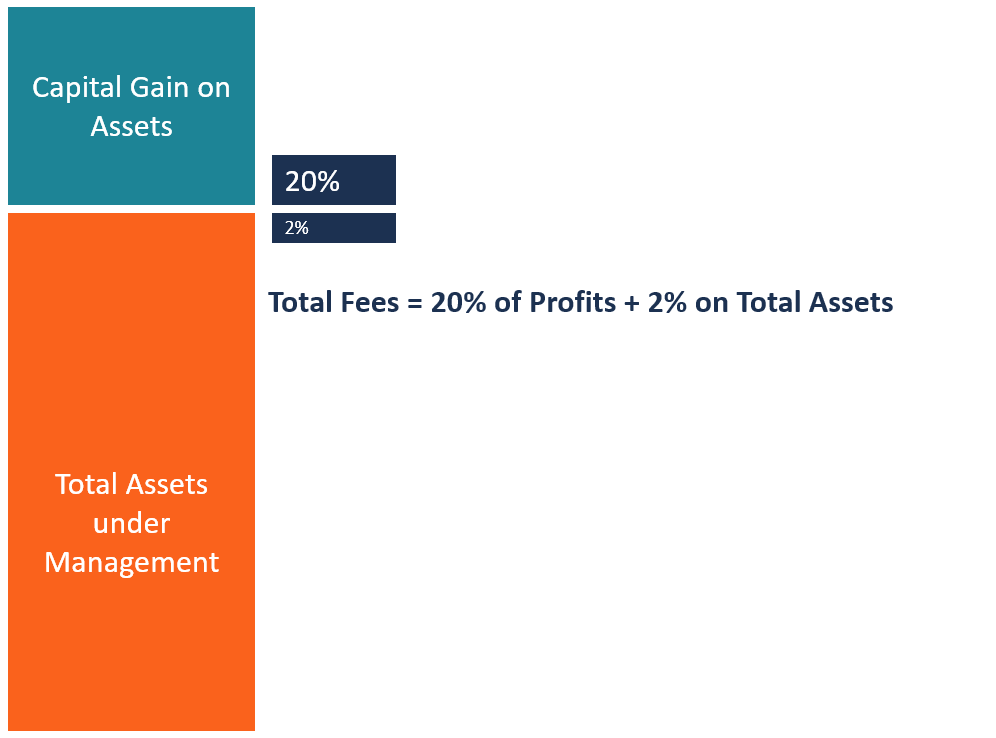
How the 2 and 20 Hedge Fund Fee Structure Works
The 2 and 20 fee structure helps hedge funds finance their operations. The 2% flat rate charged on total assets under management (AUM) is used to pay staff salaries, administrative and office expenses,SG&ASG&A includes all non-production expenses incurred by a company in any given period. It includes expenses such as rent, advertising, marketing and other operational expenses. The 20% performance fee is used to reward the hedge fund’s key executives and portfolio managers. This bonus structure is what makes hedge fund managers some of the highest paid financial professionals.
How the 20% Performance Fee is Calculated
The 20% performance fee is the biggest source of income for hedge funds. The performance fee is only charged when the fund’s profits exceed a prior agreed-upon level. A common threshold level used is 8%. That means that the hedge fund only charges the 20% performance fee if profits for the year surpass the 8% level.
For example, assume a fund with an 8% threshold level generates a return of 15% for the year. Then the 20% performance fee will be charged on the incremental 7% profit above the 8% threshold. If the hedge fund manages assets of 10 large investors and makes a sizeable profit, its income for the year may run into millions – sometimes billions – of dollars.
Justification of the 2 and 20 Fee Structure
Some investors consider the common 2 and 20 hedge fund fee structure excessively high. Nonetheless, the industry has generally maintained this compensation structure over the years. It is able to do so primarily because hedge funds have consistently been able to generate high returns for their investors. Therefore, clients have been willing to put up with the fees, even if they consider them somewhat exorbitant, in order to obtain very favorable returns on investment. (ROI)
Renaissance Technologies, a hedge fund managed by Jim Simmons, maintained an average annual return of 71.8% between 1994 and 2015. Its worst year during the period still showed a 21% profit. Because of the high yields delivered to investors, they were willing to pay performance fees up to 44%.
Criticisms against the 2 and 20 Fee Structure
Both investors and politicians have put hedge funds under pressure for their 2 and 20 compensation structure in recent years. This is largely due to the fact that, in the wake of the 2008 financial crisis, hedge funds – like many other investments – have struggled to perform at optimally high levels. As a result, an increasing number of investors have sought out hedge funds that charge fees lower than the traditional 2 and 20.
Politicians have sought a larger cut of hedge fund profits, seeking to have them taxed as ordinary income rather than at the lower capital gains rate. As of 2018, the hedge fund industry has been able to maintain the lower tax rate, arguing that their income is not a fixed salary and is based on performance.
Alternative Hedge Fund Fees Structures
Some of the alternative fee structures adopted by some hedge funds are as follows:
1. Founders Shares
Startup and emerging hedge funds offer incentives to interested investors during the early stages of their business. These incentives are known as “founders shares”. The founders shares entitle investors to a lower fee structure, such as “1.5 and 10” rather than “2 and 20”. Another option is to use the 2 and 20 fee structure but with a promise to reduce the fee when the fund reaches a specific milestone. For example, the fund might charge 2 and 20 on profits up to 20%, but only charge “2 and 15” on profits beyond the 20% level.
3. Discounts for Capital Lockup
A hedge fund may decide to offer a substantial discount to investors who are willing to lock up their investments with the company for a specified time period, such as five, seven, or 10 years. This practice is most common with hedge funds whose investments typically require longer time frames to generate a significant ROI. In exchange for the longer lockup period, clients benefit from a reduced fee structure.
High watermark clause
Most hedge funds include a watermark clause that states that a hedge fund manager can only charge performance fees after the fund has generated new profits. If the fund incurs losses, it must recover the losses before charging performance fees.
Additional resources
We hope you’ve enjoyed CFI’s explanation of the 2 and 20 hedge fund compensation structure. CFI is the official provider of the global Financial Modeling & Valuation Analyst (FMVA)™Become a Certified Financial Modeling & Valuation Analyst (FMVA)®CFI's Financial Modeling and Valuation Analyst (FMVA)® certification will help you gain the confidence you need in your finance career. Enroll today! certification program, designed to help anyone become a world-class financial analyst. To keep learning and advancing your career, the additional CFI resources below will be useful:
- Private Equity vs Hedge FundPrivate Equity vs Hedge FundCompare private equity vs hedge fund in terms of investors, risk, liquidity, time horizon, compensation structure, careers and more pros and cons of each
- Hedge Fund StrategiesHedge Fund StrategiesA hedge fund is an investment fund created by accredited individuals and institutional investors for the purpose of maximizing returns and
- Exchange Traded Funds (ETFs)Exchange Traded Fund (ETF)An Exchange Traded Fund (ETF) is a popular investment vehicle where portfolios can be more flexible and diversified across a broad range of all the available asset classes. Learn about various types of ETFs by reading this guide.
- Investing: A Beginner’s GuideInvesting: A Beginner's GuideCFI's Investing for Beginners guide will teach you the basics of investing and how to get started. Learn about different strategies and techniques for trading
-
Understanding Open-End Mutual Funds: A Comprehensive Guide
Open-end mutual funds refer to mutual funds that issue shares to investors based on the fund’s net asset value (NAV)Net Asset ValueNet asset value (NAV) is defined as the value of a fund’s
-

Sovereign Wealth Funds (SWF): A Comprehensive Overview
Sovereign Wealth Funds (SWF) are pools of income – generally derived from staple commodities – that a country uses to invest in areas of possible growth. The majority of the countries that
invest
- Hedge Fund Strategies: A Comprehensive Guide for Investors
- Hedge Funds Explained: Strategies, Risks & Investment
- Understanding Management Fees: What They Are & How They Work
- Understanding 12b-1 Fees: What Mutual Fund Investors Need to Know
- Understanding Mutual Fund Fees: What to Expect & What's Reasonable
- Understanding Mutual Fund Fees: A Comprehensive Guide
- Understanding Brokerage Fees: A Comprehensive Guide
- Trailing vs. Rolling Returns: Understanding Mutual Fund Performance
- Hidden Fees: Uncovering Costly Charges Businesses Are Imposing
-
 Closed-End Mutual Funds: A Comprehensive Guide
Closed-end mutual funds are mutual funds that raise a fixed amount of capital from investors through an initial public offering (IPO)Initial Public Offering (IPO)An Initial Public Offering (IPO) is th...
-
 No-Transaction-Fee (NTF) Mutual Funds: A Comprehensive Guide
A no-transaction-fee (NTF) mutual fund refers to mutual funds that do not charge trading fees for the transactions made. They are also known as no-load mutual funds. Investors can buy and sell the sha...