
Understanding Management Fees: What They Are & How They Work
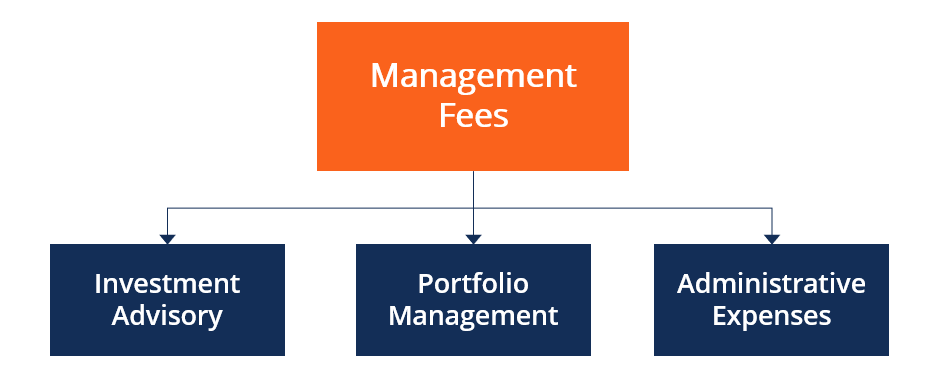
Management fees are fees paid to professionals entrusted with managing investments on a client’s behalf. Typically determined as a percentage of the total assets under management (AUM)Assets Under Management (AUM)Assets under management (AUM) is the total market value of the securities a financial institution owns or manages on behalf of its clients., management fees can cover a variety of expenses, including portfolio management, advisory services, and administrative costs.

Management fees are present in almost all investment management and advisory services, but the actual rate can vary significantly. Like any other service fee, management fees are paid to investment professionalsPortfolio ManagerPortfolio managers manage investment portfolios using a six-step portfolio management process. Learn exactly what does a portfolio manager do in this guide. Portfolio managers are professionals who manage investment portfolios, with the goal of achieving their clients’ investment objectives. in return for their services. The services can be in the form of advice, expertise, and, hopefully, a high return on your investment.
Summary
- Management fees are fees paid to professionals entrusted with managing investments on a client’s behalf.
- Typical management fees are taken as a percentage of the total assets under management (AUM).
- Management fees can also be referred to as investment fees or advisory fees.
Understanding Management Fees
In the investment management industry, management fees are the norm among all types of investment opportunities. In exchange for paying management fees, investors are provided with access to the expertise and resources of investment professionals. The professionals can help investors with allocating risk, rebalancing portfolios, or providing personalized investment advice.
Management fees can also cover expenses involved with managing a portfolio, such as fund operations and administrative costs. The management fee varies but usually ranges anywhere from 0.20% to 2.00%, depending on factors such as management style and size of the investment.
Investment firms that are more passive with their investments generally charge a lower fee relative to those that manage their investments more actively. Also, institutional investors or high-net-worth individuals with large sums of money to invest are sometimes eligible to receive a lower management fee. Management fees can also be referred to as investment fees or advisory fees.
Typical management fees are taken as a percentage of the total assets under management (AUM). The amount is quoted annually and usually applied on a monthly or quarterly basis. For example, if you’ve invested $10,000 with an annual management fee of 2.00%, you would expect to pay a fee of $200 per year. If management fees are applied every quarter, you would expect to pay a fee of $50 every three months.
Avoiding Management Fees
For those who want to avoid management fees and keep more of their money, it’s possible to avoid management fees altogether by engaging in self-directed investing. Self-directed investing allows investors to take complete control of their investments, cutting out the need for investment professionals. It can involve buying and selling individual stocks, as well as building a personalized investment portfolioInvestment PortfolioAn investment portfolio is a set of financial assets owned by an investor that may include bonds, stocks, currencies, cash and cash equivalents, and commodities. Further, it refers to a group of investments that an investor uses in order to earn a profit while making sure that capital or assets are preserved..
Although no management fees are involved, it can be a risky option for inexperienced investors. Also, self-directed investors should be wary of other expenses, such as commissions, brokerage fees, and currency exchange fees.
Management Fee vs. MER
Another term that commonly arises when discussing management fees is the management expense ratio (MER). Recall that management fees are paid to the investment professionals that manage the investments and can cover other expenses, such as fund operations and administration.
On the other hand, the MER includes the management fee, as well as other costs associated with running an investment fund. It can include operating expensesOperating ExpensesOperating expenses, operating expenditures, or "opex," refers to the expenses incurred regarding a business’s operational activities., such as accounting, valuation, legal fees, and taxes.
Therefore, when making investment decisions, it’s important to consider not only the management fee but the entirety of the MER. Generally expressed as a percentage, the MER is often higher than the management fee, as it encompasses the management fee and other operating expenses.
Management Expense Ratio (MER) = Management Fees + Operating Expenses + Taxes
Management Fee Example
A simple management fee is applied as a percentage of the total assets under management. Suppose you’re planning to invest $100,000, and an investment firm offers you an investment opportunity with a management fee of 0.45% per year. In this case, you would be charged $450 a year in management fees.
Now, suppose another investment firm offers you an investment opportunity with a lower management fee of 0.25%, with an additional operating expense of 1.25%. In this case, the MER of the fund would be 1.50%, and you would expect to be charged a fee of $1,500 per year.
Ideally, your investments should achieve an annual return greater than the MER. It ensures that you can cover any fees involved with the investment opportunity while still earning a profit on your investments.
Related Readings
CFI offers the Commercial Banking & Credit Analyst (CBCA)™Program Page - CBCAGet CFI's CBCA™ certification and become a Commercial Banking & Credit Analyst. Enroll and advance your career with our certification programs and courses. certification program for those looking to take their careers to the next level. To keep learning and developing your knowledge base, please explore the additional relevant resources below:
- CommissionCommissionCommission refers to the compensation paid to an employee after completing a task, which is, often, selling a certain number of products or services
- Expected ReturnExpected ReturnThe expected return on an investment is the expected value of the probability distribution of possible returns it can provide to investors. The return on the investment is an unknown variable that has different values associated with different probabilities.
- Service ChargeService ChargeA service charge, also called a service fee, refers to a fee collected to pay for services that relate to a product or service that is being purchased.
- Active Bond Portfolio ManagementActive Bond Portfolio ManagementA bond portfolio can be managed in several ways; however, the primary methods are active, passive, or a hybrid of the two. Active bond portfolio management,
-

Understanding Financial Derivatives: A Comprehensive Guide
Derivatives are financial contracts whose value is linked to the value of an underlying assetTypes of AssetsCommon types of assets include current, non-current, physical, intangible, operating, and no
-

Understanding Distressed Securities: Risks & Opportunities
Distressed securities are securities of a company experiencing financial distress or bankruptcy, specifically, a company that sees its bond rating downgraded by rating agencies to a CCC bond rating or
invest
- Understanding Debt Cancellation Fees: What You Need to Know
- Understanding Debt Issuance Fees: Costs of Bond Sales
- Understanding Payment Processing Fees: A Comprehensive Guide
- Understanding Hedge Fund Fees: The 2 and 20 Structure
- Understanding Management Fees: What They Are & How They Work
- Understanding Equity Issuance Fees: Costs of Raising Capital
- Understanding 12b-1 Fees: What Mutual Fund Investors Need to Know
- Understanding Mutual Fund Fees: What to Expect & What's Reasonable
- Understanding Basis Points: A Simple Guide
-
 Understanding Commodities: A Beginner's Guide to Investing
Commodities are another class of assets just like stocks and bondsBondsBonds are fixed-income securities that are issued by corporations and governments to raise capital. The bond issuer borrows capit...
-
![Defensive Industries: Stability in Economic Uncertainty | [Your Company Name]](https://www.etffin.com/article/uploadfiles/202110/2021100815224423_S.jpeg) Defensive Industries: Stability in Economic Uncertainty | [Your Company Name]
Defensive Industries: Stability in Economic Uncertainty | [Your Company Name]Defensive industries comprise businesses that are relatively stable or relatively immune to economic fluctuations, i.e., economic expansions and recessionsRecessionRecession is a term used to signify ...