
Understanding the 10-Year US Treasury Note: Definition & Key Features
The 10-year US Treasury Note is a debt obligation that is issued by the Treasury Department of the United States Government and comes with a maturity of 10 years. It pays interest to the holder every six months at a fixed interest rateInterest PayableInterest Payable is a liability account shown on a company’s balance sheet that represents the amount of interest expense that has accrued that is determined at the initial issuance. The US Government pays the par valuePar ValuePar Value is the nominal or face value of a bond, or stock, or coupon as indicated on a bond or stock certificate. It is a static value of the note to the holder at the expiry of the maturity period. The issuer uses the funds collected to fund its debts and ongoing expenses, such as employee salaries.
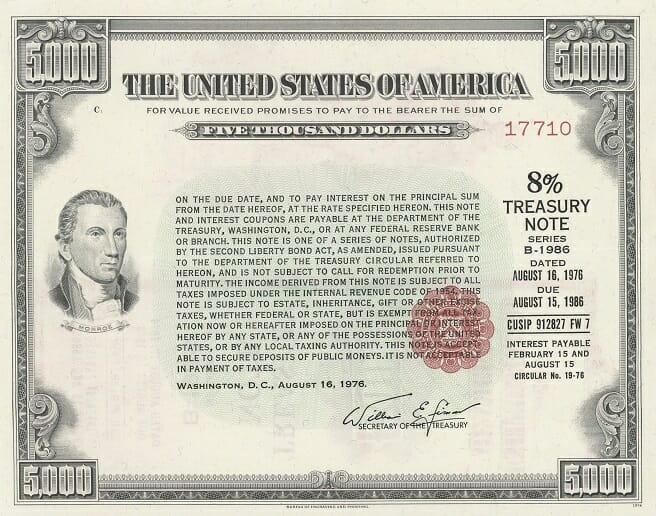
Treasury notes are issued for a term not exceeding 10 years. The 10-year US Treasury note offers the longest maturity. Other Treasury notes mature in 2, 3, 5, and 7 years. Each of these notes pays interest every six months until maturity.
The 10-year Treasury note pays a fixed interest rate that also guides other interest rates in the market. For example, it is used as a benchmark for other interest rates such as Treasury bonds and mortgage rates. One exception is adjustable-rate mortgages, which are guided more by the Federal Funds rate. When setting the Federal Funds Rate, the Federal ReserveFederal Reserve (The Fed)The Federal Reserve is the central bank of the United States and is the financial authority behind the world’s largest free market economy. takes into account the current 10-year Treasury rate of return.
The yield on the 10-Year Note is the most commonly used Risk-Free Rate for calculating a company’s Weighted Average Cost of Capital (WACC)WACCWACC is a firm’s Weighted Average Cost of Capital and represents its blended cost of capital including equity and debt. and performing Discounted Cash Flow (DCF)DCF Model Training Free GuideA DCF model is a specific type of financial model used to value a business. The model is simply a forecast of a company’s unlevered free cash flow Analysis.
Investing in Treasury Notes
The 10-year US treasury can be purchased at auctions through competitive and non-competitive bidding. It is one of the most popular and most tracked debt instruments and is viewed as one of the safest investments. Even though the U.S. debt has a more than 100% debt to GDP ratio, the government is still considered unlikely to default on its obligations. Hence, the note is attractive to investors.
Investors who buy Treasury notes can choose to hold them until maturity or sell them on the secondary market. The US Treasury does not impose limitations on how long investors must hold these investments. Unlike Treasury notes with shorter maturities of 2 to 7 years, which are issued every month, the 10-year US Treasury notes are issued only in February, May, August, and November.
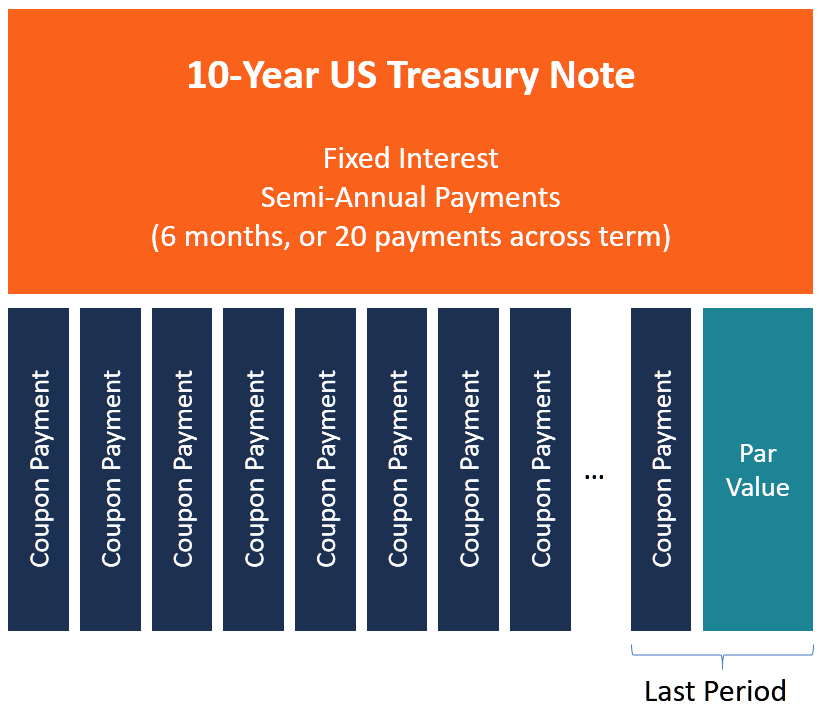
How the 10-Year US Treasury Note Works
Recession Phase
When markets are volatile, there is a high demand for 10-year US Treasuries as investors look for safe investments. When the debt instruments are sold at auctions by the US Treasury, the high demand often pushes investors to bid at or above the par valuePar ValuePar Value is the nominal or face value of a bond, or stock, or coupon as indicated on a bond or stock certificate. It is a static value.
The investors are primarily looking for investments that will safeguard their funds, even though T-note yields are low. The yield is lower during the recession phase of the business cycle.
Expansion Phase
On the other hand, during an expansion phase of the business cycle, there is a low demand for 10-year Treasuries because other debt instruments are more attractive. At these times, investors look for higher return investments as opposed to safer investments. Since Treasuries provide a low rate of return, investors will put their money in alternative investments that will give them a higher yield.
Impact of Changes in Demand for T-Notes
The demand for 10-year Treasury Notes directly affects the interest rates of other debt instruments. As the yield on 10-year T-notes rises during periods of low demand, there will be an increase in interest rates on longer-term debt. Long-term debt that is not backed by the US Treasury must pay a higher rate of interest to compensate investors for the higher risk of default.
Importance of the 10-Year US Treasury Note
Financial Modeling and Valuation
The 10-year note is what most professionals in investment bankingJobsBrowse job descriptions: requirements and skills for job postings in investment banking, equity research, treasury, FP&A, corporate finance, accounting and other areas of finance. These job descriptions have been compiled by taking the most common lists of skills, requirement, education, experience and other, equity research, corporate development, financial planning and analysis (FP&A)FP&AFinancial Planning and Analysis (FP&A) is an important function at a corporation. FP&A professionals support executive decision making for, and other areas of finance use as the risk-free rate of return.
When calculating a company’s WACC, one of the assumptions that must be made in the cost of debtCost of DebtThe cost of debt is the return that a company provides to its debtholders and creditors. Cost of debt is used in WACC calculations for valuation analysis. is the “risk-free rate,” which is usually equal to the yield on the 10-Year Treasury Note.
Below is an example of the WACC calculation:
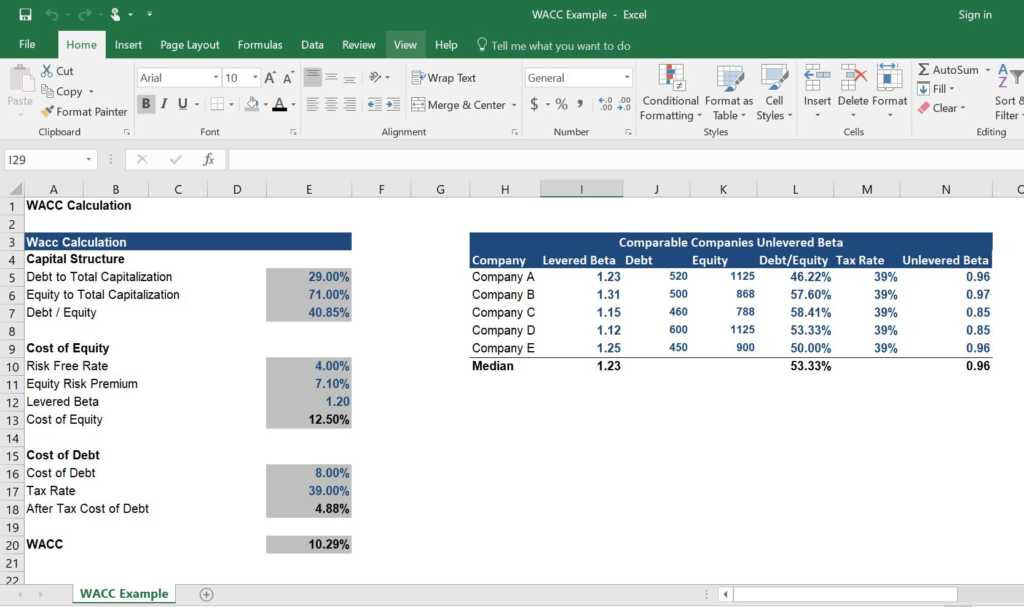
In cell E15 above, the cost of debt is equal to the yield on the 10-year Treasury Note.
Learn more in CFI’s financial modeling and valuation courses.
Investor Confidence
Demand for the 10-year US Treasury Note can show investor confidence in the state of the economy. When investors have high confidence in the performance of the economy, they look for investments with a higher return than the 10-year Treasury Note. This triggers a drop in the price of the T-Note, reflecting the lower level of demand.
In contrast, when investors have low confidence in the state of the economy, the demand for safer, government-backed 10-year T-notes increases, resulting in a price increase. The prices of less secure investments will decline because of their higher risk of default.
Economic Indicator
The 10-year US T-note is one of the most tracked treasury yields in the United States. Investors can assess the performance of the economy by looking at the Treasury yield curve. The yield curve is a graphic representation of all yields starting from the one-month T-bill to 30-year T-bond.
The 10-year T-note is located in the middle of the curve, and its yield indicates the return that investors require to tie up their money for 10 years.
Related Reading
Thank you for reading this CFI guide to the 10-year US Treasury Note. CFI is the official provider of the Capital Markets & Securities Analyst (CMSA)®Program Page - CMSAEnroll in CFI's CMSA® program and become a certified Capital Markets &Securities Analyst. Advance your career with our certification programs and courses. certification, created to help anyone become a world-class financial analyst. To continue learning and advancing your career as a financial analyst, these additional resources will be helpful:
- Bond PricingBond PricingBond pricing is the science of calculating a bond's issue price based on the coupon, par value, yield and term to maturity. Bond pricing allows investors
- Marketable SecuritiesMarketable SecuritiesMarketable securities are unrestricted short-term financial instruments that are issued either for equity securities or for debt securities of a publicly listed company. The issuing company creates these instruments for the express purpose of raising funds to further finance business activities and expansion.
- Debt Capital MarketsDebt Capital Markets (DCM)Debt Capital Markets (DCM) groups are responsible for providing advice directly to corporate issuers on the raising of debt for acquisitions, refinancing of existing debt, or restructuring of existing debt. These teams operate in a rapidly moving environment and work closely with an advisory partner
- Fixed Income TradingFixed Income TradingFixed income trading involves investing in bonds or other debt security instruments. Fixed income securities have several unique attributes and factors that
-
Understanding the January Effect: Stock Market Trends & Causes
The January Effect is known to be a seasonal increase in stock prices throughout the month of January. The increase in demand for stocks is often preceded by a decrease in price during the month of De
-

Understanding the Joseph Effect: Trends vs. Randomness
The Joseph Effect, which derives its name from a Biblical reference, is a phrase created by Benoit Mandelbrot, a Polish-born French-American mathematician. The phrase asserts that variations over time
invest
- Loan Note: Definition, Purpose & Key Features - [Your Company Name]
- Understanding 10-Year Treasury Yields: A Comprehensive Guide
- Understanding the Investment Accumulation Phase: Building Wealth Over Time
- Bandwagon Effect: Understanding Social Influence & Conformity
- Dow 30 Explained: Understanding the Dow Jones Industrial Average
- Understanding Notes: Definition, Types & Issuance
- Rule of 72: Calculate Investment Doubling Time | [Your Brand Name]
- Treasury Bonds: A Comprehensive Guide to U.S. Government Debt
- Treasury Stock Method: Calculating Diluted Earnings Per Share
-
 Understanding Implied Rates: A Comprehensive Guide
The implied rate is an interest rate that expresses the difference between the forward/future rate and the spot rate. It serves as a useful tool for comparing returns across different assets and can b...
-
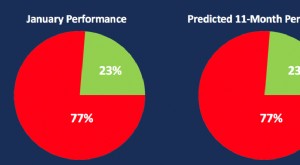 January Barometer: Predicting Market Performance - Explained
The January Barometer is the idea that the investment performance of the S&P 500S&P 500 IndexThe Standard and Poor’s 500 Index, abbreviated as S&P 500 index, is an index comprising t...