
2010 Flash Crash: Causes, Impact, and Lessons Learned
The 2010 Flash Crash is the market crash that occurred on May 6, 2010. During the 2010 crash, leading US stock indices, including the Dow Jones Industrial AverageDow Jones Industrial Average (DJIA)The Dow Jones Industrial Average (DJIA), also referred to as "Dow Jones” or "the Dow", is one of the most widely-recognized stock market indices., S&P 500, and Nasdaq Composite Index, tumbled and partially rebounded in less than an hour. The day was distinguished by high volatility in trading of all types of securities, including stocksStockWhat is a stock? An individual who owns stock in a company is called a shareholder and is eligible to claim part of the company’s residual assets and earnings (should the company ever be dissolved). The terms "stock", "shares", and "equity" are used interchangeably., futures, options, and ETFsExchange Traded Fund (ETF)An Exchange Traded Fund (ETF) is a popular investment vehicle where portfolios can be more flexible and diversified across a broad range of all the available asset classes. Learn about various types of ETFs by reading this guide..
Although the market indices managed to partially rebound in the same day, the flash crash erased almost $1 trillion in market value.
2010 Flash Crash: Main Events
Beginning in the morning, trading on major US markets on May 6, 2010 showed a negative trend. It was mainly due to concerns regarding the financial situation in Greece and the upcoming elections in the UK. By afternoon, the major indices of equities and futuresFutures ContractA futures contract is an agreement to buy or sell an underlying asset at a later date for a predetermined price. It’s also known as a derivative because future contracts derive their value from an underlying asset. Investors may purchase the right to buy or sell the underlying asset at a later date for a predetermined price. were down by 4% from their previous day’s close.
By 2:30 p.m., trading was becoming extremely turbulent. The Dow Jones Industrial Average (DJIA) lost almost 1,000 points in around 10 minutes. However, in the next 30 minutes, the index recovered almost 600 points.
Other market indices across North America were also affected by the Flash Crash. The S&P 500 Volatility Index increased by 22.5% on the same day, while the S&P/TSX Composite Index in Canada lost more than 5% of its value in between 2:30 p.m. to 3:00 p.m.
By the end of the trading day, the major indices regained more than half of the lost values. Nevertheless, the Flash Crash took away around $1 trillion in the market value.
Investigation of the 2010 Flash Crash
After the Flash Crash, the US Securities and Exchange Commission (SEC) conducted an investigation of the possible causes of the unexpected market event. In September 2010, the SEC published a report containing the findings of its investigation.
According to the report, before the flash crash, the markets were particularly fragile and were exposed to extreme turbulence. A single selling order of an enormously large amount of E-Mini S&P contracts and subsequent aggressive selling orders executed by high-frequency algorithms triggered the massive decline in market prices, which was already accruing exponentially due to prevailing negative market trends at that time.
The immense volatility compelled many high-frequency traders to halt their trading. The trading of E-Mini S&P contracts was paused to prevent it from further declines. When the trading of the contracts resumed, their prices started to stabilize. The markets started to regain their positions as the prices of many securities returned to near their initial levels.
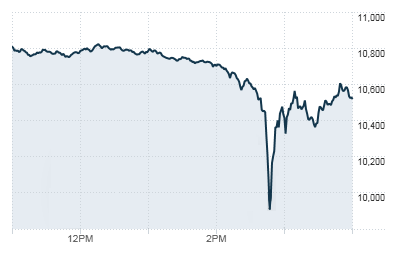
The DJIA on May 6, 2010 (11:00 AM – 4:00 PM EST)
After the Flash Crash
The results of different investigations of the 2010 Flash Crash led to conclusions that the high-frequency traders played a significant role in the crash. The aggressive selling and buying of large volumes of securities resulted in enormous price volatility in the financial markets. At minimum, the activities of high-frequency traders exacerbated the effects of the crash.
In 2015, London-based trader Navinder Singh Sarao was arrested following allegations of market manipulation that resulted in the Flash Crash. According to the charges, Sarao’s trading algorithm executed a number of large selling orders of E-Mini S&P contracts to push the prices down, which ultimately triggered the market crash.
Related Readings
Thank you for reading CFI’s explanation of the Flash Crash. CFI offers the Financial Modeling & Valuation Analyst (FMVA)™Become a Certified Financial Modeling & Valuation Analyst (FMVA)®CFI's Financial Modeling and Valuation Analyst (FMVA)® certification will help you gain the confidence you need in your finance career. Enroll today! certification program for those looking to take their careers to the next level. To learn more about related topics, check out the following resources:
- Black Swan EventBlack Swan EventA black swan event, a phrase commonly used in the world of finance, is an extremely negative event or occurrence that is impossibly difficult to predict. In other words, black swan events are events that are unexpected and unknowable. The term was popularized by former Wall Street trader Nassim Nicholas Taleb
- Momentum InvestingMomentum InvestingMomentum investing is an investment strategy aimed at purchasing securities that have been showing an upward price trend or short-selling securities that
- Subsequent EventsSubsequent EventsSubsequent events are events that occur after a company’s year-end period but before financial statements have been issued. Depending on the
- Wall StreetWall StreetWall Street takes up eight blocks in Manhattan, New York. It runs east to west from Broadway to South Street, in the heart of the financial district. Representing the heart of capitalism, Wall Street is home to the New York Stock Exchange (NYSE), numerous banks, other financial institutions, and corporations.
-

Margin of Safety: A Powerful Investment Principle
The margin of safety is an investment principle where the investor buys stocks when the market price is below their actual value. It is evaluated as the change between the price of a financial in
-

Understanding the Money Market: Short-Term Debt & Lending
The money market is an organized exchange market where participants can lend and borrow short-term, high-quality debt securities with average maturities of one year or less. It enables governments, ba
invest
- Understanding the Investment Accumulation Phase: Building Wealth Over Time
- Bandwagon Effect: Understanding Social Influence & Conformity
- Understanding the Call Market: Trading Hours & Price Determination
- Understanding the Credit Curve: A Guide for Investors
- Understanding the Dot-Com Bubble: Causes, Impact & Lessons Learned
- Dow 30 Explained: Understanding the Dow Jones Industrial Average
- Understanding the Dow Divisor: How It Impacts the DJIA
- EAFE Index: Understanding Developed Market Performance
- Rule of 72: Calculate Investment Doubling Time | [Your Brand Name]
-
 Keltner Channel: Definition, How to Use & Trading Strategies
Keltner Channel refers to a technical analysis indicator composed of three separate lines. It includes a central moving average line along with channel lines located above and below the central one.&n...
-
 Klinger Oscillator: Understanding Long-Term Trends & Price Reversals
The Klinger oscillator is a financial tool that was designed by Stephen Klinger in 1977 to predict long-term trends in money flow while also detecting short-term fluctuations. In addition, it predicts...