
Triangular Arbitrage: Definition, Strategy & How It Works
A triangular arbitrage opportunity is a trading strategy that exploits the arbitrage opportunities that exist among three currencies in a foreign currency exchange. The arbitrageArbitrageArbitrage is the strategy of taking advantage of price differences in different markets for the same asset. For it to take place, there must be a situation of at least two equivalent assets with differing prices. In essence, arbitrage is a situation that a trader can profit from is executed through the consecutive exchange of one currency to another when there are discrepancies in the quoted prices for the given currencies.
A triangular arbitrage opportunity occurs when the exchange rate of a currency does not match the cross-exchange rate. The price discrepancies generally arise from situations when one market is overvalued while another is undervalued.

The nature of foreign currency exchange markets limits the price discrepancies between different currencies to a few cents or even to a fraction of a cent. Therefore, the transactions in a triangular arbitrage opportunity involve trading large amounts of money.
Frequently, the transactions employ margin tradingBuying on MarginMargin trading or buying on margin means offering collateral, usually with your broker, to borrow funds to purchase securities. In stocks, this can also mean purchasing on margin by using a portion of profits on open positions in your portfolio to purchase additional stocks. to amplify the returns. In addition, a trader must be aware of the transaction costs. It is possible that high transaction costs may erase gains from the price discrepancies.
Example of a Triangular Arbitrage Opportunity
Sam is an FX trader with $1 million on hand. He detects the following exchange rates:
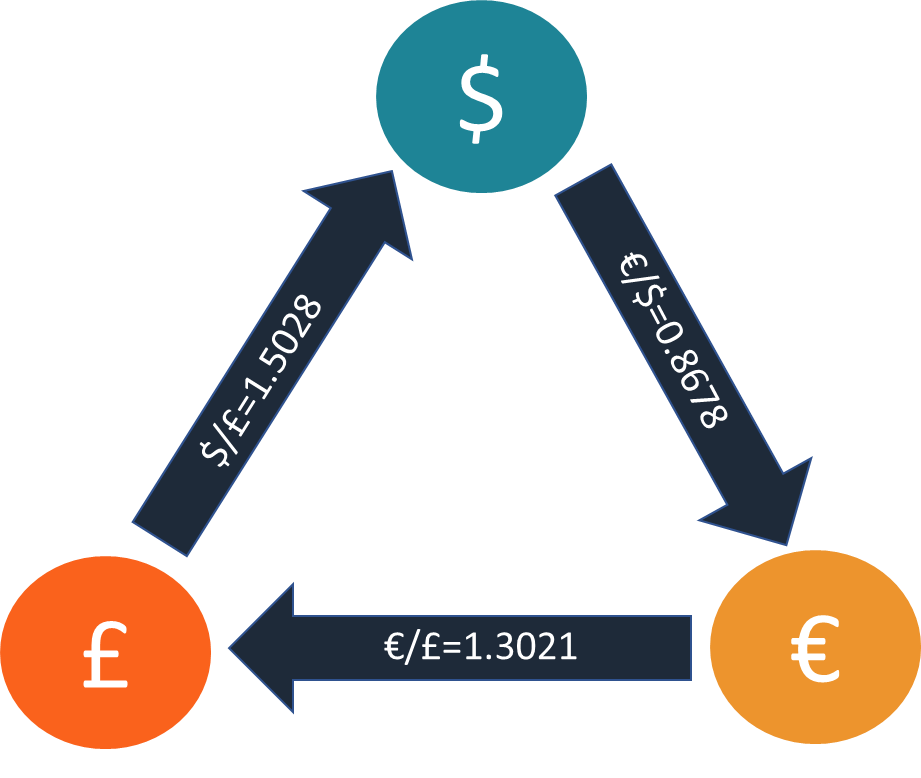
Using the cross-rate formula, Sam determines that the €/£ rate is undervalued. The cross-rate for the pair must be equal:
€/£ = 0.8678 x 1.5028 = 1.3041
Triangular arbitrage can be applied to the three currencies – the US dollar, the euro, and the pound. To execute the triangular arbitrage opportunity, Sam should perform the following transactions:
- Sell dollars for euros: $1,000,000 x 0.8678 = €867,800
- Sell euros for pounds: €867,800 / 1.3021 = £666,461.87
- Sell pounds for dollars: £666,461.87 x 1.5028 = $1,001,558.90
By utilizing the discrepancies in the price quotations of the three currencies, Sam managed to turn his initial $1,000,000 into $1,001,558.90, with a profit of $1,558.90. Note, that due to the small price discrepancy (only 0.002), even the use of a substantially large capital resulted in relatively small profits. In our simplified example, we did not account for transaction costs. Therefore, in real life, the profit would be even smaller.
Triangular Arbitrage Opportunities in the Real World
Triangular arbitrage opportunities rarely exist in the real world. This can be explained by the nature of foreign currency exchange markets. Forex markets are extremely competitive with a large number of players, such as individual and institutional traders. The competition in the markets constantly corrects the market inefficiencies and arbitrage opportunities do not last long.
Nowadays, triangular arbitrage opportunities are often exploited by high-frequency tradersHigh-Frequency Trading (HFT)High-frequency trading (HFT) is algorithmic trading characterized by high speed trade execution, an extremely large number of transactions,. Using high-speed algorithms, the traders can quickly spot mispricing and immediately execute the necessary transactions. However, the strong presence of high-frequency traders makes the markets even more efficient. Thus, the number of available arbitrage opportunities diminish.
In addition, the triangular arbitrage strategy provides applications in cryptocurrencyCryptocurrencyCryptocurrency is a form of digital currency that is based on blockchain networking. Cryptocurrency like Bitcoin and Ethereum are becoming widely accepted. trading. Cryptocurrency markets and exchanges are still in development, and more arbitrage opportunities exist in such markets relative to the traditional currency markets.
Additional Resources
Thank you for reading CFI’s explanation of a triangular arbitrage opportunity. CFI offers the Financial Modeling & Valuation Analyst (FMVA)™Become a Certified Financial Modeling & Valuation Analyst (FMVA)®CFI's Financial Modeling and Valuation Analyst (FMVA)® certification will help you gain the confidence you need in your finance career. Enroll today! certification program for those looking to take their careers to the next level. To keep learning and advancing your career, the following resources will be helpful:
- Calculating the Foreign Exchange Rate SpreadCalculating Foreign Exchange SpreadThe foreign exchange spread (or bid-ask spread) refers to the difference in the bid and ask prices for a given currency pair. The bid price refers to the maximum amount that a foreign exchange trader is willing to pay to buy a certain currency, and the ask price is the minimum price that a currency dealer is willing to accept for the currency.
- Fixed vs Pegged Exchange RateFixed vs. Pegged Exchange RatesForeign currency exchange rates measure one currency's strength relative to another. The strength of a currency depends on a number of factors such as its inflation rate, prevailing interest rates in its home country, or the stability of the government, to name a few.
- Forex Trading: How to Trade the Forex MarketForex Trading - How to Trade the Forex MarketForex trading allows users to capitalize on appreciation and depreciation of different currencies. Forex trading involves buying and selling currency pairs based on each currency's relative value to the other currency that makes up the pair.
- USD/CAD Currency CrossUSD/CAD Currency CrossThe USD/CAD currency pair represents the quoted rate for exchanging US to CAD, or, how many Canadian dollars one receives per US dollar. For example, a USD/CAD rate of 1.25 means 1 US dollar is equivalent to 1.25 Canadian dollars. The USD/CAD exchange rate is affected by economic and political forces on both
-
Banker's Acceptance: Definition, Function & Key Features
A banker’s acceptance refers to a financial instrument that represents a promised future payment from a bank. It states the name of the entity to which the funds need to be transferred, along wi
-
Barrier Options: Understanding and Trading Strategies
A barrier option is a type of derivative option contract, the payoff of which depends on the value of the underlying asset. In other words, the payoff only comes into effect if the asset underlying th
invest
- Understanding Investment Opportunities: A Comprehensive Guide
- Triangular Arbitrage: Understanding and Exploiting Currency Discrepancies
- Arbitrage Explained: Understanding and Capitalizing on Price Differences
- Arbitrageurs: Understanding Market Inefficiencies & Profit Opportunities
- Cash and Carry Arbitrage: Definition, Strategy & Examples
- Reverse Cash and Carry Arbitrage: A Comprehensive Guide
- Volatility Arbitrage: A Deep Dive into Options Trading Strategies
- Triangular Arbitrage: A Comprehensive Guide to Profiting from Currency Discrepancies
- Understanding Opportunity Cost: A Guide for Investors
-
 Understanding Average Return: A Simple Guide
Average return is the mathematical average of a sequence of returns that have accrued over time. In its simplest terms, average return is the total return over a time period divided by the number of p...
-
 Backtesting: A Comprehensive Guide to Strategy Validation
Backtesting involves applying a strategy or predictive model to historical data to determine its accuracy. It can be used to test and compare the viability of trading strategies so tradersSix Essentia...