
Understanding Anti-Dilution Provisions: Protecting Investor Equity
Anti-dilution provisions are clauses that allow investors the right to maintain their ownership percentages in the event that new shares are issued. They are rights that are usually associated with preferred sharesPreferred SharesPreferred shares (preferred stock, preference shares) are the class of stock ownership in a corporation that has a priority claim on the company’s assets over common stock shares. The shares are more senior than common stock but are more junior relative to debt, such as bonds..

Summary
- Anti-dilution provisions are clauses that allow investors the right to maintain their ownership percentages in the event that new shares are issued.
- Dilution refers to a shareholder’s ownership decreasing as a result of new shares being issued.
- There are two types of anti-dilution provisions: full ratchet and weighted average.
Understanding Anti-Dilution Provisions
Anti-dilution provisions protect an investor’s equity stake from dilution. A company may issue new shares with a round of equity financing or let its options exercised by their owners. In either case, the total number of shares outstanding will increase, while the investor still owns the same number of shares. Therefore, the investor’s percentage ownership in the company will decrease.
In some cases, the cash that a company receives for shares may offset the effect. However, usually, there will be a decline in the value of the outstanding shares. An anti-dilution provision grants an investor the right to convert their preferred shares at the new price.
Imagine you own preferred stock that you purchased for $20 per share. If the company that issued the shares goes public and issues shares at $15, the value of your investment would’ve gone down. An anti-dilution provision would protect investors from drops in value due to dilution.
Understanding Dilution
Dilution refers to a shareholder’s ownership decreasing as a result of new shares being issued. If you owned 25 shares in a company with 100 outstanding shares, you would hold a 25% stake. However, if the company were to issue 100 more shares, your ownership would be cut in half. Issuing new equity will also lower the earnings per share (EPS)Earnings Per Share (EPS)Earnings per share (EPS) is a key metric used to determine the common shareholder's portion of the company’s profit. EPS measures each common share's profit, as the total number of shares increases. Companies may try to offset the adverse effects by repurchasing its shares.
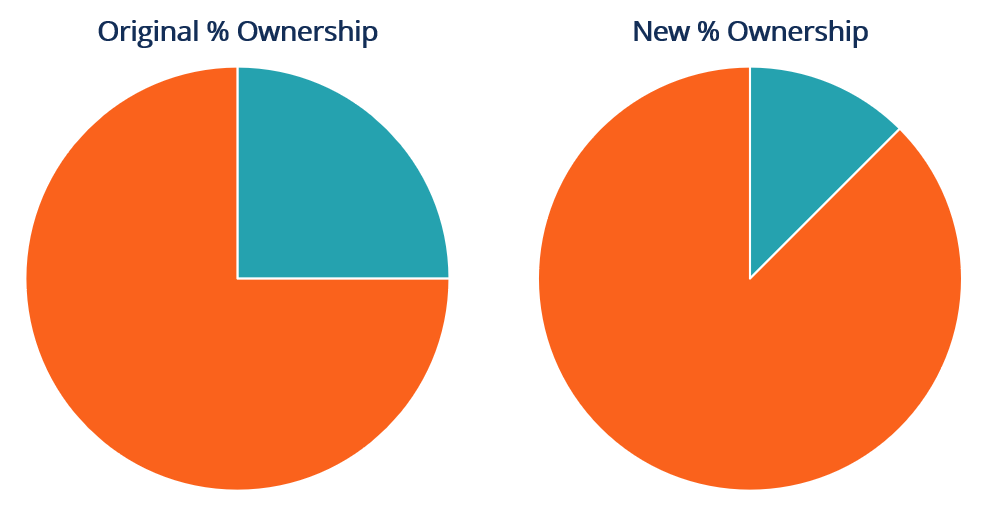
The diagram above shows the effect of dilution on ownership. Owning 25 shares out of a total of 100 outstanding is 25% ownership. If 100 more shares were issued, ownership would be 12.5%.
When are Anti-Dilution Provisions Used?
Anti-dilution provisions are used by most companies when issuing convertible stock. The provisions are especially prominent in venture capital investingVenture Capital InvestingVenture capital investing is a type of private equity investing that involves investment in a business that requires capital. The business often requires capital for initial setup (or expansion). Venture capital investing may be done at an even earlier stage known as the "idea phase"., as many rounds of financing are used. They are also used to further incentivize companies to maintain financial targets, as it allows convertible securities to remain at higher costs.
Types of Anti-Dilution Provisions and How They Work
There are two types of anti-dilution provisions – full ratchet and weighted average.
1. Full Ratchet
A full ratchet provision would protect investors who own optionsOptions: Calls and PutsAn option is a derivative contract that gives the holder the right, but not the obligation, to buy or sell an asset by a certain date at a specified price. or convertible securities. The provision allows the investors to convert at the lowest sale price offered. Therefore, they are protected if the new offering price is lower than the conversion price on the investor’s shares.
Example
Assume an investor owns preferred shares in Company ABC, with a conversion price of $10, attached to a full ratchet anti-dilution provision. However, Company ABC issues more shares at a conversion price of $5. The original conversion price of $10 would be lowered to $5. At the same price, the investor would then be able to purchase twice as many shares.
2. Weighted Average
The weighted average method uses a formula to determine the new conversion price.
New Conversion Price = O x (A + B) / (A + C)
Where:
- O – Old conversion price
- A – Shares outstanding before new issue
- B – Consideration received with new issue
- C – New shares issued
Example
Imagine that during a first offering, 1,000 preferred shares are issued at $5 per share, and are convertible at a 1:1 ratio. Now, imagine the company issues another 1,000 shares; however, at a new price of $3 per share. To determine the new conversion price under the weighted average method, you would insert the numbers into the formula above.
Therefore, the new conversion price would = $5 * (2,000 + $3,000) / (2,000 + $5,000) = $3.57. Owners of the first issue of preferred shares would now be given the option to convert their shares for $3.57, rather than $5.
Comparison of Conversion Methods
The full ratchet method will always be more beneficial to owners of preferred shares, as it grants them the right to convert at the lowest available price. The weighted average method will help protect some of the value of their preferred shares. However, the conversion price will always be better than with a full ratchet provision.
Additional Resources
CFI is the official provider of the global Commercial Banking & Credit Analyst (CBCA)™Program Page - CBCAGet CFI's CBCA™ certification and become a Commercial Banking & Credit Analyst. Enroll and advance your career with our certification programs and courses. certification program, designed to help anyone become a world-class financial analyst. To keep advancing your career, the additional resources below will be useful:
- Capital Raising ProcessCapital Raising ProcessThis article is intended to provide readers with a deeper understanding of how the capital raising process works and happens in the industry today. For more information on capital raising and different types of commitments made by the underwriter, please see our underwriting overview.
- Pro-Rata Participation RightsPro-Rata Participation RightsPro-rata participation rights, or pro-rata investing rights, guarantee existing investors the right to participate in future fundraising activities. Pro-
- Redemption Rights ClauseRedemption Rights ClauseThe redemption rights clause gives the owner of a property the right to reclaim his/her property during a foreclosure auction. The clause is often included in a mortgage agreement. Redemption rights allow the borrower to prevent foreclosure on the property by paying all liens or back taxes on the property.
- Seed FinancingSeed FinancingSeed financing (also known as seed capital, seed money, or seed funding) is the earliest stage of the capital-raising process of a startup. Seed financing is a type of equity-based financing. In other words, investors commit their capital in exchange for an equity interest in a company.
-
![Defensive Industries: Stability in Economic Uncertainty | [Your Company Name]](https://www.etffin.com/article/uploadfiles/202110/2021100815224423_S.jpeg)
Defensive Industries: Stability in Economic Uncertainty | [Your Company Name]
Defensive industries comprise businesses that are relatively stable or relatively immune to economic fluctuations, i.e., economic expansions and recessionsRecessionRecession is a term used to signify
-

Understanding Financial Derivatives: A Comprehensive Guide
Derivatives are financial contracts whose value is linked to the value of an underlying assetTypes of AssetsCommon types of assets include current, non-current, physical, intangible, operating, and no
invest
- A-Shares Explained: Understanding Preferred Stock & Share Classes
- Authorized Shares: Understanding a Company's Issuance Limit
- CCPPO Shares Explained: Understanding Cumulative, Convertible, & Participating Preferred Stock
- Common vs. Preferred Stock: Understanding the Differences
- Understanding Forfeited Shares: Causes, Consequences, and Rights
- Outstanding Shares: Definition & Importance for Investors
- Preferred Shares: A Comprehensive Guide for Investors
- Non-Renounceable Rights: Understanding Shareholder Options
- Retired Shares: Definition, Impact & Accounting Methods
-
 Understanding Bonds: A Comprehensive Guide for Investors
Bonds are fixed-income securitiesTrading & InvestingCFIs trading & investing guides are designed as self-study resources to learn to trade at your own pace. Browse hundreds of articles on trad...
-
 Understanding Commodities: A Beginner's Guide to Investing
Commodities are another class of assets just like stocks and bondsBondsBonds are fixed-income securities that are issued by corporations and governments to raise capital. The bond issuer borrows capit...