
Asset-Backed Securities (ABS): Definition & How They Work
Asset-backed securities (ABS) are securities derived from a pool of underlying assets. To create asset-backed securities, financial institutions pool multiple loans into a single security that is then sold to investors.
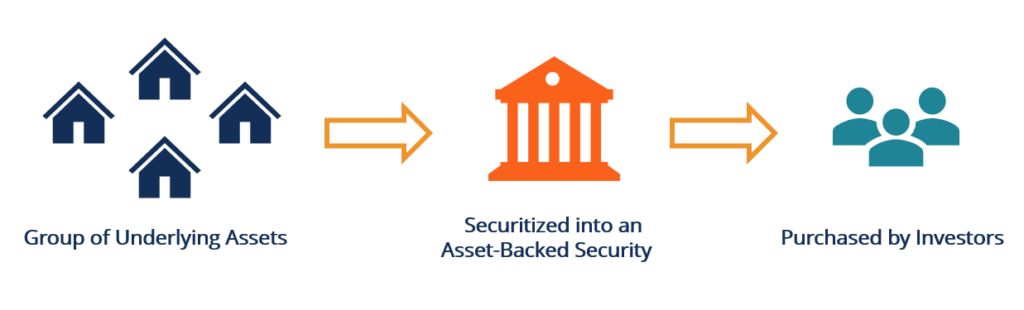
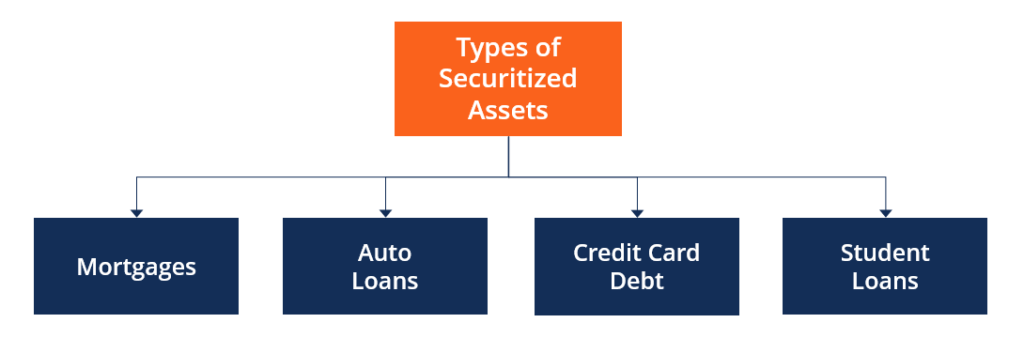
The pools can include many types of loans, such as mortgagesMortgageA mortgage is a loan – provided by a mortgage lender or a bank – that enables an individual to purchase a home. While it’s possible to take out loans to cover the entire cost of a home, it’s more common to secure a loan for about 80% of the home’s value., credit card debt, student loans, and auto loans. As many of the loans cannot be sold separately, securitizing them into asset-backed securities provides investors with further investment opportunities, and allows financial institutions to remove risky assets from their balance sheets.
Summary
- Asset-backed securities (ABS) are securities derived from a pool of underlying assets.
- Asset-backed securities are characterized by a diversified risk profile, as each security only contains a fraction of the total pool of underlying assets.
- When purchasing and asset-backed security, the investor receives all interest and principal payments but also takes on the risk of the underlying assets.
Understanding Asset-Backed Securities
Asset-backed securities are essentially pools of smaller assets held by various financial institutions, such as banks, credit unionsCredit UnionA credit union is a type of financial organization that is owned and governed by its members. Credit unions provide members with a variety of financial services, including checking and savings accounts and loans. They are non-profit organizations that aim to provide high-quality financial services, and other lenders. Most of the assets are loans provided to individuals in the form of mortgages, credit card debt, or auto loans. Since the loans provide the lender with interest and principal payments, they are assets on the lender’s balance sheet.
However, the assets are often small and illiquid and cannot be sold to investors individually. Therefore, financial institutions will pool multiple assets together through a process known as securitization. The process results in new securities with a diversified risk profile, as each security only contains a fraction of the total pool of underlying assets. The interest and principal paymentsPrincipal PaymentA principal payment is a payment toward the original amount of a loan that is owed. In other words, a principal payment is a payment made on a loan that reduces the remaining loan amount due, rather than applying to the payment of interest charged on the loan. on the assets are also passed on to the investor, as well as the risk.
Securitization of Assets
To create asset-backed securities, loans and other forms of debt are pooled together in a process known as securitization. Securitization can take place with many types of loans, such as commercial and residential mortgages, auto loans, consumer credit card debt, and student loans.
The original interest and principal payments are passed on to the investors, while the risk of default is minimized as each asset-backed security only contains a fraction of each underlying asset. Each pool is separated based on the level of risk, as well as the return. Lower-risk assets can result in lower interest payments, while riskier assets may provide a higher yield.
Benefits of Asset-Backed Securities
1. Protects from potentially risky loans
For the lender that issues asset-backed securities, the benefit is that potentially risky loans are removed from their balance sheet, as they’ve been securitized and sold to outside investors. By selling the assets through asset-backed securities, they are also able to gain a new source of funding that can be used to issue more loans or for other business purposes.
2. Provides an alternative and more stable investment vehicle
For investors, asset-backed securities provide an alternative investment vehicle that provides higher yields and greater stability than government bonds. Asset-backed securities also provide portfolio diversification for investors looking to invest in other markets. Also, not all investors can lend directly to consumers through mortgages or credit cards.
3. Reduces default risk and other credit risks
By purchasing asset-backed securities, investors can receive access to interest and principal payments of various assets without having to originate them. Since each security only contains a fraction of all the underlying assets, the risk of default and other credit risks are minimized.
Downsides of Asset-Backed Securities
Like all investments, there are still risks involved with asset-backed securities, including:
1. Lack of due diligence
When investors purchase the securities, there can be hundreds of underlying assets. It can be difficult to evaluate the credit risk of the underlying assets without conducting extensive research. For retail investors, it may not be possible to conduct such a level of due diligence, and therefore, they may be exposed to unforeseen risks.
2. Lower yield from prepayments
Asset-backed securities may also be subject to prepayment risksPrepayment RiskPrepayment risk refers to the risk that the principal amount (or a portion of the principal amount) outstanding on a loan is prematurely paid back. In other words, prepayment risk is the risk of early repayment of a loan by a borrower., which occur when the borrowers of the underlying assets decide to pay off their loans early. It can result in a lower yield for holders of the security.
3. Potential widespread defaults during an economic downturn
Finally, some risks can arise if the underlying assets are in arrears. Since each security only contains a fraction of each underlying asset, the risk of default is distributed across a wide range of assets. However, if the underlying assets are of low quality, the security can suffer from widespread defaults during an economic downturn.
Asset-Backed Securities and the Financial Crisis
During the 2008 Global Financial Crisis, many banks issued asset-backed securities backed by mortgages, also known as mortgage-backed securities (MBS). However, many investors were unaware that the securities were backed by low-quality mortgages with a high chance of default.
As the securities were unregulated at the time, banks issued a tremendous number of securities without any government oversight. The securities were then provided with AA or AAA ratings by the biggest rating agencies and were therefore deemed safe investments.
Many institutional investors, such as pension funds, purchased the securities, unaware of the underlying risk of default. When borrowers were unable to make payments and began defaulting on their mortgages, the underlying assets became worthless, collapsing the mortgage-backed security market and eventually wiping out trillions of dollars of investments.
Related Readings
CFI offers the Commercial Banking & Credit Analyst (CBCA)™Program Page - CBCAGet CFI's CBCA™ certification and become a Commercial Banking & Credit Analyst. Enroll and advance your career with our certification programs and courses. certification program for those looking to take their careers to the next level. To keep learning and advancing your career, the following resources will be helpful:
- Pooled FundsPooled FundsPooled funds is a term used to collectively refer to a set of money from individual investors combined, i.e., "pooled" together for investment purposes
- Mortgage-backed Security (MBS)Mortgage-Backed Security (MBS)A Mortgage-backed Security (MBS) is a debt security that is collateralized by a mortgage or a collection of mortgages. An MBS is an asset-backed security that is traded on the secondary market, and that enables investors to profit from the mortgage business
- Rating AgencyRating AgencyA rating agency assesses the financial strength of companies and government entities, especially their ability to meet principal and interest payments
- Credit Risk AnalysisCredit Risk AnalysisCredit risk analysis can be thought of as an extension of the credit allocation process. After an individual or business applies to a bank or financial institution for a loan, the lending institution analyzes the potential benefits and costs associated with the loan.
-
Trading Securities: Definition, Types & Short-Term Investment Strategies
Trading securities are securities purchased by a company for the purpose of realizing a short-term profit. Companies do not intend to hold such securities for a long period of time; thus, they will on
-

Understanding Liquid Assets: A Comprehensive Guide
Equity, adjusted gross income, stocks, bonds, current ratio, operating cash flow, assets, liabilities, net worth -- its easy to get lost in the jungle of financial terms out there when youre trying to
invest
- Investable Assets: A Comprehensive Guide for Investors
- Understanding Household Assets: A Comprehensive Guide
- Credit Card ABS: Understanding Asset-Backed Securities
- Fixed Assets: Definition, Examples & Importance for Businesses
- Understanding Distressed Securities: Risks & Opportunities
- Understanding Hard Assets: Definition, Examples & Investment
- Non-Marginable Securities: Definition & Investing Implications
- Trading Assets: Definition, Types & How They Work
- Securities Explained: A Beginner's Guide to Stocks, Bonds & More
-
 Understanding Financial Assets: Definitions & Types
Financial assets refer to assets that arise from contractual agreements on future cash flowsCash Flow StatementA cash flow Statement contains information on how much cash a company generated an...
-
 Understanding Intangible Assets: Definition & Importance
According to the IFRS, intangible assets are identifiable, non-monetary assets without physical substance. Like all assets, intangible assets are expected to generate economic returns for the company ...