
Balanced Funds: A Comprehensive Guide to Diversified Investing
A balanced fund, also known as a hybrid fund, is characterized by diversification among two or more asset classesAsset ClassAn asset class is a group of similar investment vehicles. They are typically traded in the same financial markets and subject to the same rules and regulations.. A balanced fund usually combines stock and bond components in a diversified portfolio. Balanced funds typically follow a 60% stock and 40% bond asset allocation, as seen below:
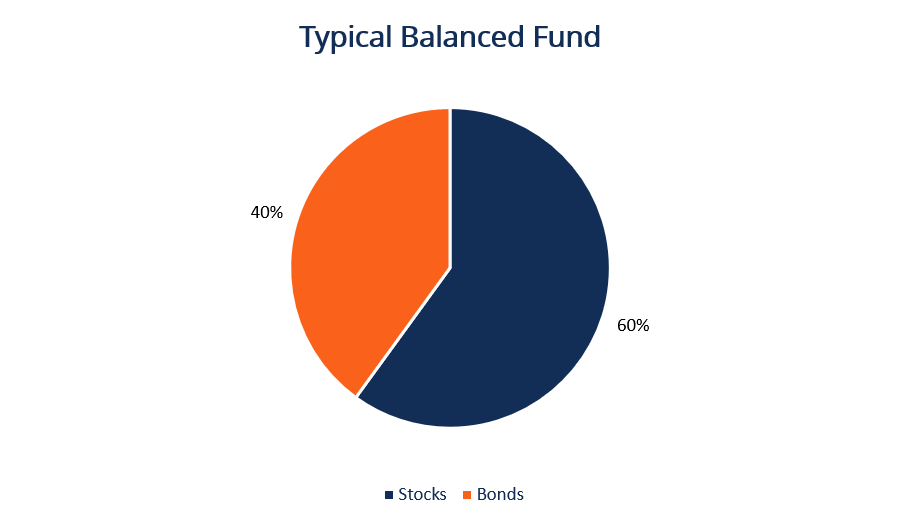
Asset allocation in a balanced fund allows investors to create an investment strategy that is relatively low-risk and high-reward. Conservative funds consist of fewer equities and more bonds, while aggressive funds comprise more equities and fewer bondsFixed Income SecuritiesFixed income securities are a type of debt instrument that provides returns in the form of regular, or fixed, interest payments and repayments of the.
Diversification
Balanced funds provide investors with diversification. By diversifying the investment across different asset classes, the investor mitigates the risk that they will otherwise face if they’ve invested in a 100% equity fund or 100% bond fund.
In a scenario where volatility occurs in one industry, a balanced fund portfolio will experience less fluctuation compared to a pure equity portfolio investing in the same industry. While a balanced fund does offer diversification, the securities selected and the weightings of each asset class may not be aligned with the holder’s investment goals.
Risks Associated with a Balanced Fund
A balanced fund is attractive to investors with low-risk tolerance because the fund’s growth outpaces inflationInflationInflation is an economic concept that refers to increases in the price level of goods over a set period of time. The rise in the price level signifies that the currency in a given economy loses purchasing power (i.e., less can be bought with the same amount of money). and provides steady returns. While balanced funds are a comparatively conservative investment strategy, they are still not 100% risk-free because bonds will fluctuate if interest rates change. Since bonds demonstrate an inverse relationship with interest rates, an increase in interest rates will cause bond values to fall.
Bonds vs. Interest Rate Example
Let’s assume an investor buys a two-year bond with a face value of $1,000 and an interest rate of 5%. If the interest rates remain the same, the bond will yield $50 each year over the two-year period.
If the interest rate was to rise to 6%, the investor will now able to buy new bonds with a higher yield, equating to a $60 return each year. With new higher-yielding bonds coming to the market nowadays, the previous ones become unattractive because of their lower yield. In order to become competitive again, the older bonds would then need to sell at a discount.
Stocks vs. Interest Rate Example
With any investment, the investor is paying the price today for expected money in the future, which is the time value of moneyTime Value of MoneyThe time value of money is a basic financial concept that holds that money in the present is worth more than the same sum of money to be received in the future. This is true because money that you have right now can be invested and earn a return, thus creating a larger amount of money in the future. (Also, with future concept. It is noticeable with bonds when interest rates go up and bond values decrease since the investor is willing to pay less for future cash flows.
The difference with stocks when comparing them to bonds is that the future value of the stock is variable. In our example, if the future value of the stock is fixed, just like with a bond, and the interest rate rises, the investor expects to receive less money from the stock in the future. For stocks, future cash flows are not guaranteed, but with bonds, they are.
Conclusion
Balanced funds are ideal for an investor who wants a combination of a low risk (investments in bonds) and a higher risk (equity investment) return profile. Diversification will lower the risk of holding only stocks or bonds, and if interest rates are not expected to increase, the bond component will not experience notable fluctuations.
More Resources
CFI is the official provider of the global Commercial Banking & Credit Analyst (CBCA)™Program Page - CBCAGet CFI's CBCA™ certification and become a Commercial Banking & Credit Analyst. Enroll and advance your career with our certification programs and courses. certification program, designed to help anyone become a world-class financial analyst. To keep advancing your career, the additional CFI resources below will be useful:
- Active Bond Portfolio ManagementActive Bond Portfolio ManagementA bond portfolio can be managed in several ways; however, the primary methods are active, passive, or a hybrid of the two. Active bond portfolio management,
- Dynamic Asset AllocationDynamic Asset AllocationDynamic asset allocation is an investment strategy that involves the frequent adjustment of the weights in a portfolio based on the overall market performance or the performance of certain securities.
- Portfolio ManagerPortfolio ManagerPortfolio managers manage investment portfolios using a six-step portfolio management process. Learn exactly what does a portfolio manager do in this guide. Portfolio managers are professionals who manage investment portfolios, with the goal of achieving their clients’ investment objectives.
- Strategic Asset AllocationStrategic Asset Allocation (SAA)Strategic asset allocation refers to a long-term portfolio strategy that involves choosing asset class allocations and rebalancing the allocations
-

Understanding Vested Interest: Definition & Implications
Vested interest refers to an entity’s personal involvement in a business project, an investment, or the outcome of a given situation. Usually, they are situations that include the possibility of
-

Understanding Annual Turnover: A Key Fund Performance Metric
Annual turnover is a measurement to describe a fund’s annual trading activity. It is a percentage used to demonstrate how many holdings a mutual fundMutual FundsA mutual fund is a pool of money
invest
- Debt Funds & Bond Funds: A Comprehensive Guide
- Endowment Funds: A Comprehensive Guide for Investors & Donors
- Hedge Funds Explained: Strategies, Risks & Investment
- NFO Explained: Understanding New Fund Offers & Investment
- No-Load Funds: Understanding Commission-Free Mutual Funds
- Understanding Vice Funds: A Guide to Controversial Investments
- Compound Interest: Understand the Power of Exponential Growth
- Understanding Bonds: A Comprehensive Guide for Investors
- Balanced Funds: Understanding Investment Allocation & Objectives
-
 Reserve Funds: A Comprehensive Guide for Businesses & Individuals
A reserve fund refers to a savings account or highly liquid assets set aside to meet unexpected costs or financial obligations. Businesses, individuals, and condominium homeowners’ associations ...
-
 Sinking Funds: Definition, Purpose & How They Work
A sinking fund is a type of fund that is created and set up purposely for repaying debt. The owner of the account sets aside a certain amount of money regularly and uses it only for a specific purpose...