
Understanding Basis Points: A Guide to Bond Yield Changes
Basis point value is a measure of the change in the price of a bond that can be attributed to the per unit change in the yield of the given bond. Therefore, it is a measure of the price volatility of bond prices to 0.01% or 1 basis point change in the yield.
Summary
- Basis point value of a bond is a measure of the price volatility of bond prices to 0.01% or 1 basis point change in its yield.
- Bond yields and their prices share an inverse relationship. Factors such as yield to maturity, coupon rate, and face value impact the relationship between the yield and price of the bond.
- A larger basis point value implies a bigger change in the price of the bond.
What is Bond Yield?
Bond yield can be defined as the return realized by the investor when he/she purchases a bond. The return comprises coupon payments over the term of the bond, which is the interest payable by the borrower or bond’s issuer.
The par valuePar ValuePar Value is the nominal or face value of a bond, or stock, or coupon as indicated on a bond or stock certificate. It is a static value of the bond must also be repaid by the issuer on the date of maturity. Therefore, bond yield can be calculated by dividing the total coupon payments by the face value of the bond.
Yield to Maturity (YTM)
However, simply using coupon rates and face value is an incomplete calculation of total bond yield. It is because of the financial principle of the time value of moneyTime Value of MoneyThe time value of money is a basic financial concept that holds that money in the present is worth more than the same sum of money to be received in the future. This is true because money that you have right now can be invested and earn a return, thus creating a larger amount of money in the future. (Also, with future, according to which $100 today is more valuable than $100 in the future.
Investing a certain sum of money in a bond, the investor foregoes her liquidity (which is required for consumption) and returns from alternative investments that could’ve been made. $100 today can be equated to the present value of $100 tomorrow, which will be lesser.
Therefore, a bond’s yield to maturity is calculated. YTM is the interest rate at which the price of a bond equals the adjusted or present value of the cash flows expected to be generated in the future.
Relationship Between Bond Yields and Bond Prices
1. Nature of relationship
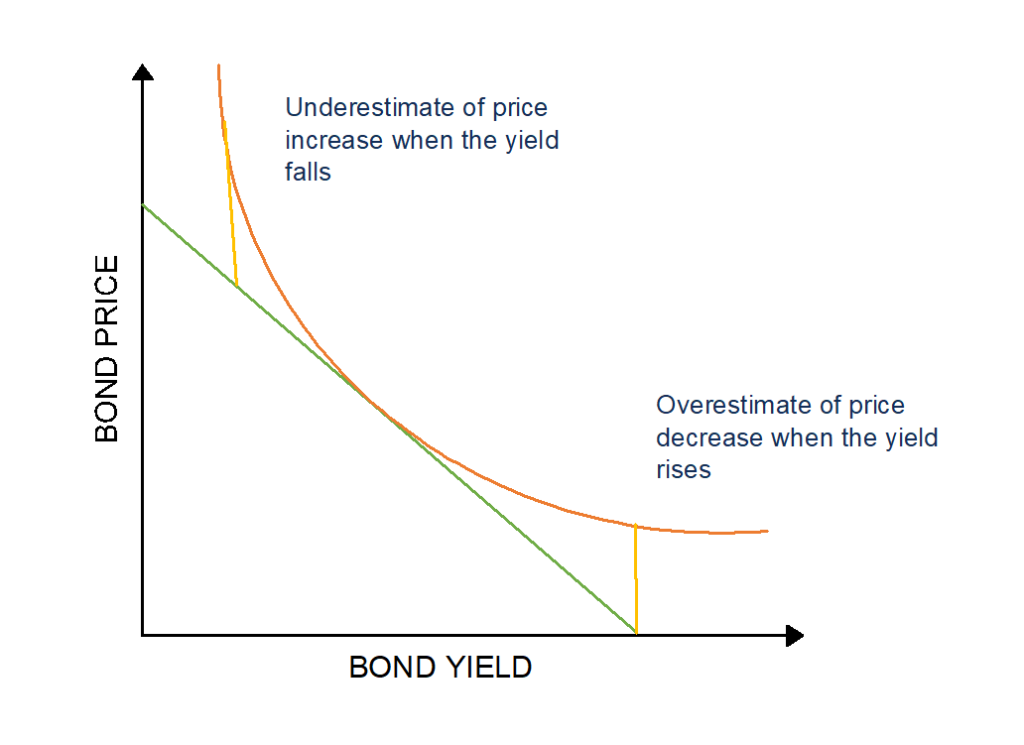
Bond yields and their prices share an inverse relationship. It means that when bond yields rise, bond prices fall, and vice versa. When bond yields rise due to falling interest rates, bond prices fall, and vice versa.
2. Factors affecting sensitivity
Factors, such as yield to maturity, coupon rateCoupon RateA coupon rate is the amount of annual interest income paid to a bondholder, based on the face value of the bond., and face value impact the relationship between the price and yield of the bond. A higher coupon rate gives a higher yield, while a higher face value gives a lower yield. The credit rating of the bond or the company issuing the bond also plays a part in determining the degree of sensitivity between the two.
3. Features of basis point value
A larger basis point value implies a bigger change in the price of the bond due to a given change in the yield of the bond. It affects the par value of the bond payable by the borrower to the lender at the time of maturity. Therefore, a higher basis point value represents a greater risk for the investor.
4. Calculation
The mathematical expression for the calculation of basis point value is as follows:
BPV = Yield x 0.0001
5. Graphical Illustration
More Resources
CFI offers the Commercial Banking & Credit Analyst (CBCA)™Program Page - CBCAGet CFI's CBCA™ certification and become a Commercial Banking & Credit Analyst. Enroll and advance your career with our certification programs and courses. certification program for those looking to take their careers to the next level. To keep learning and developing your knowledge base, please explore the additional relevant resources below:
- Bond PricingBond PricingBond pricing is the science of calculating a bond's issue price based on the coupon, par value, yield and term to maturity. Bond pricing allows investors
- Fixed Income TradingFixed Income TradingFixed income trading involves investing in bonds or other debt security instruments. Fixed income securities have several unique attributes and factors that
- VolatilityVolatilityVolatility is a measure of the rate of fluctuations in the price of a security over time. It indicates the level of risk associated with the price changes of a security. Investors and traders calculate the volatility of a security to assess past variations in the prices
- Yield CurveYield CurveThe Yield Curve is a graphical representation of the interest rates on debt for a range of maturities. It shows the yield an investor is expecting to earn if he lends his money for a given period of time. The graph displays a bond's yield on the vertical axis and the time to maturity across the horizontal axis.
-
Understanding Equity: A Comprehensive Guide for Investors
In finance and accounting, equity is the value attributable to the owners of a business. The book value of equity is calculated as the difference between assetsTypes of AssetsCommon types of assets in
-

Face Value Explained: Definition, Examples & Importance
The value mentioned on an instrument like a coin, stamp, or bill is called the face value of that instrument. For example, a $100 bill comes with a face value of $100. In calculus, the face value of 3
invest
- Understanding Bond Face Value: Definition & Importance
- Understanding Bond Accretion: A Comprehensive Guide
- Understanding Bond Pricing: Key Factors & Valuation
- Coupon Bonds: Understanding Fixed Income & Interest Payments
- Discount Bonds: Understanding Pricing & Secondary Markets
- Ex-Post Analysis: Understanding Outcomes After Events
- Understanding Noncallable Securities: A Comprehensive Guide
- Samurai Bonds: A Guide to Understanding Yen-Denominated Corporate Debt
- Treasury Bonds: A Comprehensive Guide to U.S. Government Debt
-
 Understanding Financial Denomination: A Comprehensive Guide
A denomination is a classification for the face value of a financial instrument. It includes financial instruments, such as bondsBondsBonds are fixed-income securities that are issued by corporations ...
-
 Understanding Bond Duration: A Key Fixed Income Metric
Duration is one of the fundamental characteristics of a fixed-income security (e.g., a bondBondsBonds are fixed-income securities that are issued by corporations and governments to raise capital....