
Bull Call Spread: Strategy, Benefits & How It Works
A bull call spread, which is an options strategy, is utilized by an investor when he believes a stock will exhibit a moderate increase in price. A bull spread involves purchasing an in-the-money (ITM) call option and selling an out-of-the-money (OTM) call option with a higher strike priceStrike PriceThe strike price is the price at which the holder of the option can exercise the option to buy or sell an underlying security, depending on but with the same underlying asset and expiration date. A bull call spread should only be used when the market is exhibiting an upward trend.
Formulas for Bull Call Spread
To determine the maximum profit, maximum loss, and break-even pointBreak-even Point (BEP)Break-even point (BEP) is a term in accounting that refers to the situation where a company's revenues and expenses were equal within a specific accounting period. It means that there were no net profits or no net losses for the company - it "broke even". BEP may also refer to the revenues that are needed to be reached in order to compensate for the expenses incurred for a bull call spread, refer to the following formulas:

Understanding a Bull Call Spread
Consider the following example:
An investor utilizes a bull call spread by purchasing a call optionCall OptionA call option, commonly referred to as a "call," is a form of a derivatives contract that gives the call option buyer the right, but not the obligation, to buy a stock or other financial instrument at a specific price - the strike price of the option - within a specified time frame. for a premium of $10. The call option comes with a strike price of $50 and expires in July 2020. At the same time, the investor sells a call option for a premium of $3. The call option comes with a strike price of $70 and expires in July 2020. The underlying asset is the same and is currently trading at $50. Summarizing the information above:

In writing the two options, the investor witnessed a cash outflow of $10 from purchasing a call option and a cash inflow of $3 from selling a call option. Netting the amounts together, the investor sees an initial cash outflow of $7 from the two call options.
Now, assume that it is July 2020. The table below illustrates theoretical stock prices at the expiration date.
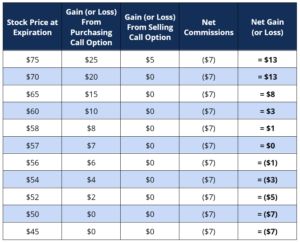
At a price of $60 or above, the investor’s gain is capped at $3 because both the long call option and short call option is in-the-money. For example, at the stock price of $65:
- The investor would gain through its long call position by being able to purchase at a strike price of $50 and sell at the market price of $65; and
- The investor would lose through its short call position by having to purchase at the market price of $65 and selling it to the option holder at $60.
Factoring in net commissionsCommissionCommission refers to the compensation paid to an employee after completing a task, which is, often, selling a certain number of products or services, the investor would be left with a net gain of $3.
At a price of $50 or below, the investor’s loss is capped at -$7, because both the long call option and short call option are out-of-the-money. For example, at the stock price of $45:
- The investor would not gain from its long call position; and
- The investor would not lose from its short call position.
Factoring in net commissions, the investor would be left with a net loss of $7.
Therefore, in a bull call spread, the investor is:
- Limited to the maximum loss equal to net commissions; and
- Limited to the maximum gain equal to the difference in strike prices between the short and long call and net commissions.
Applying the formulas for a bull call spread:
- Maximum profit = $70 – $50 – $7 = $13
- Maximum loss = $7
- Break-even point = $50 + $7 = $57
The values correspond to the table above.
Visual Representation
The comprehensive example above can be visually represented as follows:
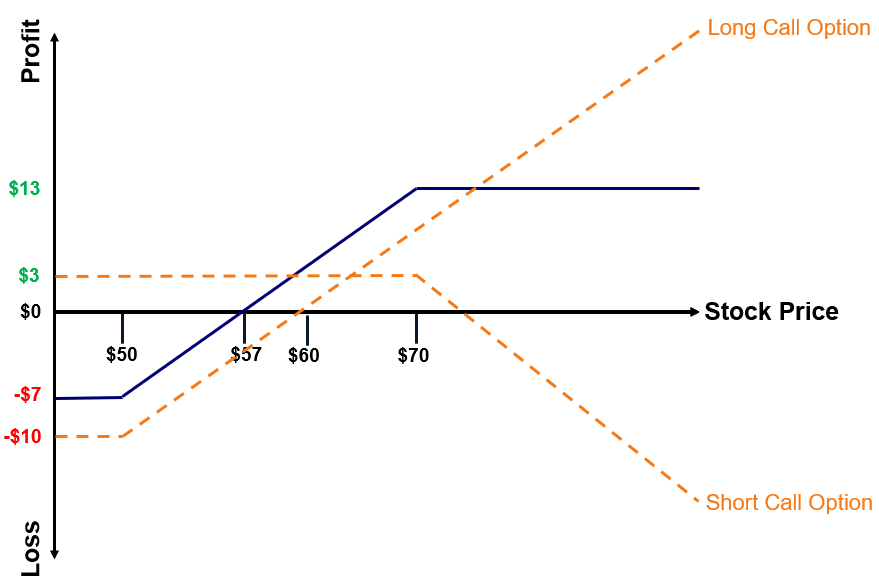
Where:
- The blue line represents the pay-off; and
- The dotted yellow lines represent a long call option and a short call option.
Note that the blue line is simply a combination of the two dotted yellow lines.
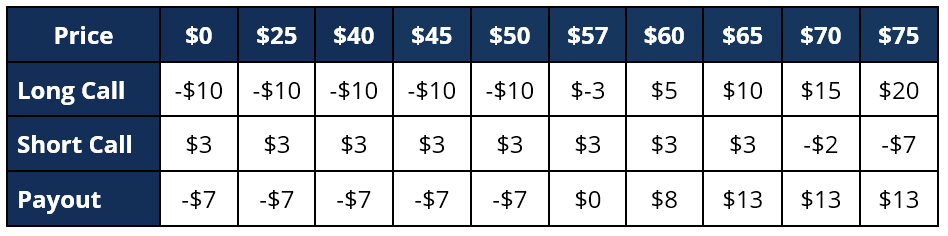
The payout table below corresponds to the visual graph above.
Example of a Bull Call Spread
Jorge is looking to utilize a bull call spread on ABC Company. ABC Company is currently trading at a price of $150. He purchases an in-the-money call option for a premium of $10. The strike price for the option is $145 and expires in January 2020. Additionally, Jorge sells an out-of-the-money call option for a premium of $2. The strike price for the option is $180 and expires in January 2020.
What are the maximum payout, maximum loss, and break-even point of the bull call spread above?
The net commission is $8 ($2 OTM Call – $10 ITM Call).
Applying the formulas for a bull call spread, Jorge determines the:
- Maximum profit = $180 – $145 – $8 = $27
- Maximum loss = $8
- Break-even point = $145 + $8 = $153
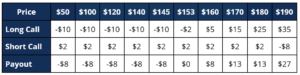
To confirm, Jorge creates a payout table:
Benefits and Drawbacks of Using a Bull Call Spread
The primary benefit of using a bull call spread is that it costs lower than buying a call option. In the example above, if Jorge only used a call option, he would need to pay a $10 premium. Through using a bull call spread, he only needs to pay a net of $8. In addition to being cheaper, the losses are lower as well. If the stock dropped to $0, Jorge would only realize a loss of $8 versus $10 (if he were to just use a long call option).
However, one significant drawback from using a bull call spread is that potential gains are limited. For example, in the example above, the maximum gain Jorge can realize is only $27 due to the short call option position. Even if the stock price were to skyrocket to $500, Jorge would only be able to realize a gain of $27.
More Resources
CFI is the official provider of the global Financial Modeling & Valuation Analyst (FMVA)™Become a Certified Financial Modeling & Valuation Analyst (FMVA)®CFI's Financial Modeling and Valuation Analyst (FMVA)® certification will help you gain the confidence you need in your finance career. Enroll today! certification program, designed to help anyone become a world-class financial analyst. To keep advancing your career, the additional resources below will be useful:
- Box SpreadBox SpreadA box spread is an options trading strategy that combines a bear put and a bull call spread. In order for a box spread to be effective:The expiration dates
- Options: Calls and PutsOptions: Calls and PutsAn option is a derivative contract that gives the holder the right, but not the obligation, to buy or sell an asset by a certain date at a specified price.
- Spread TradingSpread TradingSpread trading – also known as relative value trading – is a method of trading that involves an investor simultaneously buying one security and selling a
- Investing: A Beginner’s GuideInvesting: A Beginner's GuideCFI's Investing for Beginners guide will teach you the basics of investing and how to get started. Learn about different strategies and techniques for trading
-

Bull vs. Bear Market: Understanding Market Trends & Investor Sentiment
The term “bull vs. bear” denotes the ensuing trends in stock markets – whether they are appreciating or depreciating in value – and what is the investors’ outlook about t
-
Understanding Call Dates: What You Need to Know
A call date refers to the date when a callable bondCallable BondA callable bond (redeemable bond) is a type of bond that provides the issuer of the bond with the right, but not the obligation, to rede
invest
- Bull Call Spread: Strategy, Benefits & Risk Management
- Bull Put Spread: Strategy, Mechanics & Risk
- Call Options: A Comprehensive Guide for Investors
- Call Ratio Back Spread: A Bullish Options Strategy Explained
- Interest Rate Call Options: Understanding & Benefits
- Naked Calls Explained: Strategy, Risks & Rewards
- Bull Call Spread: A Comprehensive Guide for Investors
- Understanding Option Spreads: A Risk Management Strategy
- Covered Call Options: A Beginner's Guide to Income Strategy
-
 Calendar Spreads: Understanding Options & Futures Strategies
What Is a Calendar Spread? A calendar spread is an options or futures strategy established by simultaneously entering a long and short position on the same underlying asset but with different d...
-
 What is a Stock Option?
A stock option is a contract between two parties that gives the buyer the right to buy or sell underlying stocksStockWhat is a stock? An individual who owns stock in a company is called a shareholder ...