
Bull Put Spread: Strategy, Mechanics & Risk
A bull put spread, which is an options strategy, is utilized by an investor when he believes the underlying stock will exhibit a moderate increase in price. A bull put spread involves purchasing an out-of-the-money (OTM) put option and selling an in-the-money (ITM) put option with a higher strike priceStrike PriceThe strike price is the price at which the holder of the option can exercise the option to buy or sell an underlying security, depending on but with the same underlying asset and expiration date. A bull put spread should only be used when the market is exhibiting an upward trend.
Summary
- A bull put spread is an options strategy where an investor believes that the underlying stock will exhibit a moderate increase in price.
- A bull put spread involves purchasing an OTM put option and selling an ITM put option.
- In a bull put spread, the maximum gain is realized when the positions are initiated and faces potential losses as the strategy approaches maturity.
Formulas for Bull Put Spread
To determine the maximum loss and break-even point for a bull put spread, refer to the following formulas:

Note that when the bull put spread position is entered, the investor starts with the maximum gain and faces potential losses as the strategy approaches maturity. Following, we will go through a comprehensive example outlining this.
Understanding a Bull Put Spread
Consider the following example:
An investor utilizes a bull put spread by purchasing a put optionPut OptionA put option is an option contract that gives the buyer the right, but not the obligation, to sell the underlying security at a specified price (also known as strike price) before or at a predetermined expiration date. It is one of the two main types of options, the other type being a call option. for a premium of $15. The put option comes with a strike price of $80 and expires in July 2020. At the same time, the investor sells a put option for a premium of $35. The put option comes with a strike price of $120 and expires in July 2020. The underlying asset is the same and is currently trading at $95.
Summarizing the information above:

In writing the two options, the investor witnessed a cash outflow of $15 from purchasing a call option and a cash inflow of $35 from selling a call option. Netting the amounts together, the investor generated an initial cash inflow of $20 from the two put options.
Now, assume that it is July 2020. The table below illustrates theoretical stock prices at the expiration date.
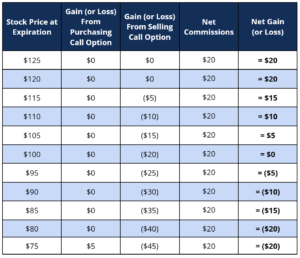
At a price of $120 or above, the investor’s gain is capped at $20 because both the long put option and the short put option are out-of-the-money. For example, at the stock price of $125:
- The investor would gain $0 from its long put option; and
- The investor would lose $0 from its short put option.
Factoring in net commissionsCommissionCommission refers to the compensation paid to an employee after completing a task, which is, often, selling a certain number of products or services, the investor would be left with a net gain of $20.
At a price of $80 or below, the investor’s loss is capped at -$20 because both the long put option and the short put option are in-the-money. For example, at the stock price of $75:
- The investor would gain $5 from its long put option; and
- The investor would lose $45 from its short put option.
Factoring in net commissions, the investor would be left with a net loss of $20.
Therefore, in a bull put spread, the investor is:
- Limited to the maximum loss equal to the strike price of the short put minus the strike price of the long put plus net premiums received; and
- Limited to the maximum gain equal to net commissions.
Applying the formulas for a bull put spread:
- Maximum profit = $20
- Maximum loss = $120 – $80 – 20 = $20
- Break-even point = $120 – $20 = $100
The values calculated correspond to the table above.
Visual Representation
The comprehensive example above can be visually represented as follows:
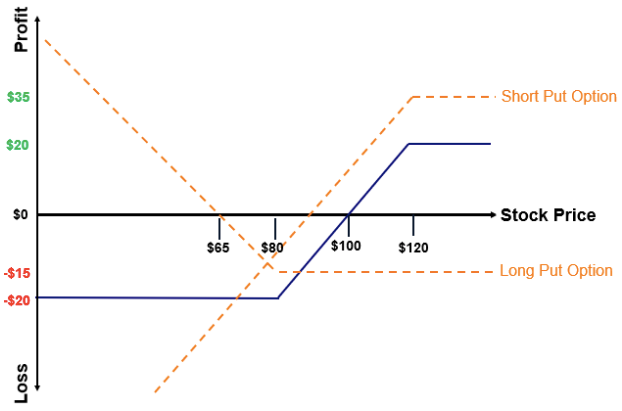
Where:
- The blue line represents the pay-off; and
- The dotted yellow lines represent the long put option and the short put option.
Note that the blue line is simply a combination of the two dotted yellow lines.
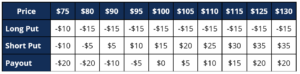
The payout table below corresponds to the visual graph above.
Example of a Bull Put Spread
Jorge is looking to utilize a bull put spread on ABC Company. ABC Company is currently trading at a price of $150. He purchases an in-the-money put option for a premium of $10. The strike price for this option is $140 and expires in January 2020. Additionally, Jorge sells an out-of-the-money put option for a premium of $30. The strike price for the option is $180 and expires in January 2020.
What are the maximum payout, maximum loss, and break-even point of the bull call spread above?
The net commissions is $20 ($30 OTM Put – $10 ITM Put).
Applying the formulas for a bull call spread, Jorge determines:
- Maximum profit = $20
- Maximum loss = $180 – $140 – $20 = $20
- Break-even point = $180 – $20 = $160
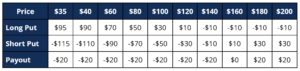
To confirm, Jorge creates a payout table:
Benefits and Drawbacks from Using a Bull Put Spread
The main reason behind using a bull put spread is to immediately realize the maximum profit upon executing the spread. In the example above, Jorge is able to realize a maximum profit of $20 immediately into executing a bull put spread. In addition, although the maximum gains are capped, the investor is protected from downside risk as well.
However, one significant drawback from a bull put spread is that potential gains are limited. For example, in the example above, the maximum gain Jorge can realize is only $20 due to the short put option position. Even if the stock price were to decline to $0, Jorge would only be able to realize a gain of $20.
Related Readings
CFI is the official provider of the Capital Markets & Securities Analyst (CMSA)®Program Page - CMSAEnroll in CFI's CMSA® program and become a certified Capital Markets &Securities Analyst. Advance your career with our certification programs and courses. certification program, designed to transform anyone into a world-class financial analyst.
To keep learning and developing your knowledge of financial analysis, we highly recommend the additional resources below:
- Bull Call SpreadBull Call SpreadA bull call spread, which is an options strategy, is utilized by an investor when he believes a stock will exhibit a moderate increase in price. A bull
- Options: Calls and PutsOptions: Calls and PutsAn option is a derivative contract that gives the holder the right, but not the obligation, to buy or sell an asset by a certain date at a specified price.
- Spread TradingSpread TradingSpread trading – also known as relative value trading – is a method of trading that involves an investor simultaneously buying one security and selling a
- Investing: A Beginner’s GuideInvesting: A Beginner's GuideCFI's Investing for Beginners guide will teach you the basics of investing and how to get started. Learn about different strategies and techniques for trading
-
Call Options: A Comprehensive Guide for Investors
A call option, commonly referred to as a “call,” is a form of a derivatives contract that gives the call option buyer the right, but not the obligation, to buy a stockStockWhat is a stock?
-

Currency Option Bonds: Understanding Flexible Investments
A currency option bond is a security that offers returns in multiple currencies. The holder of a currency option bond can choose the currency in which they would like to be paid. The feature extends t
invest
- Barrier Options: Understanding and Trading Strategies
- Bear Put Spread: Definition, Strategy & Risk Management
- Box Spread Options Strategy: Definition & How It Works
- Bull Call Spread: Strategy, Benefits & How It Works
- Understanding Gamma in Finance: A Comprehensive Guide
- Naked Puts: Definition, Strategy & Risks - Investopedia
- Put Options Explained: A Comprehensive Guide for Investors
- Short Put Options: A Comprehensive Guide for Investors
- Understanding Option Spreads: A Risk Management Strategy
-
 What is a Stock Option?
A stock option is a contract between two parties that gives the buyer the right to buy or sell underlying stocksStockWhat is a stock? An individual who owns stock in a company is called a shareholder ...
-
 Bull vs. Bear Market: Understanding Market Trends & Investor Sentiment
The term “bull vs. bear” denotes the ensuing trends in stock markets – whether they are appreciating or depreciating in value – and what is the investors’ outlook about t...