
Call Ratio Back Spread: A Bullish Options Strategy Explained
A call ratio back spread is a bullish options trading strategy that involves both buying and selling call options. The strategy is designed to maximally profit from a significant upward movement in the price of the underlying stockUnderlying SecurityUnderlying security is a term in investing that denotes the negotiable financial instrument upon which a financial derivative, such as an in the near term. The combination of options bought and sold limits your risk while still maintaining theoretically unlimited profit potential.
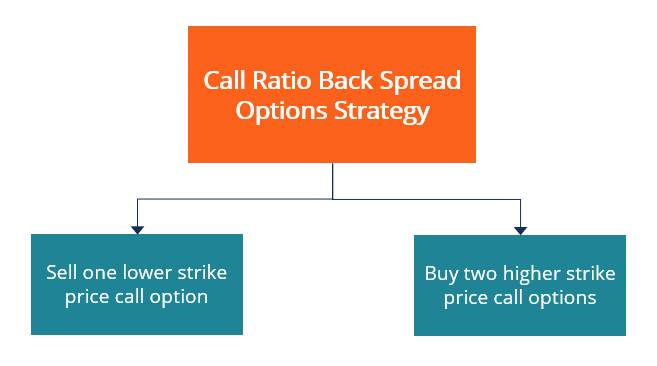
Higher volatility in the price of the underlying stock is a plus for the call ratio back spread strategy, likely to help maximize gains.
The “ratio” in the option strategy name refers to the fact that a 2:1 ratio of bought call options to sold call options is employed. It is referred to as a “back spread” because it is commonly employed using longer-term or “back-month” options, thus affording more time for the trade to work in the investor’s favor.
Summary
- A call ratio back spread is a bullish options trading strategy that involves both buying and selling call options.
- The combination of options bought and sold limits risk while still maintaining theoretically unlimited profit potential.
- The use of the call ratio back spread strategy can be enhanced by putting the call spread in place for a net credit.
Employing the Call Ratio Back Spread
The call ratio back spread strategy is implemented as follows:
- You write (sell) one lower strike price call option.
- You buy two higher strike price options.
All options bought and sold should have the same expiration date. The trade may be put into place for a net credit if the money received for selling the one lower strike price call option is more than the cost of the two higher strike price call options that are purchased.
Whether the trade is put into place with a net credit or net debit will depend on the specific option strike prices, the distance between the option strike prices, the volatilityVolatilityVolatility is a measure of the rate of fluctuations in the price of a security over time. It indicates the level of risk associated with the price changes of a security. Investors and traders calculate the volatility of a security to assess past variations in the prices of the option prices, and the time remaining until the options expire.
Profit Potential
There is theoretically unlimited potential profit from a rise in the underlying stock price, thanks to the purchase of two call options, which makes the strategy a net long call position.
If you can establish this call spread position for a net credit, then there is also potential profit even if the price of the underlying stock falls rather than rises. If at the time all of the options expire, the price of the stock is below the strike priceStrike PriceThe strike price is the price at which the holder of the option can exercise the option to buy or sell an underlying security, depending on of the call option that was sold, then all of the options will expire worthless, but you will retain the credit received when the position was established.
There is no potential profit from a downside move if the position is established at a net debit, but the maximum loss is limited to the amount of the net debit incurred when the strategy was put in place.
Maximum Risk
The maximum potential loss occurs if, at the time of the options’ expiration, the price of the underlying stock is at the higher strike price of the two calls that were purchased. The maximum amount of loss at that point will equal the difference between the bought and sold call strike prices and either minus the net credit received when establishing the position or plus the net debit incurred when establishing the position.
Example
Assume that the underlying stock is trading at $32 per share when a trader implements the call ratio back spread strategy by selling one call option with a strike price of $30 and buying two call options with a strike price of $35. There are four possible scenarios that can unfold for the trader, as follows:
1. Maximum Loss: If the underlying stock is trading at $35 per share when the options expire, then both $35 strike price calls purchased will expire worthless, while the $30 strike price call that was sold is in-the-money with an intrinsic valueIntrinsic ValueThe intrinsic value of a business (or any investment security) is the present value of all expected future cash flows, discounted at the appropriate discount rate. Unlike relative forms of valuation that look at comparable companies, intrinsic valuation looks only at the inherent value of a business on its own. of $500 for the option buyer. Thus, it will cost the trader employing the call ratio back spread strategy $500 to close out their position.
2. Breakeven: If, at the time of the options expiration, the underlying stock is at $40 per share, then the sold call will show a $1,000 loss, but the purchased calls, combined, will show a $1,000 profit.
3. Maximum Profit: Maximum profit from the call ratio back spread is achieved as the price of the underlying stock rises above $40 per share. Beyond such a point, the intrinsic value of the two purchased calls will be greater than the intrinsic value loss incurred from the lower strike price call that was sold.
4. If, at expiration, the price of the underlying stock has fallen to below $30 a share, then all the options expire worthless, and whether the trader generates a small profit or incurs a small loss depends on whether the call spread was implemented with a net credit or net debit.
Learn More
CFI is the official provider of the global Capital Markets & Securities Analyst (CMSA)™Program Page - CMSAEnroll in CFI's CMSA® program and become a certified Capital Markets &Securities Analyst. Advance your career with our certification programs and courses. certification program, designed to help anyone become a world-class financial analyst. To keep advancing your career, the additional CFI resources below will be useful:
- Bullish and BearishBullish and BearishProfessionals in corporate finance regularly refer to markets as being bullish and bearish based on positive or negative price movements. A bear market is typically considered to exist when there has been a price decline of 20% or more from the peak, and a bull market is considered to be a 20% recovery from a market bottom.
- Call PriceCall PriceA call price refers to the price that a preferred stock or bond issuer would pay to buyers if they chose to redeem the callable security
- At The Money (ATM)At The Money (ATM)At the money (ATM) describes a situation when the strike price of an option is equal to the underlying asset's current market price. It is a concept of
- Options: Calls and PutsOptions: Calls and PutsAn option is a derivative contract that gives the holder the right, but not the obligation, to buy or sell an asset by a certain date at a specified price.
-

Covered Calls: A Comprehensive Guide for Investors
A covered call is a risk management and an options strategy that involves holding a long position in the underlying asset (e.g., stockStockWhat is a stock? An individual who owns stock in a company is
-

Understanding Exotic Options: A Comprehensive Guide
Exotic options are the classes of optionOptions: Calls and PutsAn option is a derivative contract that gives the holder the right, but not the obligation, to buy or sell an asset by a certain date at
invest
- Understanding Put & Call Options: A Comprehensive Guide
- Box Spread Options Strategy: Definition & How It Works
- Bull Call Spread: Strategy, Benefits & How It Works
- Call Premium Explained: Understanding Issuer Redemptions & Option Pricing
- Call Ratio Back Spread: A Bullish Options Strategy Explained
- Hedge Ratio: A Comprehensive Guide to Risk Management
- Spread Trading: A Comprehensive Guide to Relative Value Trading
- Volatility Ratio: Understanding Price Changes for Trading & Investing
- Bear Call Spread: A Beginner's Guide to Profiting from Market Declines
-
 Call Swaptions: Understanding Receiver Options for Tax Rate Swaps
A call swaption, also known as a receiver swaption, is an option that allows the holder to take part in a private tax rate swap. All swaptions are conducted over-the-counter (OTC)Over-the-Counter (OTC...
-
 Call Warrants: Understanding Rights & Investment Potential
A call warrant gives the holder of the investment the right, not the obligation, to purchase the underlying financial securities at a specific price on or before a certain date.If the holder does not ...