
Bear Put Spread: Definition, Strategy & Risk Management
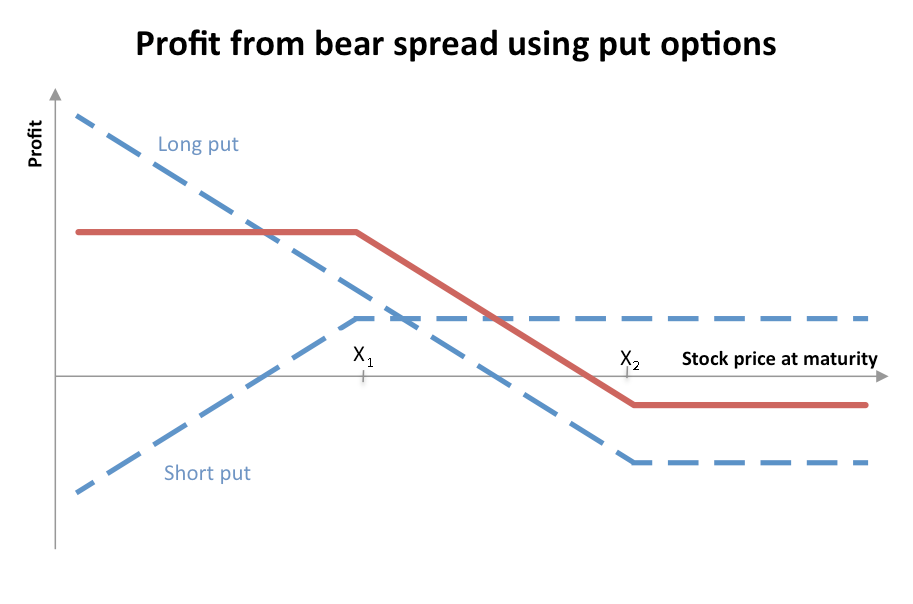
In a bear put spread, the basic idea is to purchase a high strike priceStrike PriceThe strike price is the price at which the holder of the option can exercise the option to buy or sell an underlying security, depending on put and then sell a lower one. The goal is a decline in stock price, with a close – at the time of expiration – that is equal to or below the lower strike price.

The spread is vertical, with two strike prices that expire in the same period. The put option that is sold – the one with the lower strike price – is clearly worth less than the put option with the higher strike price that is purchased. This results in a net debit, as the money received for selling the lower strike price put is less than the money paid for the higher strike price put.
Summary:
- There are two basic options contracts: puts and calls. Puts allow traders to sell an option’s underlying asset at a designated strike price up until the option expires; calls allow the trader to buy the asset at the designated price up until the option expires.
- The general strategy of a bear put spread is to buy a higher strike price put and then sell a lower one; the goal is to watch the stock decline and close at any point that is equal to or above the lower strike price at the time of expiration.
- If the stock closes at or below the lower strike price, the trader profits the difference between the strike prices, minus the premium initially paid.
Understanding Options
To better understand a bear put spread, a basic understanding of options is necessary. There are two option types: calls and putsOptions: Calls and PutsAn option is a derivative contract that gives the holder the right, but not the obligation, to buy or sell an asset by a certain date at a specified price.. A call enables an owner to purchase an option’s underlying asset at the contracted strike price, up until the date that the call option expires.
A put option, on the other hand, allows the owner to sell the option’s underlying asset at the strike price outlined in the contract, up until the date that the put option expires.
Profit and Loss in a Bear Put Spread
As mentioned above, the result of a bear put spread is a net debit. The maximum amount that a trader loses on any debit spread – such as the bear put spread – is the amount that the trader paid for it, otherwise known as the net debit. It is the price of the higher strike price option minus the price of the lower strike price option. It happens if, at the time of expiration, the underlying asset closes at any price that is higher than the strike price of the purchased put optionPut OptionA put option is an option contract that gives the buyer the right, but not the obligation, to sell the underlying security at a specified price (also known as strike price) before or at a predetermined expiration date. It is one of the two main types of options, the other type being a call option..
With minimal risk comes minimal reward. The most that a trader can profit from a bear put spread is the total difference between the strike prices, after deducting the amount paid for the higher strike put. The maximum gain occurs if the underlying asset closes at any price equal to or below the lower strike price at the time of expiration.
In such a case, the trader exercises his higher strike put, selling the stock at the higher strike price. If it’s in the money, the other, lower strike price put option is exercised automatically, and the trader purchases the stock at the lower strike price. Thus, no net position in the underlying stock is created.
If at expiration, the stock price is at or above the higher strike price, then both options expire unexercised. If the stock price is below the strike price of the higher strike option but not below the strike price of the lower strike option, then the higher strike put is exercised, giving the trader a short position in the underlying stock.
Related Readings
CFI is the official provider of the global Financial Modeling & Valuation Analyst (FMVA)™Become a Certified Financial Modeling & Valuation Analyst (FMVA)®CFI's Financial Modeling and Valuation Analyst (FMVA)® certification will help you gain the confidence you need in your finance career. Enroll today! certification program, designed to help anyone become a world-class financial analyst. To keep advancing your career, the additional resources below will be useful:
- Bull Call SpreadBull Call SpreadA bull call spread, which is an options strategy, is utilized by an investor when he believes a stock will exhibit a moderate increase in price. A bull
- Bull Put SpreadBull Put SpreadA bull put spread, which is an options strategy, is utilized by an investor when he believes the underlying stock will exhibit a moderate increase in price.
- Put-Call Ratio (PCR)Put-Call Ratio (PCR)The put-call ratio is an indicator used by investors to gauge the outlook of the market. The ratio uses the volume of puts and calls over a determined time
- Spread TradingSpread TradingSpread trading – also known as relative value trading – is a method of trading that involves an investor simultaneously buying one security and selling a
-

Understanding Forex Spreads: A Comprehensive Guide
The foreign exchange spread (or bid-ask spread) refers to the difference in the bid and ask prices for a given currency pair. The bid price refers to the maximum amount that a foreign exchange trader5
-

Understanding Bear Markets: What Investors Need to Know
The securities market can’t climb forever. Eventually prices will begin to fall. We call this period of decline a “bear market.” It’s not the end of the world for investors, but it’s a concept you sho
invest
- Bid-Ask Spread
- Bull Put Spread: Strategy, Mechanics & Risk
- Understanding Horizontal Spreads in Options Trading
- Protective Puts: A Comprehensive Guide to Risk Management
- Put Options Explained: A Comprehensive Guide for Investors
- Short Put Options: A Comprehensive Guide for Investors
- Understanding Strike Price: Options Trading Explained
- Understanding Vertical Spreads: A Beginner's Guide
- Put Options Explained: A Beginner's Guide to Protecting Your Investments
-
 Understanding Volatility: A Key Indicator of Investment Risk
Volatility is a measure of the rate of fluctuations in the price of a securityMarketable SecuritiesMarketable securities are unrestricted short-term financial instruments that are issued eit...
-
 Bear Put Spread: A Comprehensive Guide for Risk Management
A bear put spread is the simultaneous purchasing and writing of two put options. This spread has the advantage of lowering the cost of the initial investment as well as defining a set maximum lo...