
Convertible Bonds: A Comprehensive Guide for Investors
A convertible bond is a type of debt security that provides an investor with a right or an obligation to exchange the bond for a predetermined number of sharesStockWhat is a stock? An individual who owns stock in a company is called a shareholder and is eligible to claim part of the company’s residual assets and earnings (should the company ever be dissolved). The terms "stock", "shares", and "equity" are used interchangeably. in the issuing company at certain times of a bond’s lifetime. It is a hybrid security that possesses features of both debt and equityStockholders EquityStockholders Equity (also known as Shareholders Equity) is an account on a company's balance sheet that consists of share capital plus.
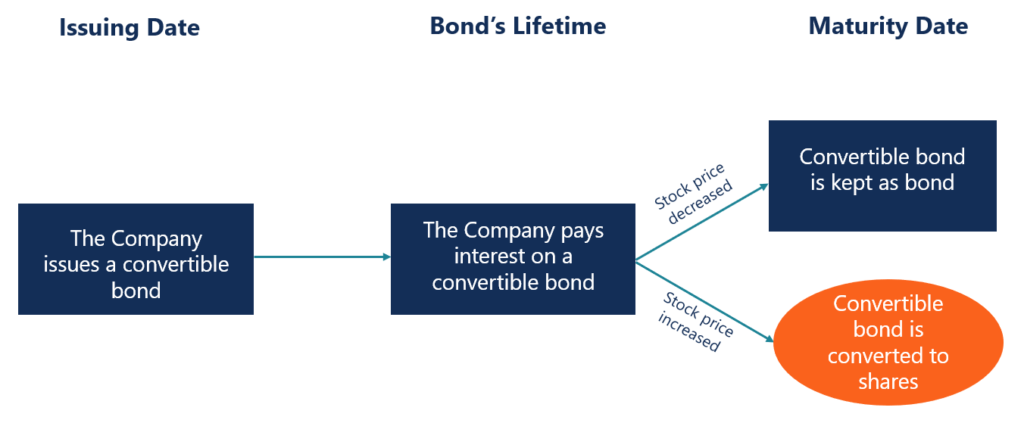
Similar to regular bonds, a convertible bond comes with a maturity date and pays interest to investors. In addition, if an investor decides not to convert their bonds to equity, they will receive the bond’s face valuePar ValuePar Value is the nominal or face value of a bond, or stock, or coupon as indicated on a bond or stock certificate. It is a static value at the maturity. However, if an investor converts the bonds to the company’s shares, the bond will lose all its debt features and then possess only equity features.
Companies with a low credit rating and high growth potential often issue convertible bonds. For financing purposes, the bonds offer more flexibility than regular bonds. They may be more attractive to investors since convertible bonds provide growth potential through future capital appreciation of the stock price.
Types of convertible bonds
There is no formal classification of convertible bonds in the financial markets. However, underwriters often refer to the following types:
1. Vanilla convertible bonds
These are the most common type of convertible bonds. Investors are granted the right to convert their bonds to a certain number of shares at a predetermined conversion price and rate at the maturity date. Vanilla bonds may pay coupon payments during the life of the bond, and come with a fixed maturity date at which the investors are entitled to the nominal value of the bond.
2. Mandatory convertibles
Mandatory convertibles provide investors with an obligation to convert their bonds to shares at maturity. The bonds usually come with two conversion prices. The first price would delimit the price at which an investor will receive the equivalent of its par value in shares. The second price sets a limit to the price that the investor can receive above the par value.
3. Reverse convertibles
Reverse convertible bonds give the issuer an option to either buy back the bond in cash or convert the bond to the equity at a predetermined conversion price and rate at the maturity date.
Advantages of convertible bonds
Convertible bonds are a flexible option for financing that offers some advantages over regular debt or equity financing. Some of the benefits include:
1. Lower interest payments
Generally, investors are willing to accept lower interest payments on convertible bonds than on regular bonds. Thus, issuing companies can save money on their interest payments.
2. Tax advantages
Since interest payments are tax-deductible, convertible bonds allow the issuing company to benefit from interest tax savings that are not possible in equity financing.
3. Deferral of stock dilution
If a company is not willing to dilute its stock shares in the short or medium term but is comfortable doing so in the long term, convertible bond financing is more appropriate than equity financing. The current company’s shareholders retain their voting power and they may benefit from the capital appreciation of its stock price in the future.
More resources
CFI is the official global provider of the Financial Modeling and Valuation Analyst (FMVA) Become a Certified Financial Modeling & Valuation Analyst (FMVA)®CFI's Financial Modeling and Valuation Analyst (FMVA)® certification will help you gain the confidence you need in your finance career. Enroll today!certification for financial analysts around the world. To continue your development, these additional resources will be helpful:
- Bond IssuersBond IssuersThere are different types of bond issuers. These bond issuers create bonds to borrow funds from bondholders, to be repaid at maturity.
- Debt Capital MarketsDebt Capital Markets (DCM)Debt Capital Markets (DCM) groups are responsible for providing advice directly to corporate issuers on the raising of debt for acquisitions, refinancing of existing debt, or restructuring of existing debt. These teams operate in a rapidly moving environment and work closely with an advisory partner
- Fixed Income SecuritiesFixed Income SecuritiesFixed income securities are a type of debt instrument that provides returns in the form of regular, or fixed, interest payments and repayments of the
- Senior Term DebtSenior Term DebtSenior term debt is a loan with a priority repayment status in case of bankruptcy, and typically carries lower interest rates and lower risk.
-

Profit Sharing Bonds: Understanding Investment Income & Potential
A profit sharing bond is a fixed income security whereby the holder receives regular interest payments and a share in the profits or dividends of the bond-issuing company. Other Nam
-

Understanding Term to Maturity: A Key Bond Concept
Term to maturity is the remaining life of a bond or other type of debt instrument. The duration ranges between the time when the bond is issued until its maturity date when the issuer is required to r
invest
- Understanding Bonds: A Comprehensive Guide for Investors
- Callable Bonds: Understanding Issuer Redemption Rights
- Green Bonds: Financing a Sustainable Future | [Your Company Name]
- High-Yield Bonds: Understanding Risk & Potential Returns
- Kangaroo Bonds: A Guide to Australian Dollar Debt
- L Bonds: Understanding Unrated Life Insurance Bonds
- Municipal Bonds: A Comprehensive Guide for Investors
- Non-Callable Bonds: Understanding Key Features & Differences
- Understanding Bonds: A Comprehensive Guide for Investors
-
 General Obligation Bonds (GO Bonds): A Comprehensive Guide
A general obligation (GO) bond is a type of municipal bond in which the bond repayments (interest and principalPrincipal PaymentA principal payment is a payment toward the original amount of a loan th...
-
 Understanding High-Yield Bond Spreads: A Comprehensive Guide
A high-yield bond spread, also known as a credit spread, is the difference in yields between multiple high-yield bonds, expressed in basis points or percentage points. A high-yield bond is a term that...