
L Bonds: Understanding Unrated Life Insurance Bonds
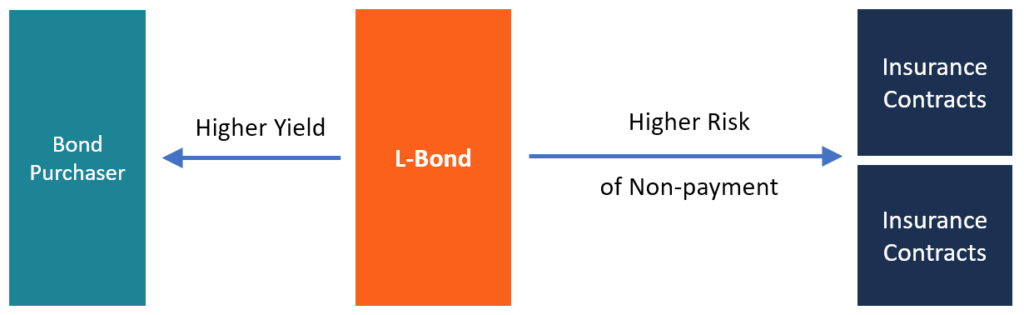
An L Bond refers to an unrated life insurance bond that finances the purchase and premium payments of life insurance contracts bought in the secondary marketSecondary MarketThe secondary market is where investors buy and sell securities from other investors. Examples: New York Stock Exchange (NYSE), London Stock Exchange (LSE).. The bond offers a higher yield than other publicly traded offeringsPublic SecuritiesPublic securities, or marketable securities, are investments that are openly or easily traded in a market. The securities are either equity or debt-based. to compensate for the risk that the insurance policy benefits may not be paid. People buy life insurance policies from insurance providers with the goal of protecting their beneficiaries after they die. The protection may be in the form of monetary compensation to bridge the gap left by the policyholder.
The policyholder may decide to sell the policy in the secondary market when they are unable to continue paying the insurance premiums, no longer need the insurance protection, or are in need of urgent cash flow. The person who purchases the policy now becomes the beneficiary. Contingent BeneficiaryA contingent beneficiary is the alternative beneficiary, designated by the account holder, who is set to receive the proceeds or benefits of a financialWhen the original policyholder dies, the buyer will receive compensation from the insurer.
After the purchase, the buyer is now responsible for making the premium payments to the insurance carrier. The buyer purchases the life insurance policy for more than the surrender value but less than the benefits expected. The buyer profits from the transaction by aligning the expected returns/benefits with the life expectancy of the original policyholder.
How an L Bond Works
Minnesota-based company GWG Holdings, the parent company of GWG Life, buys life settlements contracts from policyholders at prices that exceed the surrender value. The company finances these purchases through the sale of high-yield bonds to buyers looking to invest in instruments that have a higher yield.
GWG Holdings sells unrated bonds, which therefore come with a higher risk. According to the firm’s fact sheet, L Bonds are considered speculative and are subject to a higher degree of risk.
Maturities of L Bonds
L Bonds come with maturities ranging from two to seven years. Previously, GWG offered bonds with 6-month and 1-year maturities, but the company stopped that practice in September 2016. The bonds are illiquid, so investors must wait until maturity to access their investments.
Preferred Stock
GWG Holdings also issues preferred stocksCost of Preferred StockThe cost of preferred stock to a company is effectively the price it pays in return for the income it gets from issuing and selling the stock. They calculate the cost of preferred stock by dividing the annual preferred dividend by the market price per share. that pay a dividend of 7% and come with a conversion option. The issuer can recall them before the maturity date and their proceeds correlate to the life insurance policy purchased from the original policyholders. In a situation where the insurance provider goes bankrupt, the company may be unable to make timely dividend payments. This will affect the prices of its offerings.
Attractiveness of L Bonds
Although these bonds come with a high degree of risk, they are attractive to investors due to their high yields. Also, unlike other alternative investments that are highly correlated to certain segments of the market, they are not correlated to the equity or fixed income markets.
Characteristics of L Bonds
- Investors can purchase the bonds from GWG Holdings or a Depository Trust Company participant.
- The bonds are sold in denominations of $1,000. The minimum amount that an investor can purchase is $25,000.
- They are illiquid investments, and the holders cannot sell them on the secondary market. They need to wait until the bonds mature to redeem the principal amount. It is highly unlikely that these bonds can be purchased in the secondary market.
- The interest rate for a bond remains fixed for the entire term of the bond, even if the market interest rates change.
- The bonds are callable. The issuer possesses the right to recall the bond at any time before the maturity date without a penalty. This may occur when market interest rates fall below the interest rate offered by the bonds.
- Holders cannot redeem the bond before the maturity date or the death or disability of the original policyholder. However, if GWG agrees to redeem the bond for any other reason, the bondholder will be charged a penalty of 6%.
- Upon maturity, the bond is automatically renewed unless the bondholder decides to redeem the bond.
- The bonds do not correlate to equity or fixed income markets, and their value is not affected by the volatility of the financial markets.

How GWG Holdings Operates
GWG Holdings is a leading issuer of the high-yield bonds. The company purchases life insurance settlement contracts from seniors in order to make money. For example, the firm may purchase a 5-year $5-million life insurance policy that pays $100,000 a year for $1 million. When the policy matures, or the seller dies, the insurance provider pays GWG Holdings $5 million in life insurance settlements. The funds raised from the policy are used to purchase additional life insurance assets.
The first GWG L Bond issue was in August 2012 for a $250 million offering. The issue was fully subscribed by December 2014. The firm issued the second offering of $1 billion in January 2015 with maturities of 2 to 7 years. In total, the company sold over $400 million worth of bonds through its independent broker-dealer channel of over 5,000 advisors.
The company also entered into an arrangement where the bonds are available through Depository Trust Company. In 2016, GWG announced that it held over 500 policies with total insurance assets valued at $1.15 billion.
Summary
An L Bond is an investment vehicle that offers high yields to compensate investors for the risk that the insurance premiums or benefits may not be paid. It is used to finance the purchase and premium payments of insurance contracts purchased in the secondary market.
Other resources
CFI is a global provider of the Financial Modeling & Valuation Analyst (FMVA)®Become a Certified Financial Modeling & Valuation Analyst (FMVA)®CFI's Financial Modeling and Valuation Analyst (FMVA)® certification will help you gain the confidence you need in your finance career. Enroll today! certification program for finance professionals. To learn more and expand your career, explore the additional relevant resources below:
- Coupon RateCoupon RateA coupon rate is the amount of annual interest income paid to a bondholder, based on the face value of the bond.
- Discount BondDiscount BondA discount bond is a bond that is issued at a lower price than its par value or a bond that is trading in the secondary market at a price that is below the par value. It is similar to a zero-coupon bond, only that the latter does not pay interest. A bond is considered to trade at a discount
- Fixed Income SecuritiesTrading & InvestingCFI's trading & investing guides are designed as self-study resources to learn to trade at your own pace. Browse hundreds of articles on trading, investing and important topics for financial analysts to know. Learn about assets classes, bond pricing, risk and return, stocks and stock markets, ETFs, momentum, technical
- Social SecuritySocial SecuritySocial Security is a US federal government program that provides social insurance and benefits to people with inadequate or no income. The first Social
-

Profit Sharing Bonds: Understanding Investment Income & Potential
A profit sharing bond is a fixed income security whereby the holder receives regular interest payments and a share in the profits or dividends of the bond-issuing company. Other Nam
-

Understanding Term to Maturity: A Key Bond Concept
Term to maturity is the remaining life of a bond or other type of debt instrument. The duration ranges between the time when the bond is issued until its maturity date when the issuer is required to r
invest
- Understanding Bonds: A Comprehensive Guide for Investors
- Callable Bonds: Understanding Issuer Redemption Rights
- Convertible Bonds: A Comprehensive Guide for Investors
- Green Bonds: Financing a Sustainable Future | [Your Company Name]
- High-Yield Bonds: Understanding Risk & Potential Returns
- Kangaroo Bonds: A Guide to Australian Dollar Debt
- Municipal Bonds: A Comprehensive Guide for Investors
- Non-Callable Bonds: Understanding Key Features & Differences
- Understanding Bonds: A Comprehensive Guide for Investors
-
 General Obligation Bonds (GO Bonds): A Comprehensive Guide
A general obligation (GO) bond is a type of municipal bond in which the bond repayments (interest and principalPrincipal PaymentA principal payment is a payment toward the original amount of a loan th...
-
 Understanding High-Yield Bond Spreads: A Comprehensive Guide
A high-yield bond spread, also known as a credit spread, is the difference in yields between multiple high-yield bonds, expressed in basis points or percentage points. A high-yield bond is a term that...