
Embedded Options: Understanding Rights and Future Actions in Financial Securities
An embedded option is a provision in a financial security (typically in bondsBondsBonds are fixed-income securities that are issued by corporations and governments to raise capital. The bond issuer borrows capital from the bondholder and makes fixed payments to them at a fixed (or variable) interest rate for a specified period.) that provides an issuer or holder of the security a certain right but not an obligation to perform some actions at some point in the future. The embedded options exist only as a component of financial security such as a bond or stock and cannot be separated from it. Although embedded options can be attached to any financial security, they are mostly included in bonds.
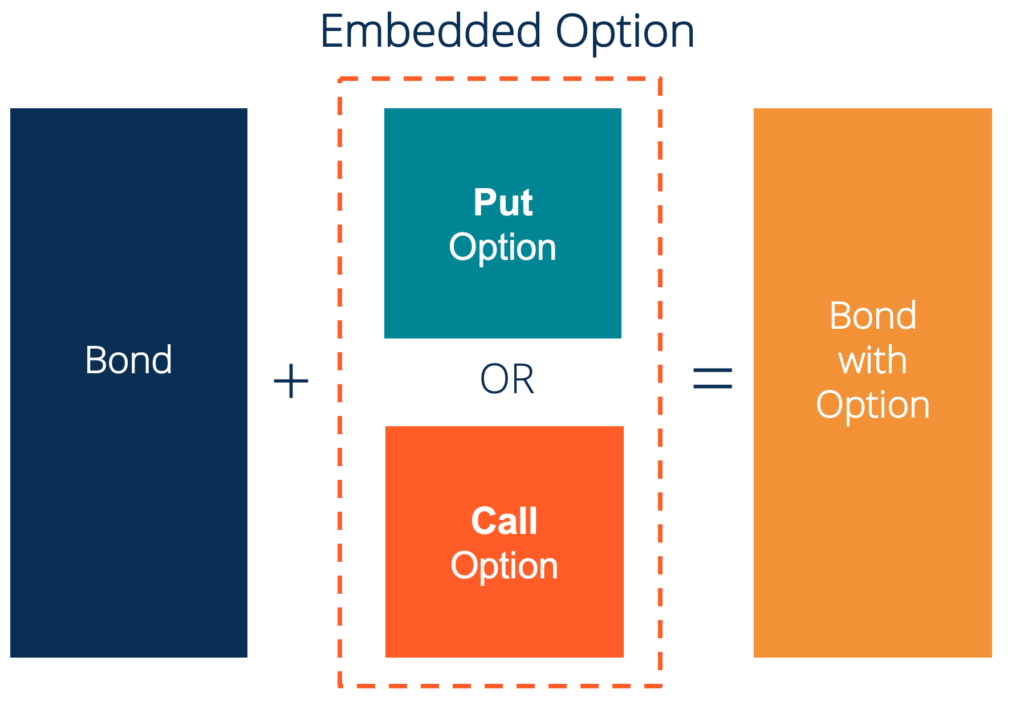
One security may contain multiple embedded options. The only restriction in such a case is that the options cannot be mutually exclusive. For instance, a bond cannot come with both call and put embedded options since the two options are mutually exclusive.
Valuation with Embedded Options
The valuation of financial securitiesAvailable for Sale SecuritiesAvailable for sale securities are the default categorization of securities that companies decide to invest in for the purposes of benefiting their financial position. Unlike trading securities, available for sale securities are not bought or sold for the sole purpose of realizing a short-term capital gain. with embedded options is definitely a more sophisticated process relative to the valuation of their plain vanilla counterparts. Essentially, the valuation of securities with an embedded option is a combination of the valuation of plain-vanilla bond or stock and options valuation.
For example, the value of a callable bondCallable BondA callable bond (redeemable bond) is a type of bond that provides the issuer of the bond with the right, but not the obligation, to redeem the bond before its maturity date. The callable bond is a bond with an embedded call option. These bonds generally come with certain restrictions on the call option. for the bondholder equals the value of the underlying plain-vanilla bond minus the value of the embedded call option. Thus, the applications of option pricing models (e.g., Black-Scholes modelOption Pricing ModelsOption Pricing Models are mathematical models that use certain variables to calculate the theoretical value of an option. The theoretical value of an) and short-rate models can be frequently encountered in the valuation of securities with embedded options.
Embedded options may be extremely beneficial to financial markets. Such options generally provide both investors and businesses with a wide degree of flexibility to develop the most appropriate design of financial security to better suit the needs of the involved parties.
On the other hand, the complexity of the securities makes their pricing less predictable, which, in turn, may result in greater risk.
Types of Embedded Options
Embedded options can be divided into two major categories: those that provide rights to the issuers of a financial security and those that provide rights to the holders of a financial security.
Options that provide rights to the issuers of a financial security contain the following provisions:
- Call provision: An issuer of a bond has the right to redeem a bond prior to the maturity date. The callable bonds generally have higher coupon rates to compensate the investors for the potential risk of the early repurchase of a bond.
- Capped floating rate provision: A bond with a capped floating rate provision specifies the maximum interest rate that an issuer will pay to the investors.
Options that deliver rights to the holders of a financial security come with the following provisions:
- Put provision: The holder of a bond has the right to demand early repayment of the bond’s principal amount. The embedded put option is exercisable on predetermined dates. Unlike callable bonds, puttable bonds carry lower coupon ratesCoupon RateA coupon rate is the amount of annual interest income paid to a bondholder, based on the face value of the bond. to compensate the bonds’ issuers.
- Convertible provision: The holder of a bond has the right to convert the bond into common shares at a predetermined rate at some point in the future. Additionally, a convertible provision is frequently attached to preferred shares.
- Exchangeable provision: The holder of a security (typically a bond or preferred stock) has the right to convert the security into the common shares of a company other than the issuer at a predetermined rate and at some point in the future.
- Extendable provision: The holder of a bond has the right to extend the maturity date of a bond. This type of embedded option is rarely used, and its primary application is taking advantage of long periods of declining interest rates.
- Floored floating rate provision: A bond with a floored floating rate provision specifies the minimum interest rate that the investors will receive from the issuer.
Related Readings
CFI is the official provider of the global Financial Modeling & Valuation Analyst (FMVA)™Become a Certified Financial Modeling & Valuation Analyst (FMVA)®CFI's Financial Modeling and Valuation Analyst (FMVA)® certification will help you gain the confidence you need in your finance career. Enroll today! certification program, designed to help anyone become a world-class financial analyst. To keep advancing your career, the additional resources below will be useful:
- Non-Callable BondNon-Callable BondA non-callable bond is a bond that is only paid out at maturity. The issuer of a non-callable bond can’t call the bond prior to its date of maturity. It is different from a callable bond, which is a bond where the company or entity that issues the bond owns the right to repay the face value of the bond
- Options: Calls and PutsOptions: Calls and PutsAn option is a derivative contract that gives the holder the right, but not the obligation, to buy or sell an asset by a certain date at a specified price.
- Puttable BondTrading & InvestingCFI's trading & investing guides are designed as self-study resources to learn to trade at your own pace. Browse hundreds of articles on trading, investing and important topics for financial analysts to know. Learn about assets classes, bond pricing, risk and return, stocks and stock markets, ETFs, momentum, technical
- SpeculationSpeculationSpeculation is the buying of an asset or financial instrument with the hope that the price of the asset or financial instrument will increase in the future.
-

Zero-Coupon Bonds: Definition, How They Work & Examples
A zero-coupon bond is a bond that pays no interest and trades at a discount to its face value. It is also called a pure discount bond or deep discount bond. U.S. Treasury billsTreasury Bills (T-Bills)
-

Understanding Bonds: A Comprehensive Guide for Investors
At its essence, a bond is a formalized IOU. It’s a loan agreement between a borrower (the bond issuer) and a lender (the bondholders). A bond issuer is looking to borrow money to spend on any number o
invest
- Understanding Called Away Options: Definition & Implications
- Currency Option Bonds: Understanding Flexible Investments
- Understanding European Options: Definition & Key Features
- Understanding Index Options: A Comprehensive Guide
- LEAPS Explained: Understanding Long-Term Equity Options
- Understanding Non-Equity Options: A Comprehensive Guide
- Rho (Finance): Understanding Interest Rate Sensitivity of Options
- Understanding Forex Options: A Beginner's Guide
- Understanding Embedded Options in Preferred Stock: A Comprehensive Guide
-
 Samurai Bonds: A Guide to Understanding Yen-Denominated Corporate Debt
A samurai bond is a corporate bond issued by foreign companies in the Japanese market and is required to abide by the Japanese regulations. It is a yen-denominated bond that attracts investors from Ja...
-
 Treasury Bonds: A Comprehensive Guide to U.S. Government Debt
A Treasury bond (or T-Bond) is a long-term government debt security issued by the U.S. Treasury Department with a fixed rate of return. Maturity periods range from 20 to 30 years. T-bond holders recei...