
Understanding the EMBI: A Guide to Emerging Market Bond Performance
The Emerging Market Bond Index (EMBI) is a benchmark index that measures the bond performance of emerging countries and their respective corporate organizations. The EMBI was first published by leading investment bank J.P. Morgan.
An emerging market is a market economy that is currently in the growth phase. As the entity grows, it becomes more engaged and interacts more with the global market.
Also, emerging markets are considered to be riskier investments because they are still in the development cycle and fluctuate quite frequently.
Summary
- The Emerging Market Bond Index (EMBI) is a benchmark index that measures the bond performance of emerging countries and their relative corporate organizations.
- Emerging markets are economies still within the growth phase and include countries like Russia, Mexico, and China.
- J.P. Morgan operates three of the most popular EMBI indices.
EMBI Indices of J.P. Morgan
The three indices track bond performance in emerging markets that are operated by J.P. Morgan are:
1. J.P. Morgan EMBI+ Index
The EMBI+ Index measures total returns for traded foreign debt instruments in emerging markets. The index provides investors with definitive emerging market external-currency debt information, a compilation of the instruments traded within the market, and their agreed terms.
The regular EMBI index differs from EMBI+ due to USD denominated Brady Bonds, EurobondsEurobondA Eurobond is a fixed-income debt instrument (security) denominated in a different currency than the local one of the country where the bond’s been issued, and loans.
Financial instruments within EMBI+ are required to meet the strict criteria for secondary-market trading liquidity and must possess a minimum face value of $500 million.
2. J.P. Morgan EMBI Global Index
Considered the “expanded” version of EMBI+, EMBI Global also measures total returns for traded foreign debt instruments in emerging countries. It differs from EMBI+ by including USD denominated Brady Bonds, Eurobonds, and loans.
The EMBI Global Index is still required to meet the minimum face value of $500 million but does not need to follow strict criteria for secondary-market trading liquidity. It is essentially a combination of the regular EMBI index and EMBI+.
3. J.P. Morgan EMBI Global Diversified Index
The EMBI Global Diversified Index limits the weights of emerging countries with larger debt stocks. It is done by only including specific portions of current face value amounts of debt outstanding.
Benefits of Investing in Emerging Markets
1. Development and growth
Development and growth are fueled by constant interaction with the global market.
2. Portfolio diversification
Investing in emerging markets is an exceptional way to diversify your portfolio. It is beneficial because an economic downturn in a developed nationDeveloped EconomyA developed economy is a region, typically a country, with a high level of wealth and resources available to its residents or citizens can potentially cause growth in others (emerging economies).
Risks of Investing in Emerging Markets
1. Currency
Currencies of emerging markets are seen to be extremely volatile due to conversion rates. In particular, profits can be lessened if the conversion rate is low.
2. Politics
The political structure in emerging markets can be unstable. This can cause serious economic changes and leave the investor with a deficit.
3. Economy
The economic condition of emerging markets differs greatly from developed markets. It is shown through inflationInflationInflation is an economic concept that refers to increases in the price level of goods over a set period of time. The rise in the price level signifies that the currency in a given economy loses purchasing power (i.e., less can be bought with the same amount of money)., monetary policies, and low employment.
Top 10 Emerging Market Bonds ETFs
Emerging market bonds ETFs are created through the investment of debt that is issued by emerging market economies. The ETFs are of lower credit quality than those of developed economies. Also, emerging market bonds ETFs tend to provide higher yields.
Here are the top 10 emerging market bonds ETFs in 2020:
- iShares J.P. Morgan USD Emerging Market Bond ETF
- VanEck Vectors J.P. Morgan EM Local Currency Bond ETF
- Invesco Emerging Markets Sovereign Debt ETF
- Vanguard Emerging Markets Government Bond ETF
- SPDR Barclays Capital Emerging Markets Local Bond ETF
- iShares Emerging Markets Local Currency Bond ETF
- iShares Emerging Markets High Yield Bond ETF
- First Trust Emerging Markets Local Currency Bond ETF
- WisdomTree Emerging Markets Local Debt Fund
- SPDR DoubleLine Emerging Markets Fixed Income ETF
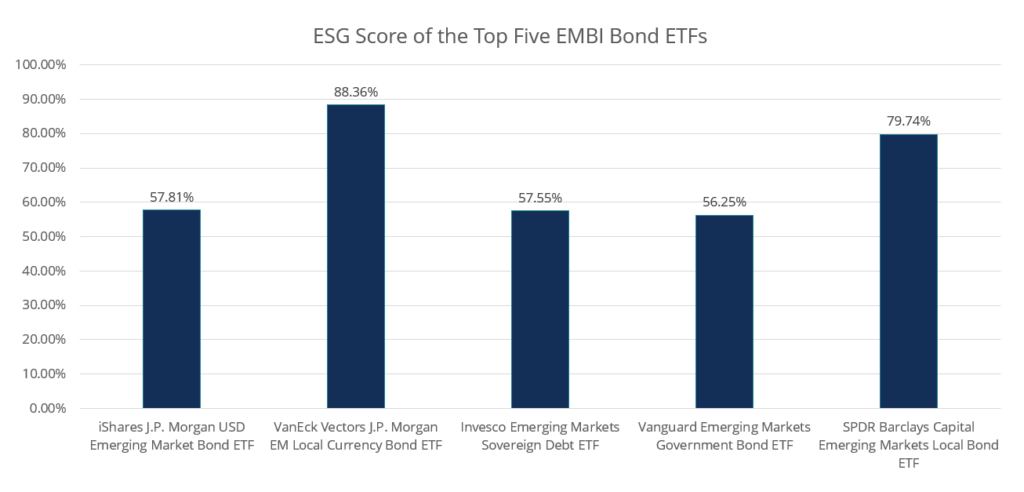
The ESG score measures different environmental, societal, and governance standards that companies are expected to follow. When it comes to investing, the ESG score shows the investor the company’s morality.
Here are the ESG scores for the first five companies listed above:
Related Readings
CFI is the official provider of the global Commercial Banking & Credit Analyst (CBCA)™Program Page - CBCAGet CFI's CBCA™ certification and become a Commercial Banking & Credit Analyst. Enroll and advance your career with our certification programs and courses. certification program, designed to help anyone become a world-class financial analyst. To keep advancing your career, the additional CFI resources below will be useful:
- Environmental, Social, and Governance (ESG)ESG (Environmental, Social and Governance)ESG is the acronym for Environmental, Social, and Governance, the three broad categories of interest for what is termed socially responsible investors.
- JP Morgan Chase & CoJP Morgan Chase & CoJPMorgan Chase & Co is a multinational bank holding company that is headquartered in New York City. It became one of the top banks in the US after the merger of J.P. Morgan and Chase Manhattan Bank in December 2000. Globally, JPMorgan Chase and Co. is the sixth largest bank by assets in the world, with total assets
- DiversificationDiversificationDiversification is a technique of allocating portfolio resources or capital to a variety of investments.The goal of diversification is to mitigate losses
- Debt/Bond FundDebt/Bond FundA debt fund or a bond fund is a pool of investments, usually a mutual fund or an exchange-traded fund, that invests in fixed-income
-
Arms Index (TRIN): Understanding Short-Term Market Sentiment
The Arms Index, also known as the Short-Term Trading Index (TRIN), refers to a short-term technical analysis trading indicator that compares the number of advancing and declining stocks issues with th
-
DAX Index: Your Guide to Germany's Top 30 Companies
The DAX (Deutscher Aktien Index) is a stock index based out of Germany that represents the 30 biggest German companies that trade on the Frankfurt Exchange. The index value is calculated every second
invest
- Understanding the Call Market: Trading Hours & Price Determination
- Capitalization-Weighted Index (CWI): Explained
- EAFE Index: Understanding Developed Market Performance
- Equal-Weighted Index Explained: Benefits & How It Works
- Understanding Market Indexes: A Comprehensive Guide
- MSCI Emerging Markets Index: Definition & Key Facts
- NIFTY 50 Index: Understanding India's Top 50 Stocks | NSE
- Russell 2000 Index: Definition, Performance & Investing
- Understanding the S&P 500: A Comprehensive Guide
-
 Advance-Decline Line: Understanding Market Sentiment & Trends
The advance-decline line (ADL) is a technical indicator that plots the difference between the number of advancing stocks to declining stocks on a daily basis. Understanding the Advance-Decl...
-
Understanding the S&P 500: Top Holdings & Long-Term Performance
The Standard & Poor’s 500 index, or S&P 500, is a collection of about 500 of the largest publicly traded companies in the U.S. It’s an ironic name for one of the best collection...