
Samurai Bonds: A Guide to Understanding Yen-Denominated Corporate Debt
A samurai bond is a corporate bond issued by foreign companies in the Japanese market and is required to abide by the Japanese regulations. It is a yen-denominated bond that attracts investors from Japan, providing capital to a non-Japanese issuer. Samurai bonds provide issuers access to the financial marketFinancial MarketsFinancial markets, from the name itself, are a type of marketplace that provides an avenue for the sale and purchase of assets such as bonds, stocks, foreign exchange, and derivatives. Often, they are called by different names, including "Wall Street" and "capital market," but all of them still mean one and the same thing. and help them raise capital.
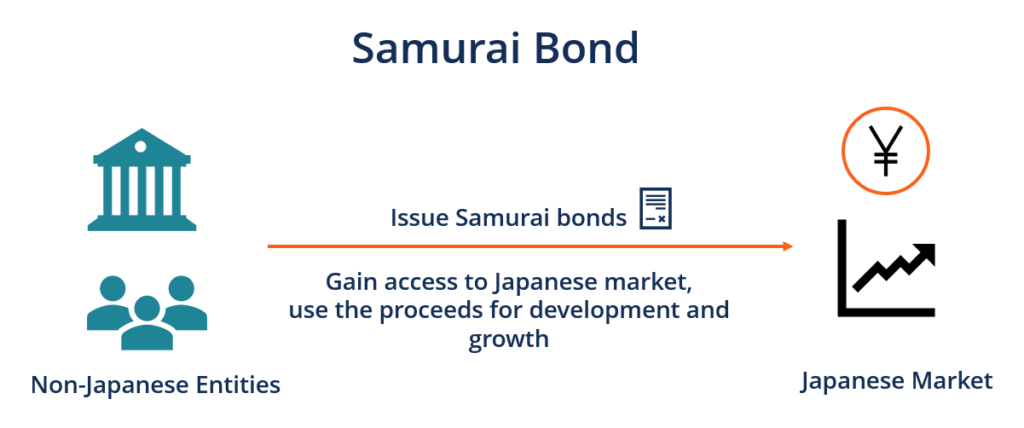
In Japan, samurai bonds offer better yields than other fixed-income investments, making them attractive to investors. Non-Japanese companies can use the proceeds from the bonds to enter the Japanese market or convert them to local currency for use in business operations.
Another form of yen-denominated bond is the Euroyen, which is issued outside of Japan, especially in London.
The samurai bond was issued for the first time in November 1970 by the Asian Development Bank. According to the Bank for International Settlements (BIS)Bank for International Settlements (BIS)The Bank for International Settlements (BIS) started in 1930, and is owned by the central banks of different countries. It serves as a bank for member central banks, and its role is to foster international monetary, financial stability and financial corporation. The Bank for International Settlements is based in, it was a seven-year bond worth 6 million yen.
Summary
- Samurai bond is a yen-denominated corporate bond issued in Japan by foreign companies.
- Companies issue this type of bond to get access to the Japanese market and benefit from low interest rates.
- Samurai bonds attract investors in Japan since the bonds hedge the currency variation risk.
Purpose of Samurai Bond
The yen-denominated samurai bonds are used to access the financial market in Japan. Issuing such bonds help foreign companies obtain funds for their businesses. The issuers can convert the proceeds into the native currency and use it to finance business operations. The proceeds can also be invested in the Japanese market, which is one of the main purposes of the bond.
The issuing entity can benefit from the lower cost of converting the proceeds of this bond to a different currency. The difference in cost is due to the varying preferences of the investors, which depend on the market segments and distinctively affect the bond market.
Moreover, the bond hedges the risk of the foreign exchange rate. Hence, the Japanese market can be explored by the issuing entity without worrying about the currency riskCurrency RiskCurrency risk, or exchange rate risk, refers to the exposure faced by investors or companies that operate across different countries, in regard to unpredictable gains or losses due to changes in the value of one currency in relation to another currency..
A samurai bond is yen-denominated; hence, the proceeds can be used in Japan without any currency conversion. The regulations and guidelines for issuing this type of bond are laid down by the Financial Services Agency, the Japanese financial regulator.
Example of Samurai Bond
In March 2019, 10-year samurai bonds worth 200 billion yen were issued by the Malaysian government. As per the Ministry of Finance, the government will use the proceeds from the bond issues for financing developments such as the construction of hospitals, schools, and other types of infrastructure.
The bonds were overdemanded at 324.7 billion yen, which is over 1.6 times the initial amount. A security is said to be overdemanded or oversubscribed when investors order more shares than what is being normally issued.
In 2015, 31.3 billion yen samurai bonds were issued by the Malaysian government, following the approval of the Securities Commission Malaysia on April 3 of that year.
Benefits of a Samurai Bond
- The U.S. and European markets are more volatile than the Japanese market. Since the issuers of samurai bonds are mostly from Europe and the U.S., they seek the stability from the Japanese market as an alternate financial source.
- Investing in multinational companiesMultinational Corporation (MNC)A multinational corporation is a company that operates in its home country, as well as in other countries around the world. It maintains a is attractive as conservative institutional investors in Japan prefer to invest in larger international companies.
- The issuers benefit from the lower coupon rates than other bonds.
- Eligible small and private companies also issue samurai bonds.
- The bonds do not need to be left in the custody of security companies or other institutions.
Limitations of a Samurai Bond
- The samurai bond market comes with high tax rates and an unclear fiscal environment.
- A major concern of U.S. companies is the lack of a constant policy.
- Lack of flexibility of issuance terms and conditions create restrictions for investors or traders to invest in samurai bonds.
- Companies issuing such bonds face high administrative burdens.
- The samurai bond market growth is stagnant since the bond issuing procedure is difficult, and tax rules are complicated.
More Resources
CFI is the official provider of the global Commercial Banking & Credit Analyst (CBCA)™Program Page - CBCAGet CFI's CBCA™ certification and become a Commercial Banking & Credit Analyst. Enroll and advance your career with our certification programs and courses. certification program, designed to help anyone become a world-class financial analyst. To keep advancing your career, the additional resources below will be useful:
- Debt/Bond FundDebt/Bond FundA debt fund or a bond fund is a pool of investments, usually a mutual fund or an exchange-traded fund, that invests in fixed-income
- Corporate BondsCorporate BondsCorporate bonds are issued by corporations and usually mature within 1 to 30 years. They usually offer a higher yield than government bonds but carry more risk.
- Coupon RateCoupon RateA coupon rate is the amount of annual interest income paid to a bondholder, based on the face value of the bond.
- EurobondEurobondA Eurobond is a fixed-income debt instrument (security) denominated in a different currency than the local one of the country where the bond’s been issued
-
Understanding Call Protection in Bonds: Investor Protection Explained
Call protection refers to protection from investment risk to bond investors that exists by limiting the conditions under which a bond issuer may elect to call, i.e., redeem bonds before a bond’s
-

Understanding Call Provisions in Bonds: A Comprehensive Guide
A call provision refers to a clause – essentially, an embedded optionEmbedded OptionAn embedded option is a provision in a financial security (typically in bonds) that provides an issuer or hold
invest
- Personal Bond Explained: Release from Jail Without Bail
- Understanding Bond Duration: A Key Fixed Income Metric
- Understanding Bond Accretion: A Comprehensive Guide
- Coupon Bonds: Understanding Fixed Income & Interest Payments
- Discount Bonds: Understanding Pricing & Secondary Markets
- Understanding Noncallable Securities: A Comprehensive Guide
- Treasury Bonds: A Comprehensive Guide to U.S. Government Debt
- Zero-Coupon Bonds: Definition, How They Work & Examples
- Understanding Bonds: A Comprehensive Guide for Investors
-
 Understanding Call Dates: What You Need to Know
A call date refers to the date when a callable bondCallable BondA callable bond (redeemable bond) is a type of bond that provides the issuer of the bond with the right, but not the obligation, to rede...
-
 Understanding Call Prices: Callable Bonds & Preferred Stocks
A call price refers to the price that a preferred stock or bond issuer would pay to buyers if they chose to redeem the callable security before the maturity date. The price is set during the issuance ...