
Knock-Out Options: A Comprehensive Guide
A knock-out option is an options contract that will become worthless if the investment reaches a specific price. In such a case, the options contract is “knocked out,” and the investor will not receive a payoff. An options contractOptions: Calls and PutsAn option is a derivative contract that gives the holder the right, but not the obligation, to buy or sell an asset by a certain date at a specified price. refers to an agreement between a buyer and a seller to buy or sell an asset by an expiration date at a certain price.

A knock-out option is the opposite of a knock-in option. It is a type of barrier option, which is a type of options contract where the payoff of the investment depends on the asset’s ability to reach a certain price specified in the contract.
Since knock-out options can potentially become worthless, they are usually sold at a small discount compared to a plain vanilla optionVanilla OptionThe term “vanilla option” refers to a type of financial instrument that enables its holders to either buy or sell an underlier, which is an underlying asset, which is a type of options contract that does not include special terms in the contract. It only gives the investors the right to buy or sell at a predetermined price on a specific date.
Types of Knock-Out Options
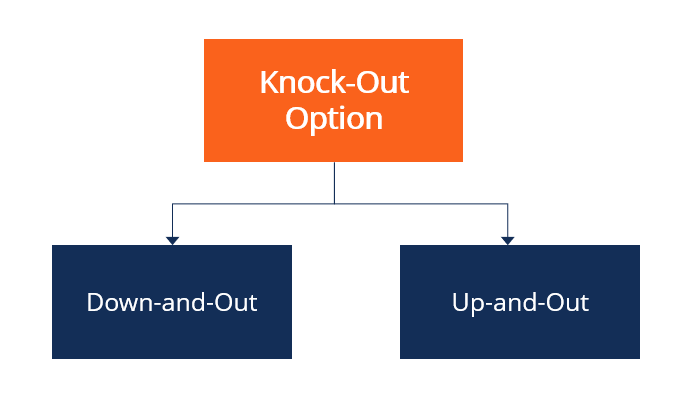
1. Down-and-Out Knock-Out Option
A down-and-out option is a type of knock-out option that gives the right for the option holder to buy or sell the underlying asset in the options contract at the strike priceStrike PriceThe strike price is the price at which the holder of the option can exercise the option to buy or sell an underlying security, depending on. This is valid as long as the asset’s price does not go below a certain price specified in the contract, called the barrier price. In the case where the asset’s price does reach the barrier price and it falls below it, then the option contracts will be considered worthless, and is knocked-out.
Note that a strike price refers to a specific price written in the options contract that allows the asset to be bought or sold at that particular price once the contract is exercised.
2. Up-and-Out Knock-Out Option
An up-and-out option is a type of knock-out option that gives the right for the option holder to buy or sell the asset in the options contract at a specific price, only when the asset’s price does not go higher than the barrier price.
In such a case, the asset can be bought or sold at the strike price. However, if the asset’s price does go higher than the barrier price, then the options contract will also be considered worthless, and is knocked-out.
Example of a Knock-Out Option
For a down-and-out option, you purchase a knock-out option with a barrier price of $50, a strike price of $70, and an asset price of $60. If the asset’s price never reaches the barrier price of $50 and does not go below it before the expiration date, then the options contract can be exercised, and the investor will receive a payoff.
As long as the asset’s price never reaches the barrier price, then the investor is allowed to sell the options contract at the strike price of $70, no matter what the asset’s price is at the time of selling. On the contrary, if the asset’s price falls down to $50 or below before it expires, the options contract will be deemed worthless.
In the case of an up-and-out option, if we assume that the barrier price is $70, the strike price is $60, and the asset price is $50. If the asset’s price never goes up high enough to reach the barrier price of $70 and does not go above it before the expiration date, then the options contract will still be valid and can be exercised.
However, if the asset’s price exceeds the barrier price of $70 before the expiration date, the options contract is “knocked-out”, cannot be exercised, and will be considered worthless.
Additional Resources
CFI is the official provider of the global Capital Markets & Securities Analyst (CMSA)™Program Page - CMSAEnroll in CFI's CMSA® program and become a certified Capital Markets &Securities Analyst. Advance your career with our certification programs and courses. certification program, designed to help anyone become a world-class financial analyst. To keep advancing your career, the additional resources below will be useful:
- American vs European vs Bermudan OptionsAmerican vs European vs Bermudan OptionsThere are different types of options that differ in terms of their exercise restrictions. Let’s explore American vs European vs Bermudan options to find out
- Non-Equity OptionNon-Equity OptionA non-equity option is an option with an underlying asset that is something other than common stock. In most cases, non-equity options include indexes and
- Exotic OptionsExotic OptionsExotic options are the classes of option contracts with structures and features that are different from plain-vanilla options (e.g., American or European options). Exotic options are different from regular options in their expiration dates, exercise prices, payoffs, and underlying as
- Trading MechanismsTrading MechanismsTrading mechanisms refer to the different methods by which assets are traded. The two main types of trading mechanisms are quote driven and order driven trading mechanisms
-

Understanding At-The-Money (ATM) Options: A Comprehensive Guide
At the money (ATM) describes a situation when the strike price of an option is equal to the underlying asset’s current market price. It is a concept of moneyness, which describes the position be
-
Barrier Options: Understanding and Trading Strategies
A barrier option is a type of derivative option contract, the payoff of which depends on the value of the underlying asset. In other words, the payoff only comes into effect if the asset underlying th
invest
- Call Options: A Comprehensive Guide for Investors
- Understanding Delta: A Key Risk Measure in Derivatives
- Understanding Digital Options: A Comprehensive Guide for Traders
- Understanding Exercise Price in Options Trading
- Knock-In Options Explained: A Comprehensive Guide
- Naked Options: Risks, Rewards, and How They Work
- Understanding Near-The-Money Options: A Comprehensive Guide
- Put Options Explained: A Comprehensive Guide for Investors
- Straddle Strategy: Definition, How It Works & Risk
-
 Understanding Put-Call Parity: A Comprehensive Guide
Put-call parity is an important concept in options Options: Calls and PutsAn option is a derivative contract that gives the holder the right, but not the obligation, to buy or sell an asset by a certa...
-
Understanding Option Intrinsic Value: A Clear Explanation
Intrinsic value for call options is literally the difference between the price of the market and the strike price (or exercise price), as long as the market is above the strike price. The intrin...