
Understanding Falling Knives: A Guide for Investors
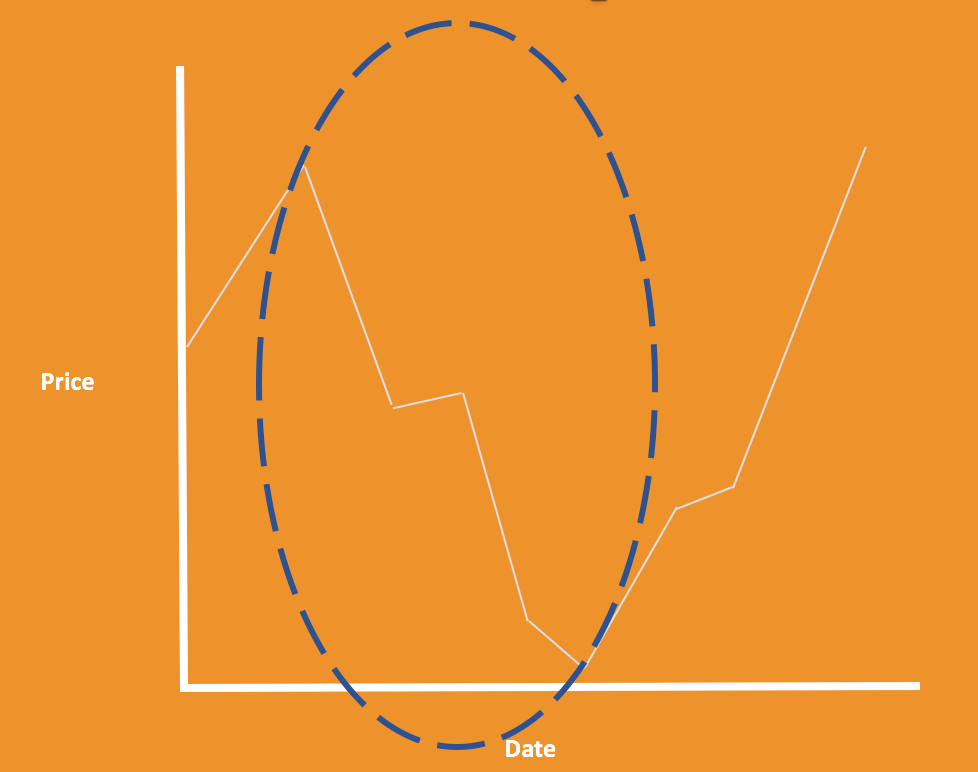
A falling knife is a term used when a security, such as a stock, quickly drops in price. During such instances, investors are recommended to wait for the security to reach its lowest point before buying back in. Despite the events of a falling knife, many equities are capable of rebounding quickly; the process is known as a whipsaw.
Summary
- A falling knife is considered a rapid drop in share price, resulting in significant momentum in a downwards direction.
- The cause behind a falling knife can vary, but some factors include poor earnings, equity offerings, underwhelming economic reports, and breaking support lines.
- For many investors, a falling knife can yield great returns if timed properly. If investors do not purchase the stock near or at the bottom of the trend, they can incur losses as the price continues to drop, unless a whipsaw occurs that rebounds prices higher than the investors’ original position.
Causes Behind a Falling Knife
A falling knife may happen for various reasons. The causes may include but are not limited to:
1. Poor earnings
When companies report their earnings numbers, and they are below expectations, the stock may drop and result in volatile swings until supply and demand for the stock re-stabilizes.
2. Equity offering
If a company requires the need to raise capital, it may issue additional shares to the public. It would result in current shareholder dilution, which would become the impetus to a sell-off.
3. Economic reports
If the Federal ReserveFederal Reserve (The Fed)The Federal Reserve is the central bank of the United States and is the financial authority behind the world’s largest free market economy. or a bank releases underwhelming or negative news regarding the current economic landscape, investors would quickly sell stocks or move assets to different types of investments causing stock prices to drop.
4. Support levels
If a security breaks below its support line, technical traders believe the price will continue to dive before reaching the next level of support.
Strategies to Generate Profit During a Falling Knife
A falling knife can be profitable if timed appropriately, assuming traders buy the stock near or at the bottom of a downwards trend. When prices begin to correct and recover, the realized gains can be enormous.
Another strategy that can be used is to short or sell the investment. If investors are capable of shorting the stock during a falling knife, they will gain the spread between selling the stock at a higher price and repurchasing it at a lower value.
For long-term investors, a falling knife can be economically beneficial if they purchase the stock at any period during the downwards trend and hold it for several years, hoping that the price will appreciate.
Understanding Momentum
Momentum is considered the rate of acceleration of a security’s price or volume, analyzing trends and the speed at which prices are changing. In technical analysisTechnical Analysis - A Beginner's GuideTechnical analysis is a form of investment valuation that analyses past prices to predict future price action. Technical analysts believe that the collective actions of all the participants in the market accurately reflect all relevant information, and therefore, continually assign a fair market value to securities., momentum is known as oscillation, which is used to identify trends. For trading, investors can use momentum as a technique to yield profits.
For example, if one sees an acceleration in a stock’s price, earnings, or revenue, they will take a long or short position, assuming that the momentum will continue to move upwards or downwards. Much like any other risk, price trends are never guaranteed; thus, it is important to be prepared for any potential reversals or corrections that may occur in the future.
Risks and Mitigations of a Falling Knife
The largest risk behind profiting from a falling knife is the timing and events. There is no guarantee that the stock price will whipsaw nor gradually regain momentum – in fact, bankruptcyBankruptcyBankruptcy is the legal status of a human or a non-human entity (a firm or a government agency) that is unable to repay its outstanding debts can ultimately be the outcome. Therefore, it is important to take precautions when deciding to enter a trade that involves a falling knife pattern.
Rather than focusing solely on the falling knife, traders should substantiate their belief that the stock will eventually recover by analyzing historical trend reversals through technical indicators and chart patterns. For example, investors can look at the RSI for signs of strong upwards before buying in.
Additional Resources
CFI offers the Capital Markets & Securities Analyst (CMSA)™Program Page - CMSAEnroll in CFI's CMSA® program and become a certified Capital Markets &Securities Analyst. Advance your career with our certification programs and courses. certification program for those looking to take their careers to the next level. To keep learning and advancing your career, the following resources will be helpful:
- Downside RiskDownside RiskDownside risk refers to the probability that an asset or security will fall in price. It is the potential loss that could result from a fall
- Long and Short PositionsLong and Short PositionsIn investing, long and short positions represent directional bets by investors that a security will either go up (when long) or down (when short). In the trading of assets, an investor can take two types of positions: long and short. An investor can either buy an asset (going long), or sell it (going short).
- Momentum InvestingMomentum InvestingMomentum investing is an investment strategy aimed at purchasing securities that have been showing an upward price trend or short-selling securities that
- Stock Market CrashStock Market CrashA stock market crash refers to a drastic, often unforeseen, drop in the prices of stocks in the stock market. The sudden drop in stock prices
-
Banker's Acceptance: Definition, Function & Key Features
A banker’s acceptance refers to a financial instrument that represents a promised future payment from a bank. It states the name of the entity to which the funds need to be transferred, along wi
-

Barrier Options: Understanding and Trading Strategies
A barrier option is a type of derivative option contract, the payoff of which depends on the value of the underlying asset. In other words, the payoff only comes into effect if the asset underlying th
invest
- PC Banking: A Comprehensive Guide to Online Banking Security & Features
- IRA CDs: Secure Retirement Savings with FDIC Insurance
- Understanding the DU: Your Mortgage Approval Explained
- Decentralized Finance (DeFi): A Comprehensive Overview
- Jumbo CDs: Higher Rates & Deposits Explained
- Understanding Cryptocurrency: A Beginner's Guide to Digital Currency
- DB(k) Plans: A Hybrid Retirement Solution for Employers & Employees
- Understanding Regulation Z: Your Rights as a Borrower
- DeFi Explained: A Beginner's Guide to Decentralized Finance
-
 Understanding Average Return: A Simple Guide
Average return is the mathematical average of a sequence of returns that have accrued over time. In its simplest terms, average return is the total return over a time period divided by the number of p...
-
 Backtesting: A Comprehensive Guide to Strategy Validation
Backtesting involves applying a strategy or predictive model to historical data to determine its accuracy. It can be used to test and compare the viability of trading strategies so tradersSix Essentia...