
Floating Rate Notes (FRNs): Explained - How They Work & Benefits
A floating rate note (FRN) is a debt instrument whose coupon rate is tied to a benchmark rate such as LIBORLIBORLIBOR, which is an acronym of London Interbank Offer Rate, refers to the interest rate that UK banks charge other financial institutions for or the US Treasury BillTreasury Bills (T-Bills)Treasury Bills (or T-Bills for short) are a short-term financial instrument issued by the US Treasury with maturity periods from a few days up to 52 weeks. rate. Thus, the coupon rate on a floating rate note is variable. It is typically composed of a variable benchmark rate + a fixed spread.
The rate is adjusted monthly or quarterly in relation to the benchmark. The maturity period of FRN’s vary but are typically in the range of two to five years.
FRN’s are issued by governments, as well as private companies and financial institutions. The notes are typically traded over-the-counterOver-the-Counter (OTC)Over-the-counter (OTC) is the trading of securities between two counter-parties executed outside of formal exchanges and without the supervision of an exchange regulator. OTC trading is done in over-the-counter markets (a decentralized place with no physical location), through dealer networks..
Floating Rate Note vs. Plain Vanilla Bond
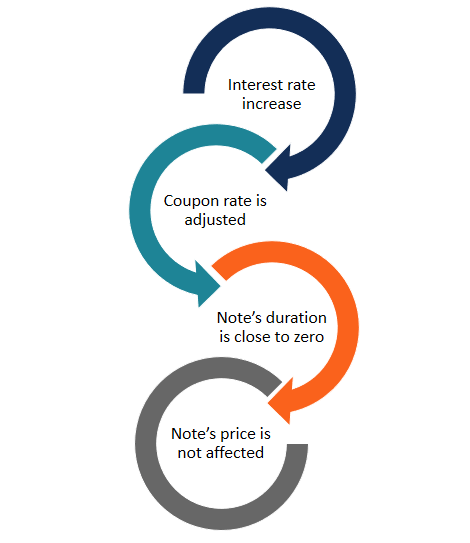
An investor may purchase a floating rate note when he or she expects the benchmark interest rate to increase in the near future. In case of a rate increase, an FRN offers an advantage over plain vanilla bonds. Plain Vanilla Bond Prices are inversely related to their expected return yield, as is discussed in the Fixed Income Fundamentals Course.
The value of plain vanilla bonds declines when the interest rateInterest RateAn interest rate refers to the amount charged by a lender to a borrower for any form of debt given, generally expressed as a percentage of the principal. goes up, and the bond’s longer duration leads to greater losses in its value. However, the price of the floating rate note does not fall with an increase in interest rates. The adjustments of the FRN’s rate help it to maintain its value. The elegant math behind the concept is explained in the Math for Corporate Finance Course.
Learn more with CFI’s Fixed Income Fundamentals Course
Risks of Floating Rate Notes
FRNs, especially those issued by governments, are generally considered safe investments. However, a potential investor in such debt securities should be aware of the following risks:
#1 Credit risk
Floating rate notes may be exposed to credit risk/default risk. Since both governments and private entities can issue FRNs, an investor should carefully assess the creditworthiness of the issuer.
#2 Interest rate risk
FRN coupon payments are linked to a benchmark rate, so they benefit from the interest rate increases. However, they are not completely hedged from interest rate risk as there are multiple benchmark interest rates, and a FRN is typically linked to only one.
Related Readings
CFI offers the Financial Modelingan& Valuation Analyst (FMVA)™Become a Certified Financial Modeling & Valuation Analyst (FMVA)®CFI's Financial Modeling and Valuation Analyst (FMVA)® certification will help you gain the confidence you need in your finance career. Enroll today! certification program for those looking to take their careers to the next level. To learn more about related topics, check out the following resources:
- Bond PricingBond PricingBond pricing is the science of calculating a bond's issue price based on the coupon, par value, yield and term to maturity. Bond pricing allows investors
- Coupon RateCoupon RateA coupon rate is the amount of annual interest income paid to a bondholder, based on the face value of the bond.
- Effective Annual Interest RateEffective Annual Interest RateThe Effective Annual Interest Rate (EAR) is the interest rate that is adjusted for compounding over a given period. Simply put, the effective
- Fixed Income TradingFixed Income TradingFixed income trading involves investing in bonds or other debt security instruments. Fixed income securities have several unique attributes and factors that
-

Understanding Good Loan Interest Rates: What to Expect
What Is a Good Loan Interest Rate? What makes an interest rate "good" varies with the type of loan, and it changes over time. At different points in the 21st century, for instance,
-

Net Interest Margin (NIM): Definition & Importance
Net interest rate spread refers to the difference between the interest rate a financial institution pays to depositors and the interest rate it receives from loans. In other words, it is the differenc
invest
- Relative Interest Rates: Understanding Their Impact on the Economy
- Debentures Explained: A Comprehensive Guide to Unsecured Corporate & Government Debt
- Understanding Floating Interest Rates: Definition & How They Work
- Understanding Interest Rates: A Comprehensive Guide
- Understanding Interest Rate Risk: Definition & Impact
- Floating Rate Funds: Understanding & Investing in Variable Interest Rates
- Interest Rate Collar: Definition, Strategy & Benefits
- Understanding Interest Rate Sensitivity: A Key Concept for Investors
- Interest Rate Caps: Understanding Protection for Adjustable-Rate Loans
-
 Interest Rate Futures: Definition, How They Work & Investing
Interest rate futures are futures contracts based on interest-bearing financial instruments. This futures contractFutures ContractA futures contract is an agreement to buy or sell an underlying asset ...
-
 What are Swap Contracts?
Swap contracts are financial derivatives that allow two transacting agents to “swap” revenue streamsRevenue StreamsRevenue Streams are the various sources from which a business earns money...