
Fundamental Analysis: A Comprehensive Guide to Investment Valuation
In accounting and finance, fundamental analysis is a method of assessing the intrinsic valueIntrinsic ValueThe intrinsic value of a business (or any investment security) is the present value of all expected future cash flows, discounted at the appropriate discount rate. Unlike relative forms of valuation that look at comparable companies, intrinsic valuation looks only at the inherent value of a business on its own. of a security by analyzing various macroeconomic and microeconomic factors. The ultimate goal of fundamental analysis is to quantify the intrinsic value of a security.Marketable SecuritiesMarketable securities are unrestricted short-term financial instruments that are issued either for equity securities or for debt securities of a publicly listed company. The issuing company creates these instruments for the express purpose of raising funds to further finance business activities and expansion. Its intrinsic value can then be compared to its current market price to help with investment decisions.

Unlike technical analysis that concentrates on forecasting a security’s price movements, fundamental analysis aims to determine the “correct price” (true value) of a security. By knowing the right price, an investor can make an informed investment decision. A security can be overvalued, undervalued, or fairly valued.
Components of Fundamental Analysis
Fundamental analysis consists of three main parts:
- Economic analysis
- Industry analysis
- Company analysis
Fundamental analysis is an extremely comprehensive approach that requires a deep knowledge of accounting, finance, and economics. For instance, fundamental analysis requires the ability to read financial statements, an understanding of macroeconomic factors, and knowledge of valuation techniques. It primarily relies on public data, such as a company’s historical earnings and profit margins, to project future growth.
Top-down vs. Bottom-up Fundamental Analysis
Fundamental analysis can be either top-down or bottom-up. An investor who follows the top-down approach starts the analysis with the consideration of the health of the overall economy. By analyzing various macroeconomic factors such as interest ratesInterest RateAn interest rate refers to the amount charged by a lender to a borrower for any form of debt given, generally expressed as a percentage of the principal., inflation, and GDPGross Domestic Product (GDP)Gross domestic product (GDP) is a standard measure of a country’s economic health and an indicator of its standard of living. Also, GDP can be used to compare the productivity levels between different countries. levels, an investor tries to determine the overall direction of the economy and identifies the industries and sectors of the economy offering the best investment opportunities.
Afterward, the investor assesses specific prospects and potential opportunities within the identified industries and sectors. Finally, they analyze and select individual stocks within the most promising industries.
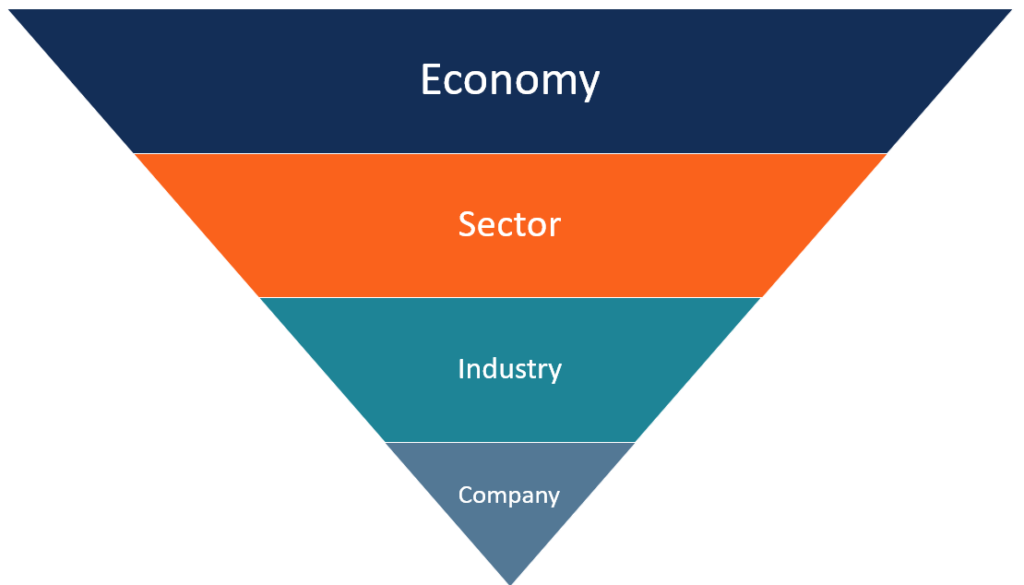
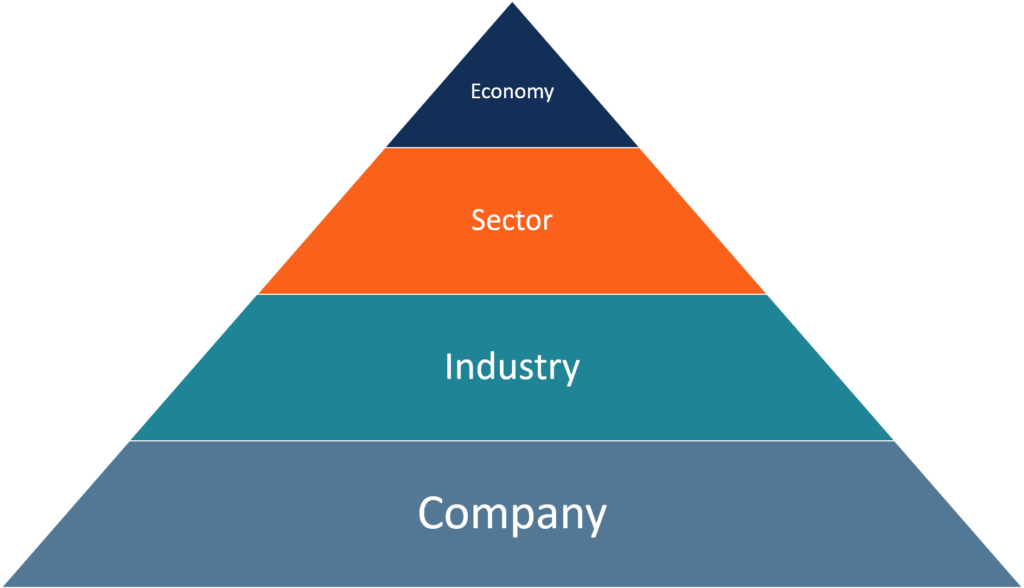
Alternatively, there is the bottom-up approach. Instead of starting the analysis from the larger scale, the bottom-up approach immediately dives into the analysis of individual stocks. The rationale of investors who follow the bottom-up approach is that individual stocks may perform much better than the overall industry.
The bottom-up approach is primarily concentrated on various microeconomic factors such as a company’s earnings and financial metrics. Analysts who use such an approach develop a thorough assessment of each company to gain a better understanding of its operations.
Additional Resources
CFI is the official provider of the global Financial Modeling & Valuation Analyst (FMVA)™Become a Certified Financial Modeling & Valuation Analyst (FMVA)®CFI's Financial Modeling and Valuation Analyst (FMVA)® certification will help you gain the confidence you need in your finance career. Enroll today! certification program, designed to help anyone become a world-class financial analyst. To keep learning and advancing your career, the additional resources below will be useful:
- Comparable Company AnalysisComparable Company AnalysisThis guide shows you step-by-step how to build comparable company analysis ("Comps") and includes a free template and many examples.
- Economic IndicatorsEconomic IndicatorsAn economic indicator is a metric used to assess, measure, and evaluate the overall state of health of the macroeconomy. Economic indicators
- Technical Analysis – A Beginner’s GuideTechnical Analysis - A Beginner's GuideTechnical analysis is a form of investment valuation that analyses past prices to predict future price action. Technical analysts believe that the collective actions of all the participants in the market accurately reflect all relevant information, and therefore, continually assign a fair market value to securities.
- Valuation MethodsValuation MethodsWhen valuing a company as a going concern there are three main valuation methods used: DCF analysis, comparable companies, and precedent transactions
-

Incremental Analysis: A Comprehensive Guide for Business Decisions
Incremental analysis (also referred to as the relevant cost approach, marginal analysis, or differential analysis) is a decision-making tool used to assess financial information and derive a decision
-
Ratio Analysis: A Comprehensive Guide to Financial Statement Insights
Ratio analysis is a popular technique of financial analysis. It is used to visualize and extract information from financial statementsThree Financial StatementsThe three financial statements are the i
invest
- Contribution Analysis: Understanding Profitability & Cost Management
- Credit Analysis: A Comprehensive Guide to Assessing Credit Risk
- Quantitative Analysis: Definition, Methods & Applications
- Financial Analysis: A Comprehensive Guide for Professionals
- Horizon Analysis: Predicting Portfolio Returns & Investment Strategies
- Fundamental Analysis: 3 Key Applications for Investors
- Fundamental Analysis: A Comprehensive Guide to Investment Valuation
- Fundamental Analysis of Stocks: A Comprehensive Guide
- Fundamental Analysis: A Guide to Crypto Value
-
 DuPont Analysis: A Comprehensive Guide to Profitability Assessment
In the 1920s, the management at DuPont Corporation developed a model called DuPont Analysis for a detailed assessment of the company’s profitability. DuPont Analysis is a tool that may help us t...
-
 Horizontal Analysis: Understanding Financial Trends & Growth
Horizontal analysis is an approach used to analyze financial statements by comparing specific financial information for a certain accounting period with information from other periods. Analysts use su...