
Understanding Hard Call Protection in Callable Bonds
Hard call protection, also known as absolute call protection, is a requirement in a callable bond where the issuer does not have the ability to exercise the call before the specified date in the agreement. A callable bondCallable BondA callable bond (redeemable bond) is a type of bond that provides the issuer of the bond with the right, but not the obligation, to redeem the bond before its maturity date. The callable bond is a bond with an embedded call option. These bonds generally come with certain restrictions on the call option. is a type of bond where the issuer is allowed to redeem the bond before the maturity date.
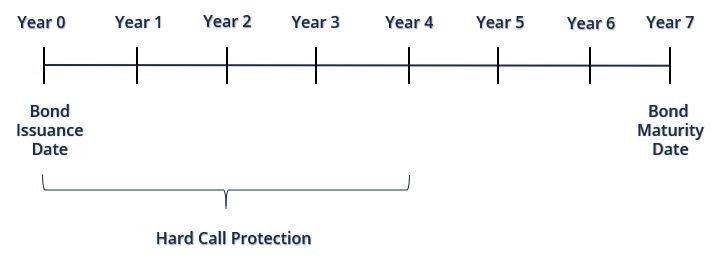
The issuer is not allowed to exercise the call for several years – usually between three to five years from the issuance date of the bond. For example, suppose a seven-year bond is callable after four years. Hard call protection refers to the four years the bond has before the issuer can exercise the bond any time before its maturity date.
Why Do Callable Bonds Have Hard Call Protection?
Investors who purchase bonds get paid with the bond’s interest over the duration of the bond’s life until it matures. Since bond prices and interest ratesInterest RateAn interest rate refers to the amount charged by a lender to a borrower for any form of debt given, generally expressed as a percentage of the principal. have an inverse relationship, investors prefer to invest in bonds with higher interest rates and lower bond prices.
On the other hand, bond issuers prefer to sell bonds with lower interest rates and higher bond prices. Therefore, if interest rates decline, the issuer will want to redeem the bond before the maturity date, which affects the investor because they will no longer receive the relatively high interest payments if the bond is retired early. This is when having hard call protection can safeguard the investor from losing interest payments because the issuer will not be allowed to exercise the bond early.
As a result, there are limits on how and when a bond can be exercised, which reduces the risk of the bond for the investor and prevents the issuer from repaying the bonds earlier than the specified date. It offers a guarantee for the investor to receive the bond’s interest payments before the bond is free to be called by the issuer.
Valuing a Bond with Hard Call Protection
When valuing a bond, both the yield-to-maturity and yield-to-call figures are considered. However, a callable bond with hard call protection usually has a lower yield-to-call compared to its yield-to-maturity.
As a result, callable bonds with hard call protection are valued using the yield-to-call method in order to understand the bond’s return and investment potential.
Hard Call Protection vs. Soft Call Protection
After the time period for protecting a bond’s hard call has passed, there may also be soft call protection to continue to reduce the bond’s risk. If a bond has soft call protection, it will occur after the protection period when the hard call is over.
Soft call protection is a requirement that specifies how the bond issuer must pay a premium to the bond’s investor if the issuer wants to redeem the bond before maturity. A premium is a price that is higher than the bond’s current face value.
An example of a provision for soft call protection may require the bond issuer to pay a 4% premium if they want to redeem the bond one year after the hard call protection is over, a 3% premium if they want to redeem the bond two years after the hard call protection is over, and a 2% premium if they want to redeem the bond three years after the hard call protection is over.
More Resources
CFI is the official provider of the Capital Markets & Securities Analyst (CMSA)®Program Page - CMSAEnroll in CFI's CMSA® program and become a certified Capital Markets &Securities Analyst. Advance your career with our certification programs and courses. certification program, designed to transform anyone into a world-class financial analyst.
To keep learning and developing your knowledge of financial analysis, we highly recommend the additional resources below:
- Call MarketCall MarketThe call market refers to a market where trading does not take place constantly, but only at designated times. Prices are dictated by the
- Bond PricingBond PricingBond pricing is the science of calculating a bond's issue price based on the coupon, par value, yield and term to maturity. Bond pricing allows investors
- Covered CallCovered CallA covered call is a risk management and an options strategy that involves holding a long position in the underlying asset (e.g., stock) and selling (writing) a call option on the underlying asset.
- Options: Calls and PutsOptions: Calls and PutsAn option is a derivative contract that gives the holder the right, but not the obligation, to buy or sell an asset by a certain date at a specified price.
-

Understanding Hard Currencies: Stability and Global Trade
A hard currency refers to a currency that is generally issued by developed countries, globally traded, and seen as politically and economically stable. International investors put their confidence and
-

Understanding Bond Accretion: A Comprehensive Guide
Accretion is a finance term that refers to the increment in the value of a bond after purchasing it at a discount and holding it until the maturity date. A bond is said to be purchased at a discount p
invest
- Understanding Call Dates: What You Need to Know
- Call Premium Explained: Understanding Issuer Redemptions & Option Pricing
- Understanding Call Prices: Callable Bonds & Preferred Stocks
- Understanding Call Protection in Bonds: Investor Protection Explained
- Understanding Call Provisions in Bonds: A Comprehensive Guide
- Understanding Call Risk in Bonds: A Comprehensive Guide
- Coupon Bonds: Understanding Fixed Income & Interest Payments
- Discount Bonds: Understanding Pricing & Secondary Markets
- Make-Whole Call Provisions: Understanding Early Bond Redemption
-
 Personal Bond Explained: Release from Jail Without Bail
A personal bond, which is also called personal recognizance and own recognizance, is a written contract in which a person who has been arrested agrees to appear at all required court dates and promise...
-
 Understanding Bond Duration: A Key Fixed Income Metric
Duration is one of the fundamental characteristics of a fixed-income security (e.g., a bondBondsBonds are fixed-income securities that are issued by corporations and governments to raise capital....