
Understanding Commodities: Hard vs. Soft - Definitions & Examples
Before we discuss hard vs soft commodities, let us discuss what a commodity is. The term commodity is an umbrella term for economic goods that are fungible, i.e., can be freely brought and sold. The commodities produced by a country include the raw materials and/or primary agricultural products mined, grown, or in any way created within the country. They depend largely on the endowment of the country (natural resources available and the ability to extract the same).
Commodities can be freely brought, sold, and traded on physical or virtual marketplaces known as commodity markets. The price-setting mechanism in commodity markets is controlled by supply and demandSupply and DemandThe laws of supply and demand are microeconomic concepts that state that in efficient markets, the quantity supplied of a good and quantity factors, which make the commodities particularly vulnerable to volatility due to macroeconomic factors.
Summary
- The term commodity is an umbrella term for economic goods that are fungible, i.e., can be freely brought and sold.
- Commodities can be freely brought, sold, and traded on physical or virtual marketplaces known as commodity markets.
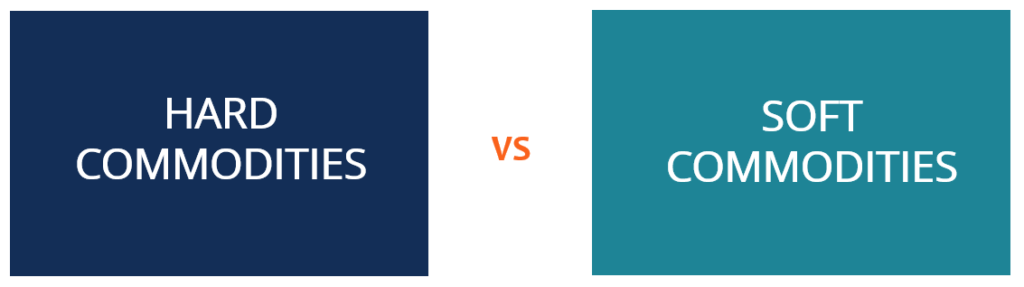
- Examples of hard commodities include natural resources, such as metal ores, oil reserves, etc. Examples of soft commodities include products that must be grown and cared for, such as agricultural produce and livestock.
Hard Commodities
Hard commodities consist of natural resources, such as metal ores, oil reservesOil & Gas PrimerThe oil & gas industry, also known as the energy sector, relates to the process of exploration, development, and refinement of crude oil and natural gas. It, etc. They form the basis of the economic health of a country, and global demand for such resources can be monitored to gauge the future stability of an economy. It is because the supply and demand for the products are largely predictable due to their fixed nature.
For example, Venezuela, a heavy oil export-dependent country, was majorly hit when oil prices slid in September 2015. The global market is largely dominated by oil, natural gas, and gold. The South American country consequently experienced an economic and political crisis, which was marked by hyperinflationHyperinflationIn economics, hyperinflation is used to describe situations where the prices of all goods and services rise uncontrollably over a defined and a failed coup.
Gold is extremely valuable, especially during times of a slowdown as it is used by investors as an inflation hedge or a wealth-preservation asset. Other products include silver, steel, copper, iron, aluminum, which also make up for a large part of government revenue.
Soft Commodities
Soft commodities consist of products that must be grown and cared for, such as agricultural produce, livestock, and related primary products. They are more volatile as their price-setting mechanism relies on multiple external factors. The production of such goods depends largely on the environmental conditions of a country. It is one reason why agrarian economies suffer more due to events such as climate change.
Moreover, bumper crops can depress prices be creating a surplus in the market. Owing to such a vulnerability, countries such as India prefer not to be export-dependent with primary agricultural goods. However, it is not the case for countries that trade exclusively in exotic produce, such as avocado-producing Columbia or major cocoa beans exporter Ghana. The goods can only be grown in specific environmental conditions (soil, humidity, temperature), which gives producers a monopoly over the pricing of these products.
Commodity Trading
There are several indirect ways to invest in hard vs soft commodities. One can invest in mutual fundsMutual FundsA mutual fund is a pool of money collected from many investors for the purpose of investing in stocks, bonds, or other securities. Mutual funds are owned by a group of investors and managed by professionals. Learn about the various types of fund, how they work, and benefits and tradeoffs of investing in them or Exchange Traded Funds (ETFs)Exchange Traded Fund (ETF)An Exchange Traded Fund (ETF) is a popular investment vehicle where portfolios can be more flexible and diversified across a broad range of all the available asset classes. Learn about various types of ETFs by reading this guide. that focus primarily on companies involved in commodity production, processing, or distribution. Such funds pool in investors’ money to make huge capital investments.
The most popular way of investing in the commodities market is by purchasing futures contracts. The contracts obligate holders to buy or sell a specified product at a set price and future date. The markets are regulated by commodities exchanges, which are the physical epicenters for trading in such investment vehicles.
More broadly, commodities exchanges are legal entities that enforce rules for trading in the aforementioned securities. The largest commodity exchange in the U.S. is the Chicago Mercantile Exchange (CME) Group, which handled contracts worth trillions of dollars annually. Other prominent exchanges include Intercontinental Exchange (ICE) in Europe, and Shanghai Futures Exchange in Asia.
More Resources
CFI is the official provider of the global Financial Modeling & Valuation Analyst (FMVA)™Become a Certified Financial Modeling & Valuation Analyst (FMVA)®CFI's Financial Modeling and Valuation Analyst (FMVA)® certification will help you gain the confidence you need in your finance career. Enroll today! certification program, designed to help anyone become a world-class financial analyst. Through financial modeling courses, training, and exercises, anyone in the world can become a great analyst. To keep advancing your career, the additional CFI resources below will be useful:
- Cash Settlement vs Physical DeliveryCommodities: Cash Settlement vs Physical DeliveryThe modes of settlement for most options and futures contracts can be either of the following two methods: Cash Settlement vs Physical Delivery
- Futures ContractFutures ContractA futures contract is an agreement to buy or sell an underlying asset at a later date for a predetermined price. It’s also known as a derivative because future contracts derive their value from an underlying asset. Investors may purchase the right to buy or sell the underlying asset at a later date for a predetermined price.
- Imports and ExportsImports and ExportsImports are the goods and services that are purchased from the rest of the world by a country’s residents, rather than buying domestically
- New York Mercantile Exchange (NYMEX)New York Mercantile Exchange (NYMEX)The New York Mercantile Exchange (NYMEX) is a commodity futures exchange located in Manhattan, New York City. It is owned by CME Group, one of the largest
-

Understanding Growth Stocks: Definition, Characteristics & Investing
Growth stocks are stocks that offer a substantially higher growth rate as opposed to the mean growth rate prevailing in the market. It means that a growth stock grows at a faster rate than the average
-

Understanding Historical Returns: A Guide for Investors
The historical return of a financial asset, such as a bond, stock, security, index, or fund, is its past rate of return and performance. The historical data is commonly used in financial analysisTypes
invest
- Understanding Soft Forks in Cryptocurrency: A Comprehensive Guide
- Hard Forks in Cryptocurrency: Understanding the Impact
- Understanding Commodities: A Beginner's Guide to Investing
- Understanding Hard Assets: Definition, Examples & Investment
- Hard Stop Orders: Protecting Your Investments in Volatile Markets
- Understanding Long-Term Investments: A Comprehensive Guide
- Robo-Advisors: A Comprehensive Guide to Automated Investing
- Hard vs. Soft Commodities: Understanding Key Differences
- Commodities Explained: A Beginner's Guide to Investing
-
 Understanding Exotic Options: A Comprehensive Guide
Exotic options are the classes of optionOptions: Calls and PutsAn option is a derivative contract that gives the holder the right, but not the obligation, to buy or sell an asset by a certain date at ...
-
 Gilts: Understanding UK Government Bonds | LSE
Gilts are bonds issued by the UK government. More specifically, the debt securities are issued by the Bank of England, by His or Her Majesty’s treasury, and are listed on the London Stock Exchan...