
Understanding Historical Returns: A Guide for Investors
The historical return of a financial asset, such as a bond, stock, security, index, or fund, is its past rate of return and performance. The historical data is commonly used in financial analysisTypes of Financial AnalysisFinancial analysis involves using financial data to assess a company’s performance and make recommendations about how it can improve going forward. Financial Analysts primarily carry out their work in Excel, using a spreadsheet to analyze historical data and make projections Types of Financial Analysis to project future returns or determine what variables may impact future returns and the extent to which the variables may influence returns. Concerning standard deviations, historical returns can be used to predict future data points.

The analysis of historical data and historical performance can provide an overview of how a financial asset or security has been reacting to external or internal events that may have caused returns to grow or decline. Such events can be attributed to changes in the economic cycleEconomic CycleThe economic cycle is the fluctuating state of an economy from periods of economic expansion and contraction. It is usually measured with the, or they can be global events.
Although historical data can be used to project future returns and what investors can expect, the data does not forecast actual future returns. Data that is too old may not be ideal for estimating returns.
Summary
- The historical return of a financial asset – such as a bond, stock, security, index, or fund – is its past rate of return and performance.
- Historical data is commonly used in financial analysis to project future returns or determine what variables may impact future returns and the extent to which the variables may influence returns.
- The historical returns of a financial asset are usually recorded from the beginning of a year (i.e., January 1st) to the end of the year (i.e., December 31st) to determine the annual return of a particular year.
Understanding Historical Returns
The historical returns of a financial asset are usually recorded from the beginning of a year (i.e., January 1st) to the end of the year (i.e., December 31st) to determine the annual return of a particular year. A compilation of past annual returns is needed to depict historical returns over many years. By obtaining the historical returns data, analysts and investors can compute the average historical returns of a financial asset.
It is important to note that average returns do not account for possible fluctuations in the returns. Some years might have seen significant increases in returns, while others might have seen a decline in returns. The high returns offset the low or negative returns; thus, an average return may not always necessarily embody all the information needed for forecasting acceptably.
Historical returns can be estimated for any financial asset, including portfolios, indexes such as the S&P 500S&P 500 IndexThe Standard and Poor’s 500 Index, abbreviated as S&P 500 index, is an index comprising the stocks of 500 publicly traded companies in the, ETFs, mutual funds, commodities, stocks, real estate, etc.
Calculating Historical Returns
The computation for historical returns is relatively simple, provided that all information on past annual performance is available.
The data below provides the historical performance of the S&P 500 index. The data used is for educational purposes only and does not depict real-time historical data.
- December 31, 2016: 2,105
- December 31, 2017: 2,540
To begin calculating the historical returns, the difference between the most recent price and the past price needs to be computed and then divided by the past price multiplied by 100 to get the result as a percentage. The calculation can be done iteratively to cater for longer time periods – e.g., 5 years or more.
Hence, the historical return for the S&P 500 based on the data provided above is calculated as:
Historical Return(s) = [(2,540 – 2,105) / 2,105] x 100 = 0.20665 x 100
Historical Return(s) = 20.7%
Calculating Average Historical Returns
The computation for average historical returns is relatively simple, provided that historical returns have already been calculated.
The data below provides the average historical returns of an index over a 5-year period. The data used is for educational purposes only and does not depict real-time historical data.
- December 31, 2015: 28%
- December 31, 2016: 18.7%
- December 31, 2017: 19.9%
- December 31, 2018: 23.1%
- December 31, 2019: 29.7%
Using a simple mean computation, the average historical return can be found by summing up all the returns and dividing the sum by the number of years (or periods). The calculation can be longer and more tedious, depending on the number of time periods used – e.g., 5 years or more.
Hence, the average historical return for the index based on the data provided above is calculated as:
Average Historical Return(s) = (28% + 18.7% + 19.9% + 23.1% + 29.7%) / 5 = 119.4% / 5
Average Historical Return(s) = 23.9%
Related Readings
CFI is the official provider of the global Capital Markets & Securities Analyst (CMSA)®Program Page - CMSAEnroll in CFI's CMSA® program and become a certified Capital Markets &Securities Analyst. Advance your career with our certification programs and courses. certification program, designed to help anyone become a world-class financial analyst. To keep advancing your career, the additional CFI resources below will be useful:
- Historical CostHistorical CostIn accounting, the historical cost of an asset refers to its value on purchase or its original value. Based on the historical cost principle,
- Exchange Traded FundExchange Traded Fund (ETF)An Exchange Traded Fund (ETF) is a popular investment vehicle where portfolios can be more flexible and diversified across a broad range of all the available asset classes. Learn about various types of ETFs by reading this guide.
- Rate of ReturnRate of ReturnThe Rate of Return (ROR) is the gain or loss of an investment over a period of time copmared to the initial cost of the investment expressed as a percentage. This guide teaches the most common formulas
- Stock, Bonds, and Mutual FundsStocks, Bonds, and Mutual FundsStocks, bonds, and mutual funds are well known and powerful components of a diversified portfolio. To achieve desired returns to accomplish goals, it is
-

Managed Futures: A Comprehensive Guide for Diversified Investing
Managed futures is a subclass of alternative investment strategies used by large funds and institutional investors to achieve both portfolio and market diversification. With the ability to take both l
-

Understanding Management Fees: What They Are & How They Work
Management fees are fees paid to professionals entrusted with managing investments on a client’s behalf. Typically determined as a percentage of the total assets under management (AUM)Assets Und
invest
- Understanding Abnormal Returns: A Guide to Investment Performance
- Understanding Absolute Return: A Comprehensive Guide
- Baby Bonds: A Comprehensive Guide to Investing in Children's Futures
- Understanding Bonds: A Comprehensive Guide for Investors
- Understanding Commodities: A Beginner's Guide to Investing
- Defensive Industries: Stability in Economic Uncertainty | [Your Company Name]
- Understanding Financial Derivatives: A Comprehensive Guide
- Understanding Excess Returns (Alpha): A Comprehensive Guide
- Understanding Historical Volatility (HV): A Comprehensive Guide
-
 Investment-Grade Bonds: Understanding Credit Risk & Ratings
An investment-grade bond is a bond classification used to denote bonds that carry a relatively low credit riskCredit RiskCredit risk is the risk of loss that may occur from the failure of any party to...
-
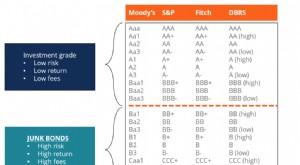 Understanding Junk Bonds: Risks, Rewards, and Investment Strategies
Junk bonds, also known as high-yield bonds, are bonds that are rated below investment grade by the big three rating agencies (see image below). Junk bonds carry a higher risk of defaultMarket Ri...