
Investment-Grade Bonds: Understanding Credit Risk & Ratings
An investment-grade bond is a bond classification used to denote bonds that carry a relatively low credit riskCredit RiskCredit risk is the risk of loss that may occur from the failure of any party to abide by the terms and conditions of any financial contract, principally, compared to other bonds. There are three major credit rating agencies (Standard & Poor’s, Moody’s, and Fitch) that provide ratings on bond. Each credit rating agency sets a minimum bond rank to be classified as investment-grade:
- Standard & Poor’s denotes bonds rated BBB- or higher as investment grade.
- Moody’s denotes bonds rated Baa3 or higher as investment grade.
- Fitch denotes bonds rated BBB- or higher as investment grade.

Summary
- An investment-grade bond is a bond classification used to denote bonds that carry a relatively low credit risk compared to other bonds.
- Investment-grade bonds, historically, have had low default rates (low credit risk).
- Yields for investment-grade bonds are lower than that of non-investment-grade bonds.
Understanding Investment-grade Bonds
An understanding of credit ratings is extremely important as they convey information regarding the credit risk of a bond. In other words, the credit rating imposed on a bond denotes the likelihood of the bond defaulting. Of the credit ratings, bonds can be investment-grade or non-investment grade. For example, the bond ratings for Standard & Poor’s (S&P)S&P – Standard and Poor'sStandard & Poor’s is an American financial intelligence company that operates as a division of S&P Global. S&P is a market leader in the are provided below:
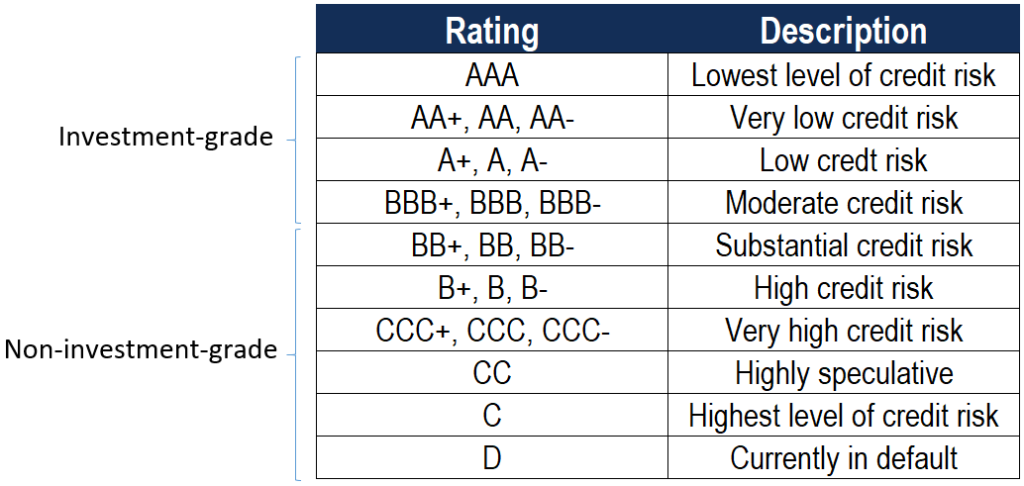
As such, the credit risk of investment-grade bonds ranges from the lowest level of credit risk to moderate credit risk – investment-grade bonds are generally likely to meet payment obligations. Bonds that are not investment-grade are called junk bondsJunk BondsJunk Bonds, also known as high-yield bonds, are bonds that are rated below investment grade by the big three rating agencies (see image below). Junk bonds carry a higher risk of default than other bonds, but they pay higher returns to make them attractive to investors., high-yield bonds, or non-investment-grade bonds.
Default Rates for Global Corporate Bonds
In the 2018 Annual Global Corporate Default and Rating Transition Study by S&P Global, information regarding the global default rates of certain bond ratings can be found.
Historically, investment-grade bonds witness a low default rate compared to non-investment grade bonds. For example, S&P Global reported that the highest one-year default rate for AAA, AA, A, and BBB-rated bonds (investment-grade bonds) were 0%, 0.38%, 0.39%, and 1.02%, respectively. It can be contrasted with the maximum one-year default rate for BB, B, and CCC/C-rated bonds (non-investment-grade bonds) of 4.22%, 13.84%, and 49.28%, respectively. Therefore, institutional investors generally adhere to a policy of limiting bond investments to only investment-grade bonds due to their historically low default rates.
Example of Investment-Grade Bonds
An investor is looking to invest in a floating rate fund. His criterion is that the bonds in the fund must majority (>50%) consist of investment-grade bonds. The fund follows the credit rating system of S&P and shows the following credit allocation of the fund:
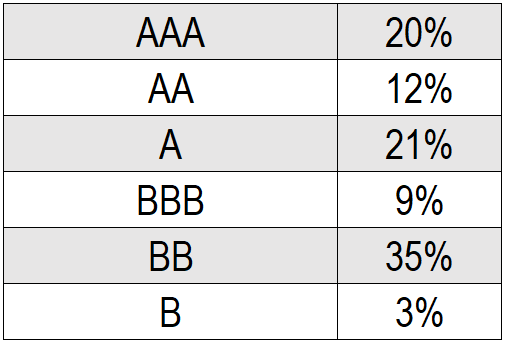
Does the floating rate fund satisfy the criteria of being comprised of majority investment-grade bonds?
In the credit rating system by S&P, bonds that are rated BBB- or higher are considered investment-grade. Therefore, the floating rate fund above shows 62% of its fund invested in investment-grade bonds. Therefore, the floating rate fund satisfies the investor’s criterion.
Implications of Credit Rating on Bond Yields
The higher rated the bond, the lower the bond yield. Bond yield refers to the return realized on a bond. As such, investment-grade bonds will always provide a lower yield than non-investment grade bonds. It is due to investors demanding a higher yield to compensate for the higher credit risk in holding non-investment-grade bonds.
For example, an investor may demand a yield of 3% for a 10-year bond rated AAA (investment-grade) due to the extremely low credit risk but demand a yield of 7% for a 10-year bond rated B (non-investment-grade) due to the higher implied credit risk associated with the bond.
Additional Resources
CFI offers the Financial Modeling & Valuation Analyst (FMVA)™ Become a Certified Financial Modeling & Valuation Analyst (FMVA)®CFI's Financial Modeling and Valuation Analyst (FMVA)® certification will help you gain the confidence you need in your finance career. Enroll today!certification program for those looking to take their careers to the next level. To keep learning and advancing your career, the following resources will be helpful:
- Bond RatingsBond RatingsBond ratings are representations of the creditworthiness of corporate or government bonds. The ratings are published by credit rating agencies and provide evaluations of a bond issuer’s financial strength and capacity to repay the bond’s principal and interest according to the contract.
- Probability of DefaultProbability of DefaultProbability of Default (PD) is the probability of a borrower defaulting on loan repayments and is used to calculate the expected loss from an investment.
- Rating AgencyRating AgencyA rating agency assesses the financial strength of companies and government entities, especially their ability to meet principal and interest payments
- Yield to MaturityYield to Maturity (YTM)Yield to Maturity (YTM) – otherwise referred to as redemption or book yield – is the speculative rate of return or interest rate of a fixed-rate security.
-

Callable Bonds: Understanding Issuer Redemption Rights
A callable bond (redeemable bond) is a type of bond that provides the issuer of the bond with the right, but not the obligation, to redeem the bond before its maturity date. The callable bond is a bon
-

Understanding Commodities: A Beginner's Guide to Investing
Commodities are another class of assets just like stocks and bondsBondsBonds are fixed-income securities that are issued by corporations and governments to raise capital. The bond issuer borrows capit
invest
- Understanding Tiger Bonds: A Guide to Zero-Coupon Treasury Securities
- Corporate Bonds: A Comprehensive Guide to Investing
- Fidelity Bonds: Protection Against Employee Dishonesty & Fraud
- Baby Bonds: A Comprehensive Guide to Investing in Children's Futures
- Understanding Bonds: A Comprehensive Guide for Investors
- Bonds vs. Stocks: A Comprehensive Guide for Investors
- Understanding Junk Bonds: Risks, Rewards, and Investment Strategies
- Perpetual Bonds: Understanding Interest-Paying Bonds with No Maturity Date
- Mortgage Bonds: Understanding Real Estate-Backed Investments
-
 Foreign Currency Convertible Bonds (FCCB): A Comprehensive Guide
Foreign currency convertible bonds, as the name suggests, are bonds that are issued in a currency foreign to the investor. The name also suggests that the bonds are convertible in nature, indicating t...
-
 Understanding Investment Options: A Comprehensive Guide
An investment can be anything from a piece of land, to a stake in a small business, to stock in a Fortune 500 company. If you put money into something expecting a financial return, you’ve made an inve...