
Understanding Junk Bonds: Risks, Rewards, and Investment Strategies
Junk bonds, also known as high-yield bonds, are bonds that are rated below investment grade by the big three rating agencies (see image below). Junk bonds carry a higher risk of defaultMarket Risk PremiumThe market risk premium is the additional return an investor expects from holding a risky market portfolio instead of risk-free assets. than other bonds, but they pay higher returns to make them attractive to investors. The main issuers of such bonds are capital-intensive companies with high debt ratios,Cost of DebtThe cost of debt is the return that a company provides to its debtholders and creditors. Cost of debt is used in WACC calculations for valuation analysis. or young companies that have yet to establish a strong credit rating.
When you buy a bond, you are lending to the issuer in exchange for periodic interest payments. Once the bond matures, the issuer is required to repay the principal amount in full to investors. But if the issuer has a high risk of default, the interest payments may not be disbursed as scheduled. Thus, such bonds offer higher yields to compensate investors for the additional risk.
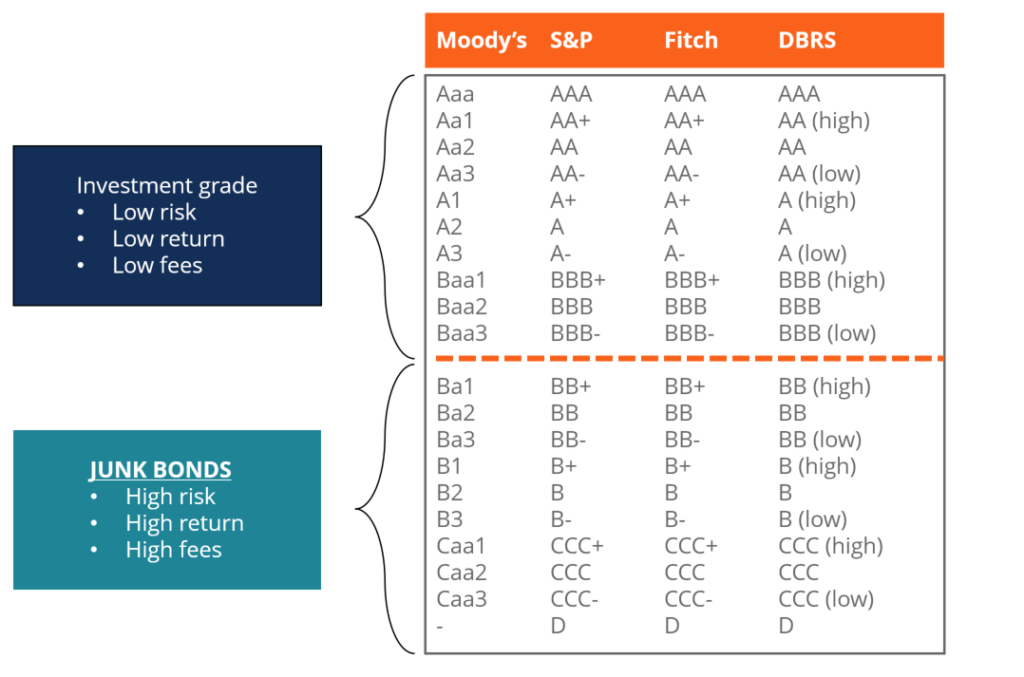
Image: CFI’s Free Introduction to Corporate Finance Course.
Market analysts sometimes use the junk bond market to get an indication of the state of the economy. If more investors are buying them, their willingness to take on risk indicates optimism about the economy. Conversely, if investors are shying away from high-yield bonds, then that is a sign that they are risk-averse.Risk Averse DefinitionSomeone who is risk averse has the characteristic or trait of preferring avoiding loss over making a gain. This characteristic is usually attached to investors or market participants who prefer investments with lower returns and relatively known risks over investments with potentially higher returns but also with higher uncertainty and more risk. This indicates a pessimistic view of the current state of the economy. This circumstance may be used to predict either a contraction of the business cycle or a bear market.
History of Junk Bonds
The United States government started using junk bonds in the 1780s as a way of financing an unproven government. At the time, the country’s risk of default was high. Therefore, not many international lenders were willing to lend unless the investment offered high returns.
Junk bonds returned in the early 1900s as a form of financing startups. Companies like General Motors and IBM were at their early stages at the time. Few banks were willing to extend credit to companies without a track record. In the 1970s and 1980s, the junk bond market experienced a boom due to fallen angel companies. Fallen angelsFallen AngelA fallen angel is a bond that was rated investment-grade but has since been downgraded to junk status due to the declining financial position of its issuer. The bond is downgraded by one or more of the big three rating services - Fitch, Moody’s and Standard & Poor’s (S&P). are companies that had previously issued investment-grade bonds, but that experienced a drop in their credit rating.
Research published by Braddock Hickman, Thomas Atkinson, and Orina Burrell also contributed to the 1970s to 1980s boom. The study showed that junk bonds paid higher returns than was necessary to compensate for the extra risk involved. Drexel Burnham used this research to build a large junk bond market. Their investments in junk bonds grew from $10 billion to $189 billion between 1979 to 1989. The average returns stood at 14.5%, while the defaults were only 2.2%. Unfortunately, the market suffered a blow after Drexel was brought down by illegal trading activities. Drexel was eventually forced into bankruptcy.
The Recent High-Yield Bond Market
The United States junk bond market increased by 80% between 2009 to 2015, with its value estimated at $1.3 trillion. This was after the Global Financial Crisis of 2008, where high-yield bonds were linked to the subprime mortgage meltdown. The market grew steadily in 2013 when the Federal ReserveFederal Reserve (The Fed)The Federal Reserve is the central bank of the United States and is the financial authority behind the world’s largest free market economy. announced that it would begin tapering quantitative easing. Due to perceived improved economic conditions and fewer instances of default, investors showed renewed interest in junk bonds. However, by September 2015, junk bonds started experiencing turmoil again, with more than 15% at distressed levels. They continued to fall in 2016 as investors moved back to investing in investment-grade bonds amid the economic uncertainty propelled by unstable prices in the stock market.
How are Junk Bonds Rated?
Bond issuersCorporate InformationLegal corporate information about Corporate Finance Institute (CFI). This page contains important legal information about CFI including registered address, tax number, business number, certificate of incorporation, company name, trademarks, legal counsel and accountant. are given credit ratings depending on the likelihood of meeting or defaulting on their financial obligations. The creditworthiness of bonds is evaluated by the big three rating agencies: Standard and Poor’s (S&P), Fitch, and Moody’s. Bonds that are given a higher credit rating are considered investment-grade and are the most sought after by investors. Bonds with a low credit rating are known as non-investment grade or junk bonds. Due to the higher risk of default, they typically pay 4 to 6 points higher interest rates than investment-grade bonds.
Based on the credit ratings of two of the big three rating agencies, junk bonds are those with a “Baa” rating or lower from Moody’s and a “BBB” rating or lower from S&P. Bonds with a “C” rating carry a higher risk of default, while a “D” rating shows that the bond is in default. Most investors buy junk bonds through mutual funds or exchange-traded funds. Mutual funds help reduce the risk of investing in junk bonds by offering a diversified bond portfolio. The returns for non-investment grade bonds fluctuate over time, depending on the issuers and the general state of the economy.
Advantages
Junk bond investors usually enjoy higher rates of return as compared to other fixed-income investments. Since they are often issued with 10-year terms, junk bonds have the opportunity to do better if the issuer’s credit rating improves prior to the bond’s maturity. If the issuer’s credit rating improves, then the value of the bond increases and this leads to increased returns for its holders. Investors in bonds also get precedence over stockholders during liquidation, giving them an advantage to at least recover part of their investment in a case of default.
Disadvantages
Junk bonds have a higher likelihood of default than other types of bonds. In the event that a company defaults, the bondholders are at risk of losing 100% of their investment. If a company’s credit rating deteriorates further, the value of the bonds declines. When interest rates on investment-grade bonds increases, junk bonds become less attractive to investors. During recessions, junk bonds suffer the most, as investors flock to more conservative investments – “safe havens”.
Other Resources
Thank you for reading CFI’s guide to junk bonds. CFI is the official provider of the global Financial Modeling & Valuation Analyst (FMVA)™Become a Certified Financial Modeling & Valuation Analyst (FMVA)®CFI's Financial Modeling and Valuation Analyst (FMVA)® certification will help you gain the confidence you need in your finance career. Enroll today! certification program, designed to help anyone become a world-class financial analyst. To keep learning and advancing your career, the additional resources below will be useful:
- Bond IssuersBond IssuersThere are different types of bond issuers. These bond issuers create bonds to borrow funds from bondholders, to be repaid at maturity.
- Bond PricingBond PricingBond pricing is the science of calculating a bond's issue price based on the coupon, par value, yield and term to maturity. Bond pricing allows investors
- Debt Capital MarketsDebt Capital Markets (DCM)Debt Capital Markets (DCM) groups are responsible for providing advice directly to corporate issuers on the raising of debt for acquisitions, refinancing of existing debt, or restructuring of existing debt. These teams operate in a rapidly moving environment and work closely with an advisory partner
- Investing: A Beginner’s GuideInvesting: A Beginner's GuideCFI's Investing for Beginners guide will teach you the basics of investing and how to get started. Learn about different strategies and techniques for trading
-
Foreign Currency Convertible Bonds (FCCB): A Comprehensive Guide
Foreign currency convertible bonds, as the name suggests, are bonds that are issued in a currency foreign to the investor. The name also suggests that the bonds are convertible in nature, indicating t
-

Understanding Investment Options: A Comprehensive Guide
An investment can be anything from a piece of land, to a stake in a small business, to stock in a Fortune 500 company. If you put money into something expecting a financial return, you’ve made an inve
invest
- Understanding Tiger Bonds: A Guide to Zero-Coupon Treasury Securities
- Corporate Bonds: A Comprehensive Guide to Investing
- Fidelity Bonds: Protection Against Employee Dishonesty & Fraud
- Baby Bonds: A Comprehensive Guide to Investing in Children's Futures
- Understanding Bonds: A Comprehensive Guide for Investors
- Bonds vs. Stocks: A Comprehensive Guide for Investors
- Investment-Grade Bonds: Understanding Credit Risk & Ratings
- Perpetual Bonds: Understanding Interest-Paying Bonds with No Maturity Date
- Mortgage Bonds: Understanding Real Estate-Backed Investments
-
Municipal Bonds: A Comprehensive Guide for Investors
A bond is a type of loan that you’re giving to a corporation or government (via your investment). A bond comes with an end date by which the totality of the loan will be paid back to you, while also e...
-
Understanding Bonds: A Comprehensive Guide for Investors
At its essence, a bond is a formalized IOU. It’s a loan agreement between a borrower (the bond issuer) and a lender (the bondholders). A bond issuer is looking to borrow money to spend on any number o...