
Japan Exchange Group (JPX): Overview & Financial Markets
Japan Exchange Group is a Tokyo-based financial services corporation that operates different financial instruments exchange markets. It facilitates the trading of Japan’s financial securitiesMarketable SecuritiesMarketable securities are unrestricted short-term financial instruments that are issued either for equity securities or for debt securities of a publicly listed company. The issuing company creates these instruments for the express purpose of raising funds to further finance business activities and expansion. under the country’s Financial Instruments and Exchange Act. It was established in 2013 following the merger between Tokyo Stock Exchange Group and Osaka Securities Exchange.
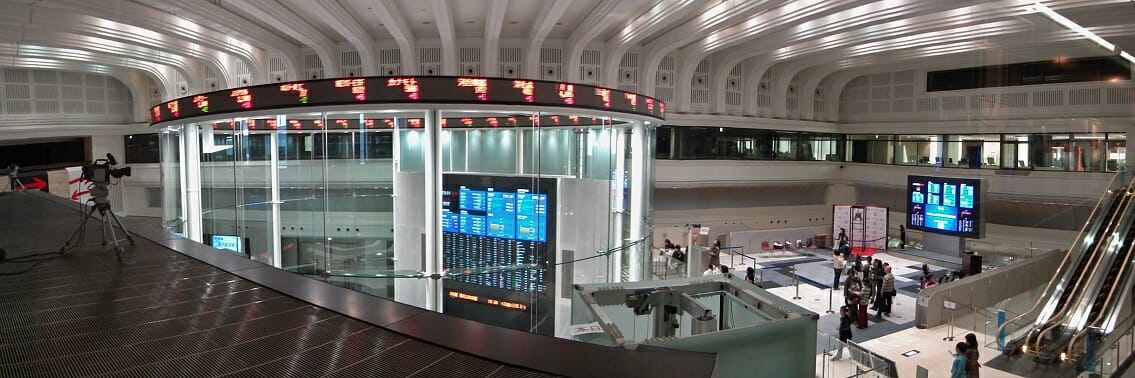
The Japan Exchange Group is the largest stock exchange in Asia. It is also the world’s third largest stock exchange after NYSE Euronext and NASDAQ OMX Group. Joining the ranks of elite exchanges globally, it boasts a market capitalizationMarket CapitalizationMarket Capitalization (Market Cap) is the most recent market value of a company’s outstanding shares. Market Cap is equal to the current share price multiplied by the number of shares outstanding. The investing community often uses the market capitalization value to rank companies of US$4.48 trillion.
Business Model of the Japan Exchange Group
The Japan Exchange Group provides secure and fair market infrastructure and data, and clearing and settlement services, and conducts trading oversightThe 1933 Securities ActThe 1933 Securities Act was the first major federal securities law passed following the stock market crash of 1929. The law is also referred to as the Truth in Securities Act, the Federal Securities Act, or the 1933 Act. It was enacted on May 27, 1933 during the Great Depression. ...the law was aimed at correcting some of the wrongdoings. The corporation aims to provide convenience for all market users and ensure that the markets are reliable. In return, it receives fees from market users such as issuers, information vendors, and securities firms. Specifically, its main profit sources are from trading, listing, and clearing services.
Subsidiaries of the Japan Exchange Group
Tokyo Stock Exchange (TSE), Osaka Exchange (OSE), and Japan Exchange Regulation (JPX-R) are the three major subsidiaries of the Japan Exchange Group. Both the Tokyo Stock Exchange and the Osaka Exchange provide market access to traders and investors. The Japan Exchange Regulation operates as a self-regulatory body.
1. Tokyo Stock Exchange (TSE)
The Tokyo Stock Exchange serves as the central equities marketplace of Japan, providing a large portion of the total liquidity of the Japan Exchange Group. With more than 3,500 companies listed on the Tokyo Stock Exchange, almost 750 million trades are conducted every year.
It is composed of four separate entities:
- 1st Section Market – where large-cap companies are listed
- 2nd Section
- Mothers (Market of High Growth and Emerging Stocks)
- JASDAQ (Japan Securities Dealers Association)
2. Osaka Exchange (OSE)
The Osaka Exchange is an exclusively digital marketplace, enabling market users to take part in the derivatives markets of Japan online. Volatility indexes, foreign and local equities indexes, as well as interest rate products, are some of the derivatives available on the OSE. The most commonly traded products on the Osaka Exchange are the Tokyo Stock Price Index, Nikkei 225 mini, and Nikkei 225Nikkei IndexThe Nikkei Index, or Nikkei 225, is the most recognized Japanese stock market index. It comprises Japan's top 225 companies listed on the Tokyo Exchange..
3. Japan Exchange Regulation (JPX-R)
As an independent, self-regulating body, the Japan Exchange Regulation aims to uphold the integrity of the marketplace. It is in charge of overseeing trading operations on OSE and TSE.
Related Readings
Thank you for reading CFI’s explanation of the Japan Exchange Group. CFI offers the Financial Modeling & Valuation Analyst (FMVA)™Become a Certified Financial Modeling & Valuation Analyst (FMVA)®CFI's Financial Modeling and Valuation Analyst (FMVA)® certification will help you gain the confidence you need in your finance career. Enroll today! certification program for those looking to take their careers to the next level. To keep learning and advancing your career, the following resources will be helpful:
- 2010 Flash Crash2010 Flash CrashThe 2010 Flash Crash is the market crash that occurred on May 6, 2010. During the 2010 crash, leading US stock indices, including the Dow
- NASDAQ CompositeNASDAQ CompositeThe NASDAQ Composite is an index of more than 3,000 common equities listed on the NASDAQ stock market. The index is one of the most followed indices in the
- New York Mercantile Exchange (NYMEX)New York Mercantile Exchange (NYMEX)The New York Mercantile Exchange (NYMEX) is a commodity futures exchange located in Manhattan, New York City. It is owned by CME Group, one of the largest
- Trading FloorTrading FloorA trading floor refers to a literal floor in a building where equity, fixed income, futures, options, commodities, or foreign exchange traders buy and sell securities.
-

SEBI: Understanding India's Securities and Exchange Board
The Securities and Exchange Board of India (SEBI) is a regulatory body that came into power in 1992 to protect the Indian securities market from fraudulent activities. It functions with the same
-

Understanding the Saudi Stock Exchange (Tadawul): A Comprehensive Overview
It is well-known that Saudi Arabia plays a major role in the oil markets. As a key member of the Organization of the Petroleum Exporting Countries (OPEC), the national petroleum and natural gas comp
invest
- American Stock Exchange (AMEX): History, Overview & Key Facts
- Australian Securities Exchange (ASX): Your Guide to Australia's Stock Market
- Dow 30 Explained: Understanding the Dow Jones Industrial Average
- Eurex Exchange: European Derivatives Market Overview
- Hong Kong Stock Exchange (HKEX): Overview & Key Facts
- Jakarta Stock Exchange (IDX): History & Overview
- Japan ETFs: Invest in Japanese Equities - A Comprehensive Guide
- London Stock Exchange (LSE): History, Overview & Key Facts
- Vancouver Stock Exchange (VSE): History & Overview | [Your Company Name]
-
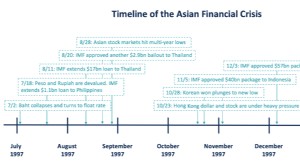 Understanding the Asian Financial Crisis: Causes, Impact, and Lessons Learned
The Asian Financial Crisis is a crisis caused by the collapse of the currency exchange rate and hot money bubble. It started in Thailand in July 1997 and swept over East and Southeast Asia. The financ...
-
 Understanding the Temporal Method for Currency Translation
The temporal method is a currency exchange method used to convert the currency that a foreign subsidiary ordinarily does business in into the currency used by its parent company. The parent company&rs...