
Medium-Term Notes (MTNs): Definition, Features & How They Work
A medium-term note (MTN) usually refers to a note payable that comes with a maturity date that is within five to ten years.

What is a Note?
A note, or note payable, is a legal document that represents an amount owed from a borrower to a lender or investor. Notes generally include a principal amount, or face valuePar ValuePar Value is the nominal or face value of a bond, or stock, or coupon as indicated on a bond or stock certificate. It is a static value, that is lent to the borrower and is expected to be repaid at a later date, in addition to scheduled interest payments. Notes can be thought of as a form of fixed income security that is similar to a bond.
The notes can be issued by various organizations and entities, including federal governments, state or provincial governments, municipal governments, corporations, non-profit organizations, etc.
Examples of notes include:
- Bank notes
- Treasury notes
- Unsecured notes
- Secured notes
- Mortgage-backed notes
- Municipal notes
- Euro notes
- Promissory notesPromissory NoteA promissory note refers to a financial instrument that includes a written promise from the issuer to pay a second party – the payee –
- Demand notes
- Convertible notes
- Structured notes
- Term notes
Understanding Medium-Term Notes
In order to distinguish medium-term notes from other notes, the definition of “medium term” must be identified. Generally, when comparing fixed-income securitiesFixed Income SecuritiesFixed income securities are a type of debt instrument that provides returns in the form of regular, or fixed, interest payments and repayments of the, all else being equal, medium-term notes will come with a higher stated rate or coupon rate than shorter-term notes.
It is because, to compensate for the risks associated with lending money for a longer period of time, an investor will demand a higher yield. Following that logic, a long-term note will generally offer a higher stated rate than a medium-term note.
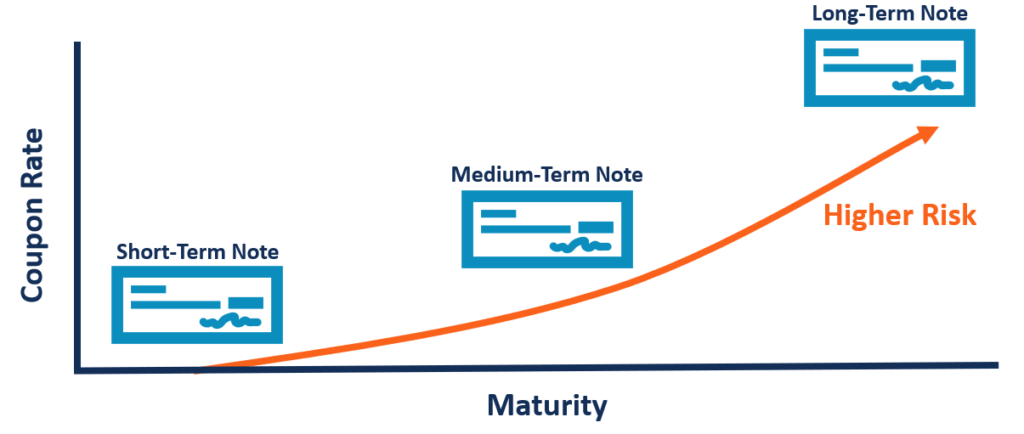
Various organizations or corporations may issue MTNs and can continuously offer the notes through a dealer. A dealer represents market actors who buy and sell securities from their own account to provide liquidity and make markets within the securities markets.
It is in contrast to brokers, who buy and sell securities on behalf of another party. Investors can select different maturities ranging from short term (less than a year) to long term (30+ years). However, medium-term notes are distinguished by offering a maturity of five to ten years.
Advantages of Medium-Term Notes
From an Investor’s Perspective
Investors may prefer medium-term notes if they match the time horizonInvestment HorizonInvestment horizon is a term used to identify the length of time an investor is aiming to maintain their portfolio before selling their securities for a profit. An individual’s investment horizon is affected by several different factors. However, the primary determining factor is often the amount of risk that the investor that the investors are seeking. Some investors may not need capital in the short term but may eventually need funds in the long term. The investors may want higher yields than short-term notes but may still require liquidity in the long term.
For the investors, medium-term notes are an ideal alternative since they offer a higher interest rate than short-term investments and are preferable as opposed to continuously renewing low-yield, short-term investments.
Making repeated short-term investments exposes investors to reinvestment risk, which is the risk that an investor may not be able to reinvest cash flows at the desired rate of return. The risk is more pronounced in an economic environment with decreasing interest rates. Medium-term notes allow investors to remove this risk in the medium term and lock in a specific yield over the life on the investment.
Medium-term notes offer investors the advantage of offering a wider range of investment options to choose from. Investors looking to invest within the medium-term notes market can choose among several investment options regarding the nature, size, and time length of the investment.
From an Issuer’s Perspective
Issuers of medium-term notes can benefit from the consistent cash flow generation provided by offering the notes to investors. It allows issuers to issue notes as needed to meet their financing needs. For example, if a company needs to fund a large upcoming project but is short on cash, it can issue medium-term notes to investors to raise funds at a lower cost than issuing a long-term note.
Issuers also retain the flexibility to issue notes with embedded options such as call options.
Options on Notes
A call optionCall OptionA call option, commonly referred to as a "call," is a form of a derivatives contract that gives the call option buyer the right, but not the obligation, to buy a stock or other financial instrument at a specific price - the strike price of the option - within a specified time frame. on a note is also referred to as a callable note or redeemable note, and it allows the issuer to redeem a note before its stated maturity date. Essentially, it gives an issuer more flexibility if they wish to pay off their debt early.
It may be ideal in an environment when interest rates are decreasing, since an issuer can repay the note, then either refinance or issue a new note at a lower interest rate. Because of the flexibility, investors typically demand a higher interest rate on a callable note, as opposed to a non-callable note, to compensate for the risk that an issuer may redeem the note early.
Additional Resources
CFI is the official provider of the global Commercial Banking & Credit Analyst (CBCA)™Program Page - CBCAGet CFI's CBCA™ certification and become a Commercial Banking & Credit Analyst. Enroll and advance your career with our certification programs and courses. certification program, designed to help anyone become a world-class financial analyst. To keep advancing your career, the additional CFI resources below will be useful:
- 10-Year US Treasury Note10-Year US Treasury NoteThe 10-year US Treasury Note is a debt obligation that is issued by the US Treasury Department and comes with a maturity of 10 years.
- Negotiable Certificate of DepositNegotiable Certificate of Deposit (NCD)A negotiable certificate of deposit (NCD) refers to a certificate of deposit with a minimum par value of $100,000, although typically, NCDs will carry a
- Rate of ReturnRate of ReturnThe Rate of Return (ROR) is the gain or loss of an investment over a period of time copmared to the initial cost of the investment expressed as a percentage. This guide teaches the most common formulas
- Fixed Income TradingFixed Income TradingFixed income trading involves investing in bonds or other debt security instruments. Fixed income securities have several unique attributes and factors that
-

Understanding Five Against Note Spread (FAN) Futures Strategy
What Is a Five Against Note Spread (FAN)? A five against note spread (FAN) is a futures spread using positions in five-year Treasury notes to offset positions in 10-year Treasury notes, also ca
-

Variable Rate Demand Notes (VRDNs): Understanding Floating Rate Debt
A variable rate demand note (VRDN) is a long-term floating rate instrument. It carries an interest rate that accrues periodically in line with the current money markets. From the outset of the loan, t
invest
- Loan Note: Definition, Purpose & Key Features - [Your Company Name]
- Bank Notes vs. Currency: Understanding the Key Differences
- Convertible Notes: A Comprehensive Guide for Investors & Startups
- What is an Equity-Linked Note (ELN)?
- Euro Medium-Term Notes (EMTNs): A Comprehensive Guide
- Understanding Notes: Definition, Types & Issuance
- Structured Notes: Understanding Hybrid Investments & Potential Returns
- Understanding Notes Receivable: A Comprehensive Guide
- Promissory Note: Definition, Types & Key Terms - [Your Company Name]
-
 Reverse Convertible Notes (RCNs): A Comprehensive Guide
A Reverse Convertible Note (RCN) is a short-term investment option that can be very helpful to investors suffering from some cash flow problems. RCNs are securitiesMarketable SecuritiesMarketable secu...
-
 Variable Coupon Renewable Notes (VCRs): Explained
A variable coupon renewable note (VCR) is a type of fixed-income security that is renewable. Its distinguishing characteristic is that the return, which is known as the variable coupon rate, is subjec...